All species › Passerines › Antbirds › Spot-winged Antshrike
Spot-winged Antshrike | Pygiptila stellaris
Vlekvleugelmierklauwier | Batará alimoteado | Choca-cantadora
The Spot-winged Antshrike is a small, short-tailed antshrike with a heavy bill that lives in the canopy of Amazonian rainforest. It is a regular member of mixed flocks in the treetops. It is often heard before it is seen.
Voice
The song is a short, fast, dry series of notes ending in a sharp, emphatic final note. Short, sharp calls are also given.
Recording: JAYRSON ARAUJO DE OLIVEIRA — CC BY-NC-SA 4.0 · xeno-canto
Identification
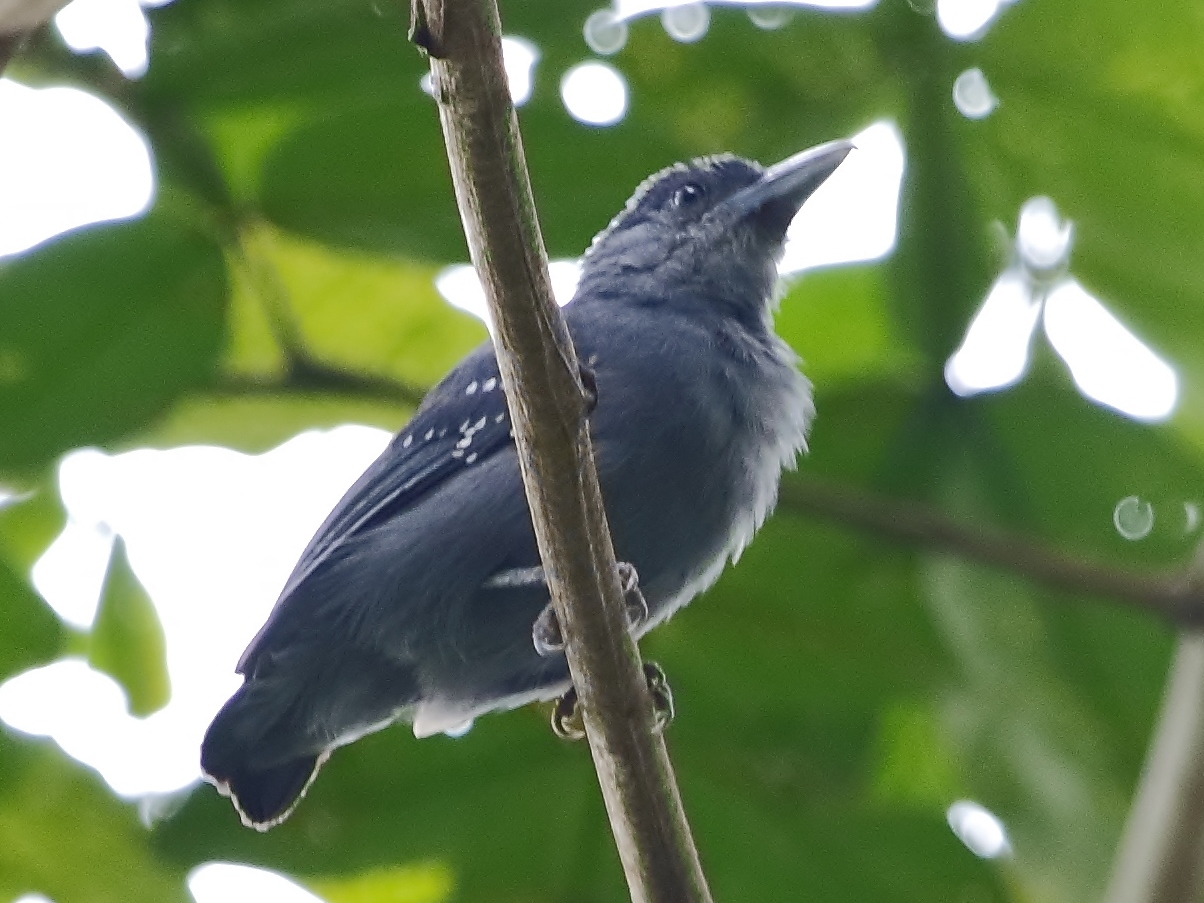
13 cm, compact, with a short tail and a thick, hook-tipped bill. The male is blue-grey with a black crown, small white spots on the wing coverts and paler grey underparts. The female is grey-olive above with unspotted rufous wings and an ochre to buff face and underparts.
Confusion species
Cinereous Antshrike Thamnomanes caesius has a longer tail, lacks the black crown and perches upright in the forest mid-storey. Plain Antvireo Dysithamnus mentalis is smaller, with a dark cheek patch, and lives lower in the forest. The female resembles the female White-flanked Antwren Myrmotherula axillaris, but is larger with a much heavier bill.
Habitat
Canopy and upper mid-storey of humid lowland rainforest on terra firme and in várzea, locally also foothill forest, mostly below 800 m. It searches leaves, vines and dead leaves in the crown for insects, almost always with a mixed flock.
Where the bird is most at home, classified by the vegetation units of the Andes and the west coast.


Range and movements
Colombia: in the lowlands east of the Andes. Ecuador: in the east. Peru: throughout the Amazonian lowlands. Bolivia: in the north. Absent from the Galápagos. Outside the guide area in southern Venezuela, the Guianas and Amazonian Brazil.
- Resident
- dark = core range, pale = thinly spread
How and when to look
Look for canopy mixed flocks from towers or observation platforms in the Amazonian lowlands. The dry series with its sharp final note reveals the species within a flock.
Conservation status
Least Concern. Widespread and fairly common in intact lowland forest; numbers are declining locally through deforestation.
Scientific name
Pygiptila stellaris | (Spix, 1825)
Spix described the species in 1825 as Thamnophilus stellaris; because it was later moved to another genus, the author and year stand in brackets. The genus Pygiptila was introduced in 1858 by Sclater. The genus name comes from Greek pugē, 'rump', and ptilon, 'feather'. The species name comes from Latin stellaris, 'starry', for the white spots on the wing. The specimen the first description was based on came from Pará, Brazil.