All species › Passerines › Antbirds › Yapacana Antbird
Yapacana Antbird | Aprositornis disjuncta
Yapacanamiervogel | Hormiguero de Yapacana | Formigueiro-de-yapacana
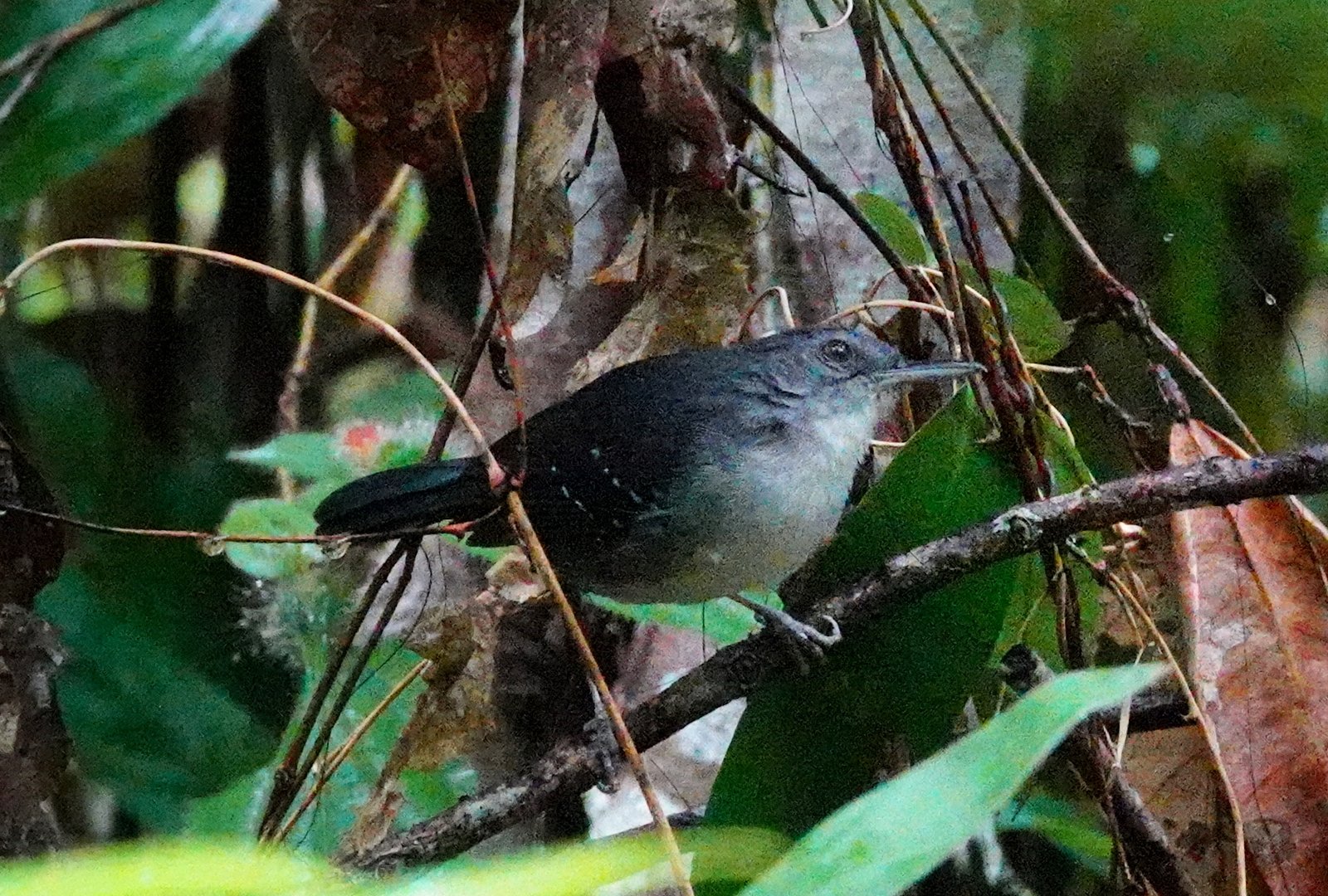
The Yapacana Antbird is a small grey-and-white antbird that lives only in low, dense forest on white sand in the upper Orinoco and Rio Negro drainages. It is named after its type locality, Cerro Yapacana in Venezuela. In the guide area it is known only from the east of Guainía department in Colombia.
Voice
The song is a rapid run of one or two harsh, rising trills, followed by very high pip-ip notes. Calls are a long, harsh note pitched higher than the song, a sharp squip and a soft rattle.
Recording: Iván Lau — CC BY-NC-SA 4.0 · xeno-canto
Identification
13 cm. The male is dark grey above with a grey face, a white interscapular patch and blackish-grey wings and tail; the wing coverts and flight feathers have narrow white tips. The underparts are white, with a light grey wash on the breast, flanks and undertail coverts. The female has similar upperparts without the white wing tips and is pale ochre-buff below, with a paler throat and greyish flanks. The upper mandible is blackish and the lower mandible pale; the legs are pinkish grey.
Confusion species
Grey-bellied Antbird Ammonastes pelzelni, also a white-sand bird, has a rufous back, large buff wing spots and a black (male) or scaled (female) breast. Black-chinned Antbird Hypocnemoides melanopogon has a black chin and throat and a shorter, white-tipped tail, and lives along water. Black-throated Antbird Myrmophylax atrothorax has brown upperparts and, in the male, a black throat and breast.
Habitat
Low, dense forest on white sand that is partly flooded in the rainy season, up to about 150 m. It forages alone, in pairs or in family groups on or just above the ground under dense vegetation for insects and spiders; it turns over leaf litter, gleans prey from low twigs and sometimes follows army ants. It does not join mixed flocks. It probably breeds in the wet season; little is known about the nest.
Where the bird is most at home, classified by the vegetation units of the Andes and the west coast.


Range and movements
In Colombia only locally in eastern Guainía, near the border with Venezuela. Absent from Ecuador, Peru, Bolivia and the Galápagos. Outside the guide area in south-western Amazonas state in Venezuela and in north-western Brazil, in the states of Amazonas and Roraima.
- Resident
- dark = core range, pale = thinly spread
How and when to look
Search low white-sand forest along the rivers around Inírida in Guainía. The harsh trills give the birds away in the dense undergrowth.
Conservation status
Least Concern. The range is small and the species is closely tied to one forest type, but its habitat is largely intact. Illegal gold mining is a local threat.
Scientific name
Aprositornis disjuncta | (Friedmann, 1945) (GBIF: Myrmeciza disjuncta)
Friedmann described the species in 1945 as Myrmeciza disjuncta; because it was later moved to another genus, the author and year stand in brackets. The genus Aprositornis was introduced in 2013 by Isler, Bravo & Brumfield. The genus name combines Greek aprositos, 'unapproachable, hard to get at', and ornis, 'bird'. The species name disjuncta is Latin for 'separated, disjunct'. The specimen the first description was based on came from Cerro Yapacana, Amazonas, Venezuela.