All species › Passerines › Antbirds › Ocellated Antbird
Ocellated Antbird | Phaenostictus mcleannani
McLeannans miervogel | Hormiguero ocelado | Formigueiro-ocelado
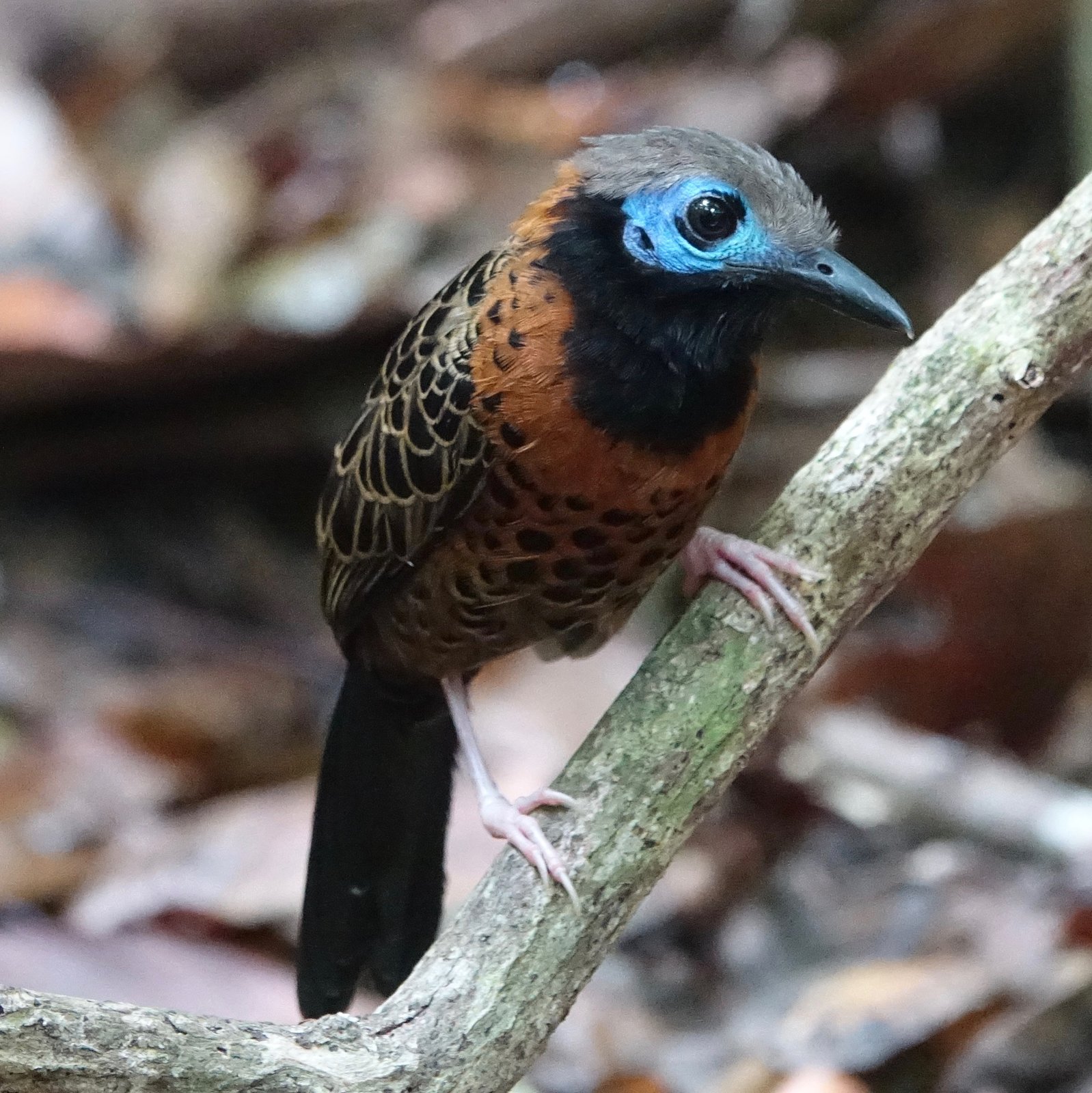
The Ocellated Antbird is a large, long-tailed antbird with blue bare skin around the eye and a back full of black, pale-fringed spots that give the species its name. It is an obligate ant follower: nearly all its food is caught at army ant swarms. At a swarm it usually displaces the smaller antbirds from the best positions.
Voice
The song is a long series of whistles that first rises and accelerates and then falls and slows. At ant swarms it gives many harsh, grating calls and a churring chirrr.
Recording: Kent Livezey — CC BY-NC-SA 4.0 · xeno-canto
Identification
19–20 cm, with a long tail and long legs. A fairly large patch of blue bare skin surrounds the eye. Crown grey-brown, throat and foreneck black. Nape, breast and belly rufous-chestnut; the back, wing coverts and upper breast have black feather centres with pale buff to cinnamon fringes, giving a scaled or ocellated pattern. Tail dark brown. The sexes are alike; young birds are duller, with less distinct spotting.
Confusion species
White-cheeked Antbird Gymnopithys leucaspis often attends the same ant swarms, but is much smaller, short-tailed, with brown upperparts and a white throat and breast. Spotted Antbird Hylophylax naevioides is small, with a band of black spots across the white breast and rufous wing bars. Chestnut-backed Antbird Poliocrania exsul also has blue skin around the eye, but is smaller and plainly patterned, without spots. Zeledon's Antbird Hafferia zeledoni is uniform black (male) or brown (female).
Habitat
Understorey of humid lowland and foothill forest, also tall secondary forest, from sea level to about 900 m. It follows army ant swarms, above all of Eciton burchellii, and from low saplings and twigs catches the arthropods fleeing the ants; usually in pairs or family groups. The nest is in a cavity, for example in a rotting palm stump.
Where the bird is most at home, classified by the vegetation units of the Andes and the west coast.


Range and movements
Colombia: in the Pacific lowlands from Chocó to Nariño and in the north-west through Urabá to Córdoba and northern Antioquia. Ecuador: in the north-west, mainly in Esmeraldas, occasionally in Pichincha. Absent from Peru, Bolivia and the Galápagos. Outside the guide area from eastern Honduras through Nicaragua and Costa Rica to Panama.
- Resident
- dark = core range, pale = thinly spread
How and when to look
In the Chocó or north-western Ecuador, look for an active army ant swarm and stand quietly beside it: the antbirds foraging there can often be seen at close range. The grating calls of ant followers often reveal a swarm from a distance.
Conservation status
Least Concern. Fairly scarce in the guide area and tied to continuous forest; as an obligate ant follower it disappears quickly from fragmented forest, and deforestation in the Chocó and north-western Ecuador is the main threat.
Scientific name
Phaenostictus mcleannani | (Lawrence, 1861)
Lawrence described the species in 1861 as Phlogopsis MeLeannani (sic); because it was later moved to another genus, the author and year stand in brackets. The genus Phaenostictus was introduced in 1909 by Ridgway. The genus name comes from Greek phainō, 'to display', and stiktos, 'spotted'. The species name honours James McLeannan, a railway engineer on the Panama Railroad, who collected the type specimen in Panama. The specimen the first description was based on came from Lion Hill, Panama.