All species › Passerines › Antbirds › Bare-crowned Antbird
Bare-crowned Antbird | Gymnocichla nudiceps
Kaalkopmiervogel | Hormiguero calvo | Formigueiro-de-cabeça-pelada
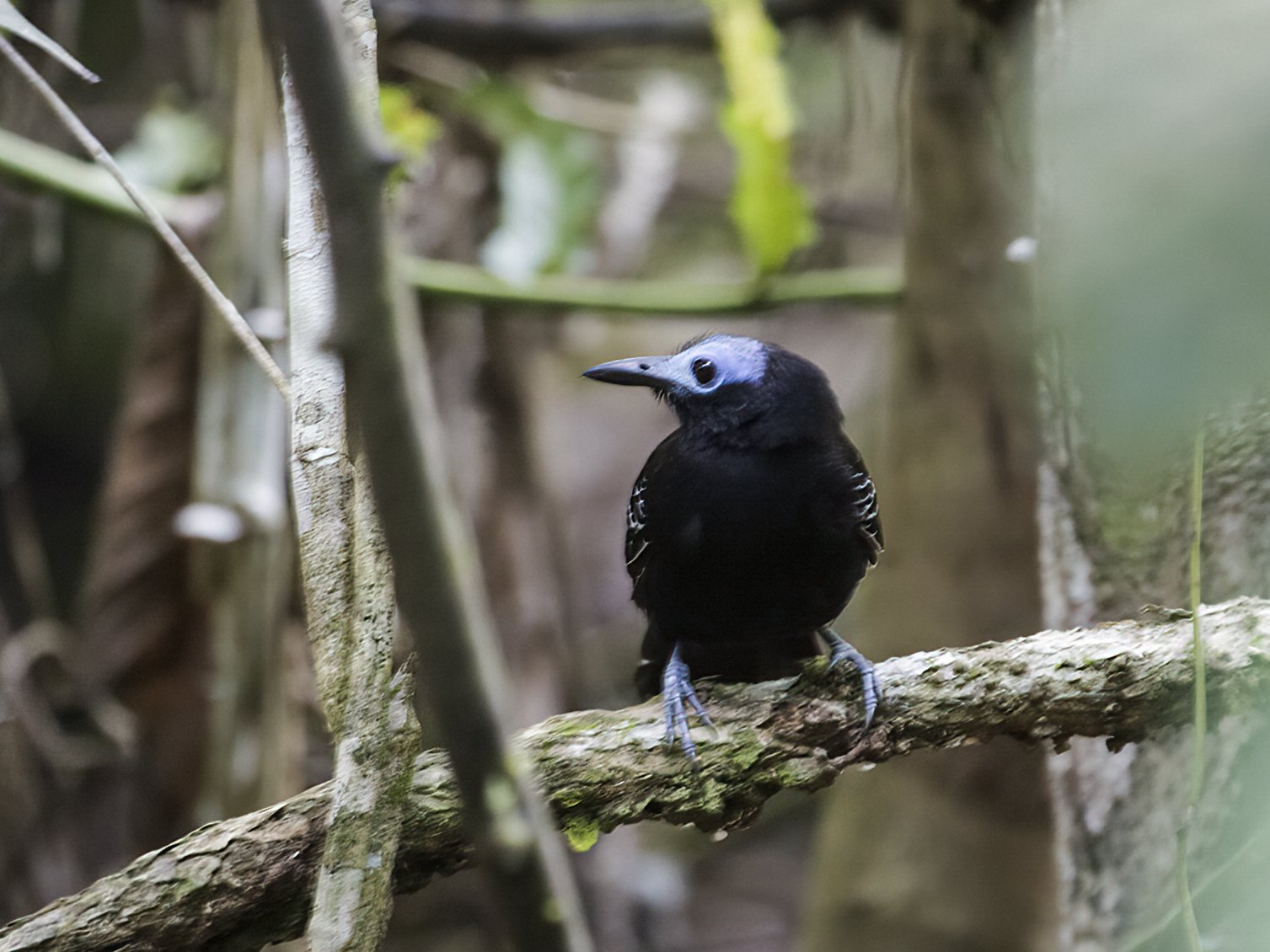
The Bare-crowned Antbird is a Central American antbird that in the guide area occurs only in northern and north-western Colombia. It is the only species in its genus. The male has a bare, bright blue forecrown and facial skin.
Voice
The male sings a series of clear, sweet whistles that rise in the middle and speed up towards the end; the female often joins in partway through. The tail vibrates during singing. The call is a sharp peeet and a bubbling rattle.
Recording: Bram Vogels — CC BY-NC-SA 4.0 · xeno-canto
Identification
16 cm, with a red iris. The male is almost entirely black, with bright blue bare skin on the forehead, forecrown, lores and around the eye, white tips to the wing coverts and narrow white tail tips. The female has blue bare skin on the lores and around the eye, is dark yellowish brown above with redder wings and tail, and has a cinnamon-rufous throat and underparts, darker on the breast.
Confusion species
Blue-lored Antbird Hafferia immaculata and Zeledon's Antbird Hafferia zeledoni have blue skin only in front of and around the eye, no bare crown, and are larger, with a brown iris; they live more in taller, closed forest. Chestnut-backed Antbird Poliocrania exsul is smaller, with a shorter tail and a grey or black face. The female Bare-crowned Antbird is marked by the blue eye-ring combined with cinnamon-rufous underparts.
Habitat
Dense understorey in lowland and foothill forest: forest edges, secondary forest, clearings and abandoned plantations with regrowth, often in swampy areas and along stagnant streams. In Colombia up to about 600 m. It regularly follows army-ant swarms. The nest is an open cup low in the vegetation.
Where the bird is most at home, classified by the vegetation units of the Andes and the west coast.


Range and movements
Colombia: in the north-west, from the border with Panama south to Valle del Cauca, and in the north from Córdoba and Antioquia east into southern La Guajira. Absent from Ecuador, Peru, Bolivia and the Galápagos. Outside the guide area from southern Mexico and Guatemala to Panama.
- Resident
- dark = core range, pale = thinly spread
How and when to look
Search dense regrowth along forest edges and swampy streams in the Caribbean lowlands of Colombia, for example around the Sinú or in the Urabá region, and watch for army-ant swarms.
Conservation status
Least Concern. Local in Colombia; the population is thought to be declining as forest and old secondary growth are converted to pasture and plantations.
Scientific name
Gymnocichla nudiceps | (Cassin, 1850)
Cassin described the species in 1850 as Myiothera nudiceps; because it was later moved to another genus, the author and year stand in brackets. The genus Gymnocichla was introduced in 1858 by Sclater. The genus name combines Greek gumnos, 'bare, naked', and kikhlē, 'thrush', for the bare head. The species name combines Latin nudus, 'bare', and -ceps, 'headed', for the bare crown. The specimen the first description was based on came from Panama.