All species › Passerines › Tityras, becards and allies › One-colored Becard
One-colored Becard | Pachyramphus homochrous
Vale bekarde | Cabezón unicolor | Caneleiro-unicolor
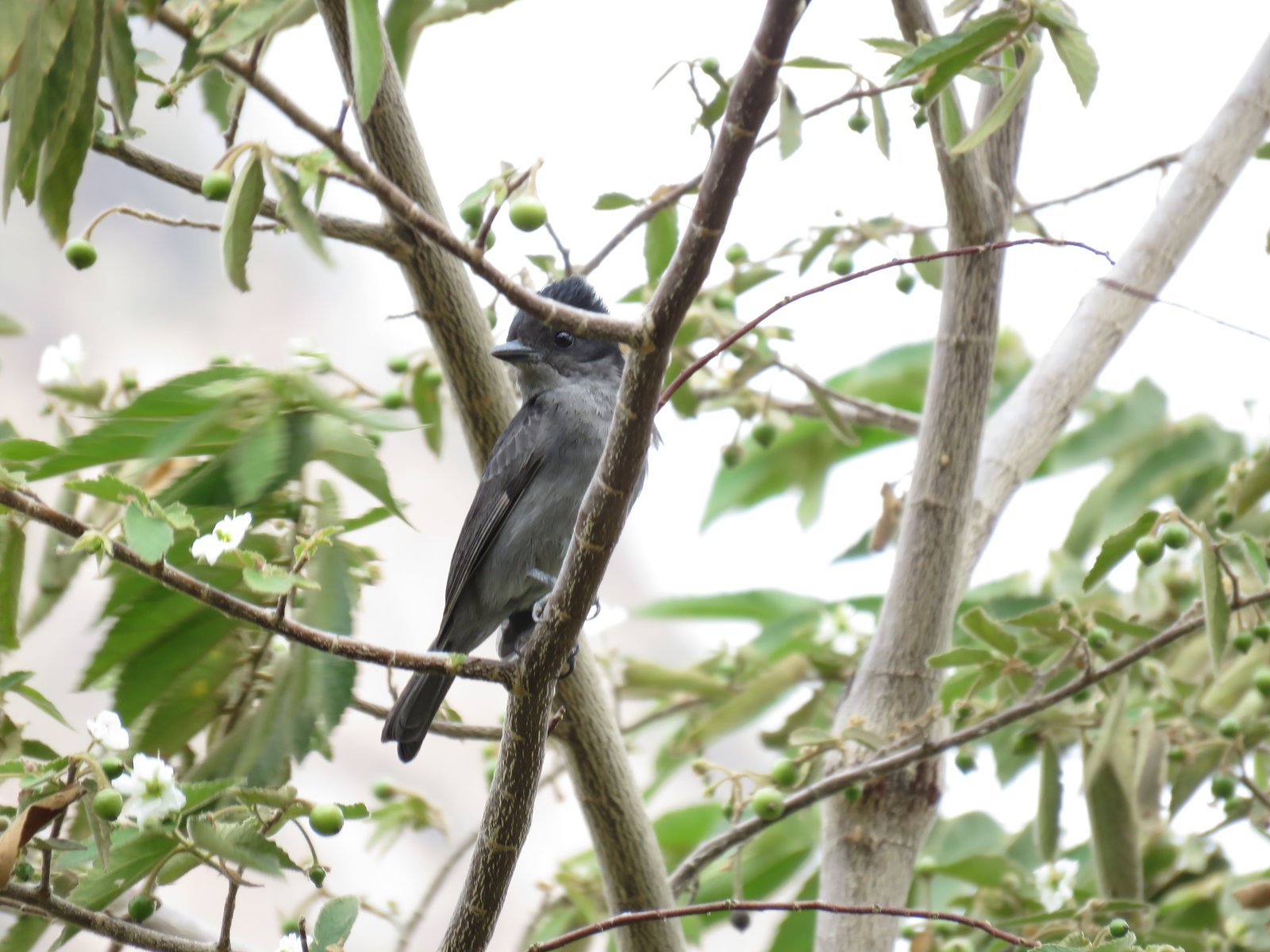
The One-colored Becard is a medium-sized, rather plain becard of the forests west of the Andes. The male is slate-grey with a blackish crown, the female cinnamon. In western Ecuador it is one of the most frequent becards, in both humid and dry forest.
Voice
Sharp, dry calls and a fast, chattering series, like tsit-tsit-tsit-tsirrr.
Recording: José María Loaiza B. — CC BY-NC-SA 4.0 · xeno-canto
Identification
16–17 cm, with a large head and a stout bill. The male is dark slate-grey above with a blackish crown, and paler grey below; the wings are almost plain, without obvious white edges. The female is rufous to cinnamon above, with a slightly darker crown, and paler buff below. Young males at first resemble the female.
Confusion species
Slaty Becard Pachyramphus spodiurus is smaller; the male has pale edges to the wing feathers, and the female is also cinnamon. Cinnamon Becard Pachyramphus cinnamomeus resembles the female, but is warmer cinnamon and has a pale stripe between eye and bill. Black-and-white Becard Pachyramphus albogriseus lives higher in the mountains and has a white supercilium and white wing edges.
Habitat
Humid and semi-dry forest, forest edges, secondary woodland and wooded gardens and plantations in the lowlands and foothills west of the Andes, up to about 1500 m. It searches for insects in the middle and upper levels of the trees, often in mixed flocks, and also eats fruit. The nest is a large, globular ball of plant material high in a tree.
Where the bird is most at home, classified by the vegetation units of the Andes and the west coast.


Range and movements
In Colombia in the Pacific lowlands and in the north, including the Magdalena valley. In Ecuador widespread west of the Andes. In Peru only in the north-west, mainly in Tumbes, Piura and Lambayeque. Absent from Bolivia, east of the Andes and from the Galápagos. Outside the guide area in Panama and north-western Venezuela.
- Resident
- dark = core range, pale = thinly spread
How and when to look
Common in western Ecuador, also in dry forest and at forest edges along roads; watch mixed flocks in the middle storey of the forest.
Conservation status
Least Concern. The species tolerates secondary woodland and partly cleared landscapes.
Scientific name
Pachyramphus homochrous | Sclater, 1859
Sclater described the species in 1859 and placed it straight away in the genus where it still stands. The genus Pachyramphus was introduced in 1840 by Gray. The genus name comes from Greek pakhus, 'stout, thick', and rhamphos, 'bill'. The species name comes from Greek homos, 'same', and khroa, 'colour': 'uniformly coloured'. The specimen the first description was based on came from Pallatanga, Chimborazo, Ecuador.