All species › Passerines › Tanagers and allies › Orange-browed Hemispingus
Orange-browed Hemispingus | Kleinothraupis calophrys
Okerbrauwhemispingus | Hemispingo de los bambúes | Sanhaço-de-sobrancelha-laranja
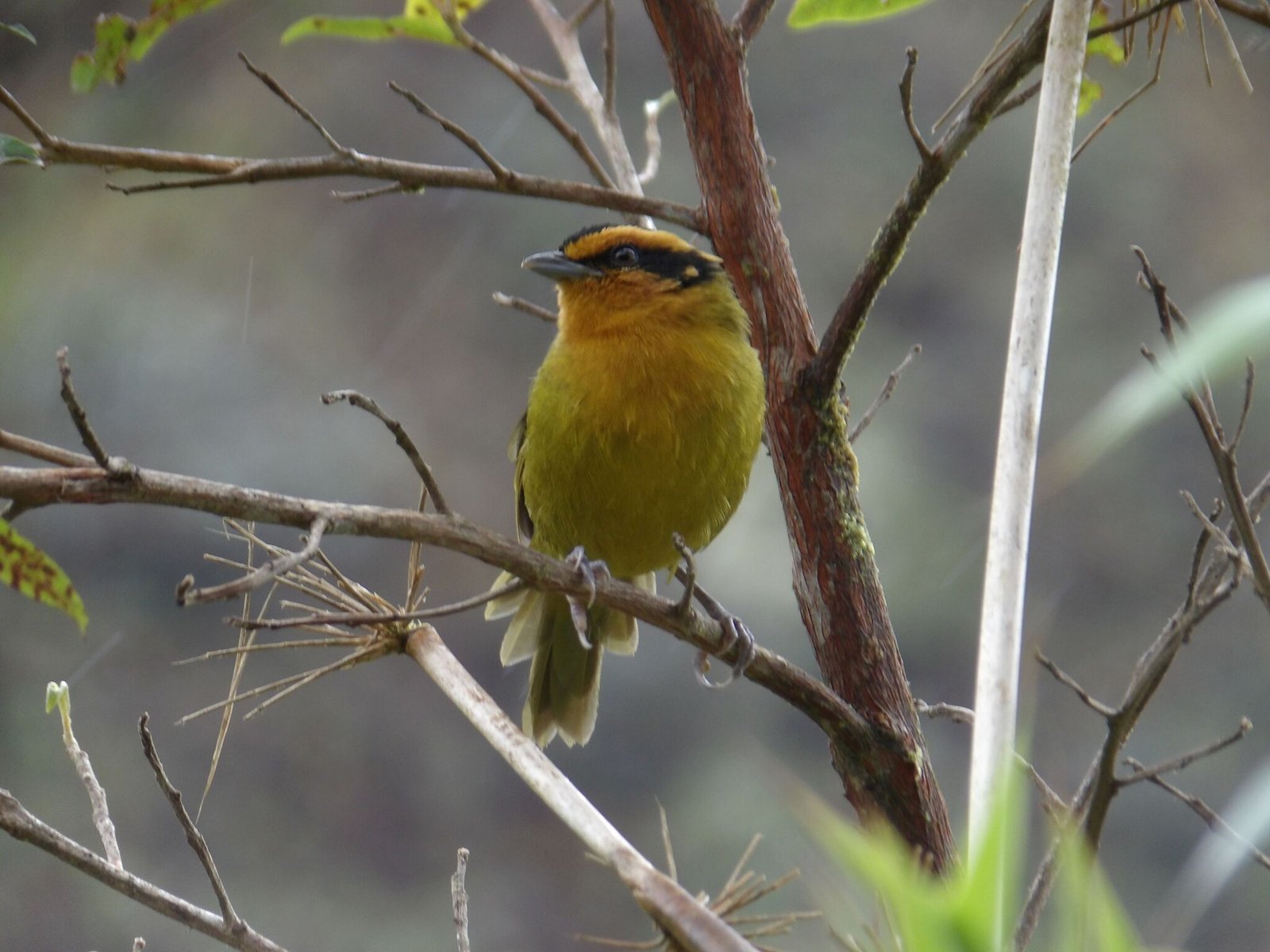
The Orange-browed Hemispingus is a tanager of bamboo at the upper edge of montane forest in southeastern Peru and Bolivia. A broad, orange-yellow supercilium on a blackish head and warm yellow-orange underparts characterize it. It is closely related to Parodi's Hemispingus, which replaces it farther northwest.
Voice
The song is a fast, high twitter, often given as a duet. The call is a thin tsit.
Recording: GABRIEL LEITE — CC BY-NC-SA 4.0 · xeno-canto
Identification
15 cm, with a fairly short, dark bill. Crown and sides of the head blackish. A broad, orange-yellow to ochre supercilium runs from the bill to the nape. Upperparts, wings and tail olive-green. Underparts warm yellow-orange, the flanks washed olive. Sexes alike. Young birds are duller, with a paler yellow supercilium.
Confusion species
Parodi's Hemispingus Kleinothraupis parodii in Cusco has a bright yellow supercilium and purer yellow underparts. Black-capped Hemispingus Kleinothraupis atropileus occurs farther north and has a whitish supercilium. Superciliaried Hemispingus Thlypopsis superciliaris has an olive-grey crown and a narrower yellow supercilium. Three-striped Hemispingus Microspingus trifasciatus is olive-brown, with a whitish supercilium and ochraceous-brown underparts.
Habitat
Dense Chusquea bamboo in cloud forest and upper montane forest, especially at the upper edge of the forest and near the treeline, roughly between 2500 and 3500 m. It forages in pairs or small groups in bamboo and the understory for insects, sometimes with mixed flocks. Little is known about the nest.
Where the bird is most at home, classified by the vegetation units of the Andes and the west coast.

Range and movements
In Peru on the eastern slope of the Andes in the southeast, in Puno. In Bolivia on the eastern slope of the Andes in La Paz and Cochabamba. Absent from Colombia, Ecuador and the Galápagos. Does not occur outside the guide area.
- Resident
- dark = core range, pale = thinly spread
How and when to look
Search bamboo near the treeline along the roads on the eastern slope in La Paz, for example in the Yungas above Coroico; the birds stay low in the bamboo and give themselves away by their twittering.
Conservation status
Least Concern. Its range is limited, but the species is locally fairly common within it. Fires and deforestation at the treeline may locally degrade its habitat.
Scientific name
Kleinothraupis calophrys | (Sclater & Salvin, 1876)
Sclater & Salvin described the species in 1876 as Chlorospingus calophyrys; because it was later moved to another genus, the author and year stand in brackets. The genus Kleinothraupis was introduced in 2016 by Burns, Unitt & Mason. The genus name honours the ornithologist Nedra K. Klein, combined with Greek thraupis, an unidentified small bird mentioned by Aristotle. The species name comes from Greek kalos, 'fine', and ophrys, 'eyebrow', after the orange eyebrow stripe. The specimen the first description was based on came from Tilotilo, Yungas of La Paz, Bolivia.