All species › Passerines › Tyrant flycatchers and allies › Orange-crested Flycatcher
Orange-crested Flycatcher | Myiophobus phoenicomitra
Oranjekuiftiran | Mosquerito crestinaranja | Filipe-de-crista-laranja
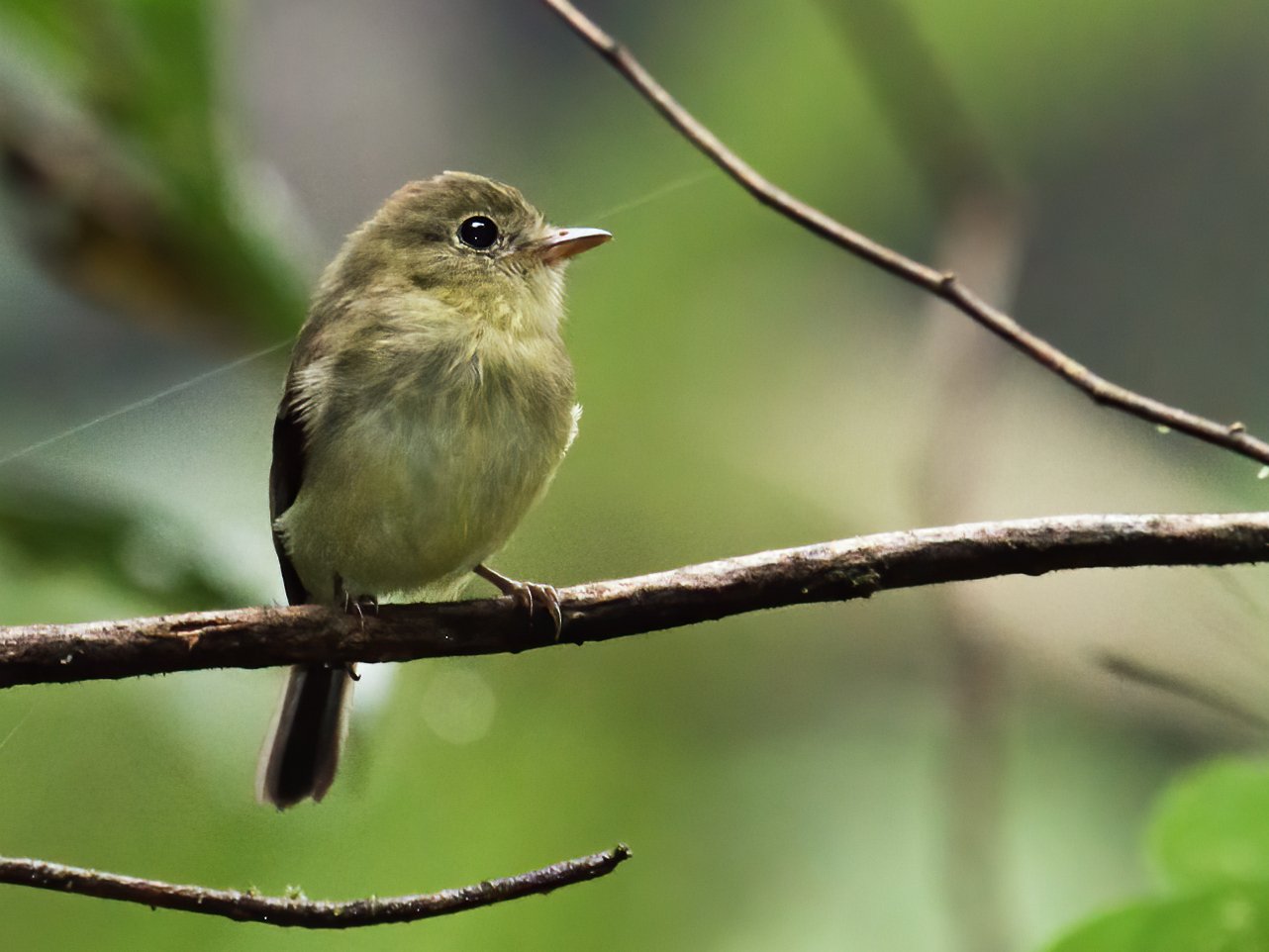
The Orange-crested Flycatcher is a small olive-green tyrant of the humid foothill forest on both sides of the Andes in Colombia and Ecuador. The male has an orange crown patch that usually remains concealed. It lives in the middle levels of the forest and is best known from forest edges along roads and rivers.
Voice
A high, sharp tsip or psit and a short, dry sputter.
Recording: Bram Vogels — CC BY-NC-SA 4.0 · xeno-canto
Identification
12 cm, with a short, broad bill with a pale lower mandible. The upperparts are dark olive-green, with a narrow, indistinct yellow eye-ring. The underparts are yellow, with an olive wash on the breast and flanks. The wings have two faint ochre wing bars. The male has a concealed orange crown patch, which the female lacks.
Confusion species
Flavescent Flycatcher Myiophobus flavicans is larger and yellower, with more distinct yellow spectacles, and lives higher in cloud forest. Roraiman Flycatcher Myiophobus roraimae is browner, with rufous wing bars. Olive-chested Flycatcher Myiophobus cryptoxanthus has a brownish-olive streaked breast and lives in semi-open country on the eastern slope.
Habitat
Humid foothill forest and lower montane forest, mainly in the middle levels and at forest edges, roughly between 500 and 1600 m. It catches insects with short sallies from a branch and joins mixed flocks. Little is known about the nest.
Where the bird is most at home, classified by the vegetation units of the Andes and the west coast.


Range and movements
Colombia: on the Pacific slope of the Western Andes and on the eastern slope of the Eastern Andes. Ecuador: on both slopes of the Andes. Peru: only locally in the north, on the eastern slope. Absent from Bolivia and the Galápagos. The range lies largely within the guide area.
- Resident
- dark = core range, pale = thinly spread
How and when to look
Search along roads through foothill forest, such as on the Pacific slope of north-western Ecuador, and follow mixed flocks in the middle levels.
Conservation status
Least Concern. Foothill forest on the Pacific side has been heavily cleared, making the species locally vulnerable.
Scientific name
Myiophobus phoenicomitra | (Taczanowski & Berlepsch, 1885)
Taczanowski & Berlepsch described the species in 1885 as Myiobius phoenicomitra; because it was later moved to another genus, the author and year stand in brackets. The genus Myiophobus was introduced in 1850 by Reichenbach. The genus name comes from Greek muia, 'fly', and phobos, 'terror, fear'. The species name comes from Greek phoinix, 'crimson', and mitra, 'headband, turban', after the orange-red crown. The specimen the first description was based on came from Hacienda Mapoto, Tungurahua, Ecuador.