All species › Woodpeckers and allies › Woodpeckers › Orinoco Piculet
Orinoco Piculet | Picumnus pumilus
Orinocodwergspecht | Carpinterito del Orinoco | Pica-pau-anão-do-orinoco
The Orinoco Piculet is a small, olive piculet of the lowlands around the upper Orinoco and the Rio Negro. In the guide area it occurs only in eastern Colombia. It forages in thin twigs and vines at forest edges and along rivers.
Voice
A high, thin, rapid trill, often slightly descending, and short, sharp tsit calls. Drums softly and briefly on thin twigs; a soft tapping is often heard while it feeds.
Recording: Mauricio Cuéllar Ramírez — CC BY-NC-SA 4.0 · xeno-canto
Identification
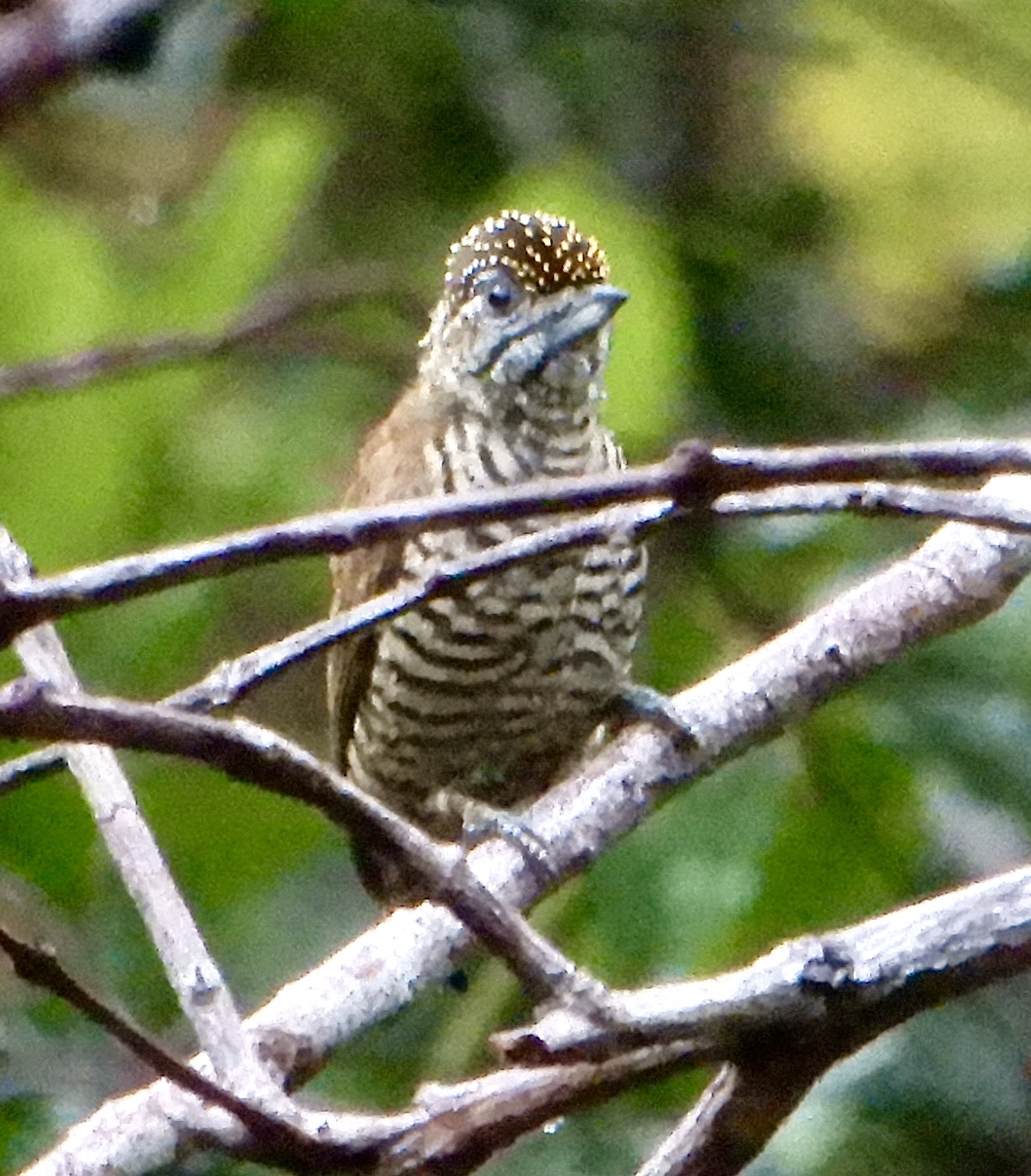
9 cm, with a short, pointed bill. The upperparts are plain olive-green, without barring. The crown is black; in the male with red to orange streaks on the forecrown and white dots behind, in the female with white dots only. The underparts are yellowish white with narrow dark bars. The short tail is black with pale inner webs. Young birds are duller, with fewer dots on the crown.
Confusion species
Lafresnaye's Piculet Picumnus lafresnayi has a clearly barred olive-green back and lives further south-west. Golden-spangled Piculet Picumnus exilis has yellow, dark-edged spangles on the back and more heavily barred underparts. White-bellied Piculet Picumnus spilogaster has a greyish-brown back and white underparts.
Habitat
Edges of humid lowland forest, várzea and gallery forest, secondary forest and scrub along rivers, mostly below 300 m. It searches thin twigs, vines and dead wood for ants, termites and their larvae and eggs. The nest is a small cavity it excavates in a thin dead branch or trunk.
Where the bird is most at home, classified by the vegetation units of the Andes and the west coast.


Range and movements
In the guide area only in eastern Colombia, in the lowlands of Guaviare, Vaupés and Guainía among other departments. Absent from Ecuador, Peru, Bolivia and the Galápagos. Outside the guide area in southern Venezuela and north-western Brazil.
- Resident
- dark = core range, pale = thinly spread
How and when to look
Search forest edges and riverbanks around Mitú in Vaupés and Inírida in Guainía, especially in mixed flocks of small birds. Listen for soft tapping in thin twigs and the high trill.
Conservation status
Least Concern. The range is large and still largely forested.
Scientific name
Picumnus pumilus | Cabanis & Heine, 1863
Cabanis & Heine described the species in 1863 and placed it straight away in the genus where it still stands. The genus Picumnus was introduced in 1825 by Temminck. The genus name refers to Picumnus, a Roman god of fertility and agriculture, brother of Pilumnus, whose name is related to Latin picus, 'woodpecker'. The species name comes from Latin pumilus, 'dwarf, small'. The specimen the first description was based on came from (according to the description).