All species › Passerines › Tyrant flycatchers and allies › Pacific Flatbill
Pacific Flatbill | Rhynchocyclus pacificus
Pacifische breedbektiran | Picoplano del Pacífico | Bico-chato-do-pacífico
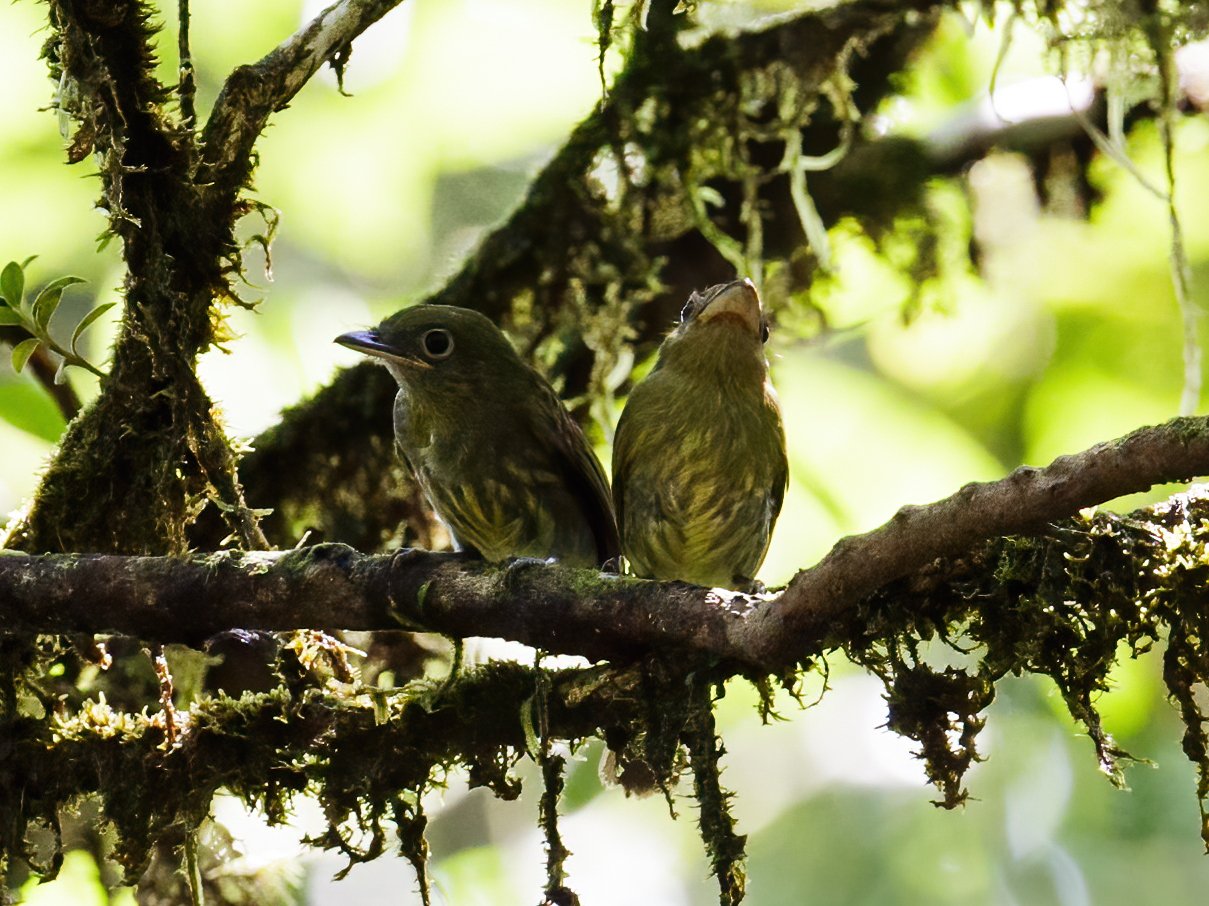
The Pacific Flatbill is an olive-green tyrant with a very broad, flat bill and a white eye-ring, found in the Chocó region of western Colombia and north-western Ecuador. It was formerly included in Eye-ringed Flatbill. Like its relatives, it sits still for long periods in the middle storey of humid forest.
Voice
A sharp, rising tseep or sssip, often repeated at intervals.
Recording: Niels Krabbe — CC BY-NC-SA 3.0 · xeno-canto
Identification
15–16 cm, with a large head and a very broad, flat bill: upper mandible black, lower mandible pale. Head and upperparts dark olive-green, with a white eye-ring. Wings dark with olive to yellowish edges to coverts and flight feathers. Throat and breast olive with faint pale streaks, belly pale yellow. Sexes alike.
Confusion species
Eye-ringed Flatbill Rhynchocyclus brevirostris is practically identical, but in the guide area occurs only in the far north-west of Colombia. Western Olivaceous Flatbill Rhynchocyclus aequinoctialis has a less conspicuous eye-ring and more distinct yellow wing edgings. Fulvous-breasted Flatbill Rhynchocyclus fulvipectus has a tawny throat and breast. Yellow-olive Flatbill Tolmomyias sulphurescens is smaller, with a grey crown, a pale eye and a narrower bill.
Habitat
The middle storey and understorey of humid and very wet forest in the lowlands and foothills, also tall secondary forest, from sea level to about 1200 m. It catches large insects in a short sally from the perch to the underside of leaves. The nest is a hanging, pear-shaped bag with an entrance at the bottom.
Where the bird is most at home, classified by the vegetation units of the Andes and the west coast.


Range and movements
Colombia: along the Pacific side, from Chocó south to Nariño, and in the foothills of the Western Andes. Ecuador: in the north-west, south to southern Pichincha. Peru and Bolivia: absent. Absent from the Galápagos. Does not occur outside the guide area.
- Resident
- dark = core range, pale = thinly spread
How and when to look
Search humid forest in north-western Ecuador or the Colombian Chocó, for example in Esmeraldas or along the roads down to the Pacific coast, and watch for a motionless olive-green bird with a broad bill and a white eye-ring.
Conservation status
Least Concern. The species is tied to humid forest in the Chocó region, which has been heavily logged, especially in Ecuador.
Scientific name
Rhynchocyclus pacificus | (Chapman, 1914)
Chapman described the species in 1914 as Craspedoprion pacificus; because it was later moved to another genus, the author and year stand in brackets. The genus Rhynchocyclus was introduced in 1860 by Cabanis & Heine. The genus name is an anagram of the earlier name Cyclorhynchus, from Greek kuklos, 'circle, shield', and rhunkhos, 'bill'. The species name refers to the Pacific Ocean; the species lives on the Pacific slope of Colombia and Ecuador. The specimen the first description was based on came from Juntas de Tamaná, Chocó, Colombia.