All species › Passerines › Tyrant flycatchers and allies › Fulvous-breasted Flatbill
Fulvous-breasted Flatbill | Rhynchocyclus fulvipectus
Bruine breedbektiran | Picoplano pechifulvo | Bico-chato-de-peito-fulvo
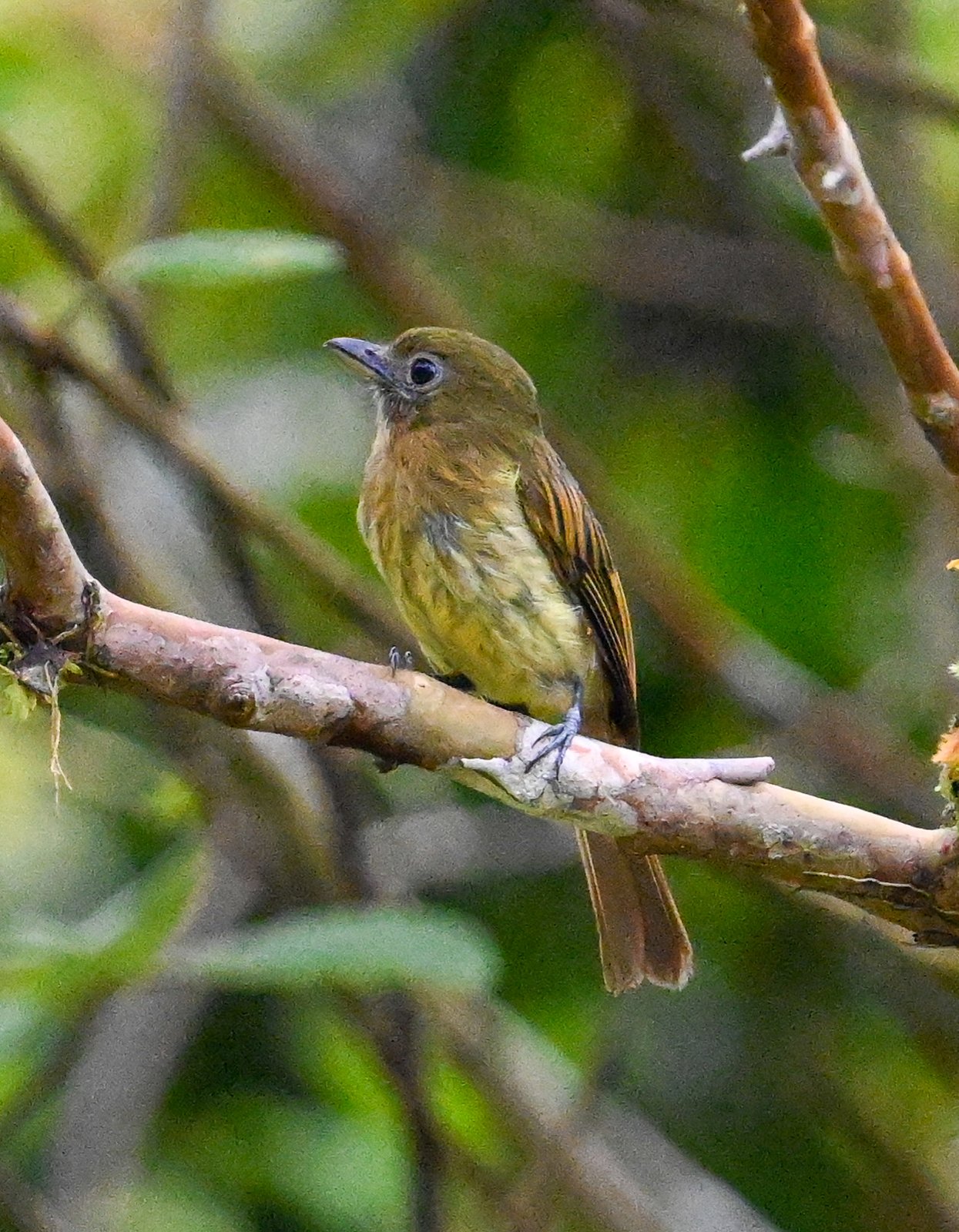
The Fulvous-breasted Flatbill is a sizeable, olive-green flycatcher with a strikingly broad, flat bill, living in humid montane forest on the Andean slopes. It often sits motionless for long periods in the middle storey. It is the flatbill of the mountains; its relatives in the genus Rhynchocyclus live in the lowlands.
Voice
A rasping, rising zrreeep, repeated at intervals, and short, sharp calls.
Recording: Ross Gallardy — CC BY-NC-SA 4.0 · xeno-canto
Identification
15–16 cm, with a large head and a very broad, flat bill with a pale lower mandible. The head and upperparts are olive-green, with a narrow, pale eye-ring. The wings are dark, the coverts and tertials broadly edged rufous or ochre. The throat and breast are warm fulvous to olive-brown, the belly pale yellow. The sexes are alike.
Confusion species
Pacific Flatbill Rhynchocyclus pacificus lives lower, in lowland forest west of the Andes, and has an olive, faintly yellow-streaked breast without fulvous. Eastern Olivaceous Flatbill Rhynchocyclus olivaceus lives in the Amazonian lowlands and also has an olive-grey breast. The flatbills of the genus Tolmomyias are smaller, with a narrower bill and yellowish-green wing bars instead of rufous edges.
Habitat
Humid lower montane forest and cloud forest, also old secondary forest and forest edge, roughly between 600 and 2000 m. It sits still on a branch in the middle storey and catches insects with a short sally to the foliage; it sometimes joins mixed flocks. The nest is a hanging, pear-shaped pouch with an entrance at the bottom.
Where the bird is most at home, classified by the vegetation units of the Andes and the west coast.


Range and movements
Colombia: in all three Andean ranges, mainly at middle elevations. Ecuador: on both slopes of the Andes. Peru: on the east slope south to Cusco and Puno. Bolivia: locally in the Yungas of La Paz and Cochabamba. Absent from the Galápagos. Outside the guide area in western Venezuela.
- Resident
- dark = core range, pale = thinly spread
How and when to look
Search the middle storey of humid montane forest at 900–1800 m; look for a still, greenish bird with a broad bill. The call often gives it away first.
Conservation status
Least Concern. The species is tied to humid montane forest and disappears where that forest is cleared.
Scientific name
Rhynchocyclus fulvipectus | (Sclater, 1860)
Sclater described the species in 1860 as Cyclorhynchus fulvipectus; because it was later moved to another genus, the author and year stand in brackets. The genus Rhynchocyclus was introduced in 1860 by Cabanis & Heine. The genus name is an anagram of the earlier name Cyclorhynchus, from Greek kuklos, 'circle, shield', and rhunkhos, 'bill'. The species name comes from Latin fulvus, 'fulvous, tawny', and pectus, 'breast'. The specimen the first description was based on came from Nanegal, Pichincha, Ecuador.