All species › Passerines › Tyrant flycatchers and allies › Drab Water Tyrant
Drab Water Tyrant | Ochthornis littoralis
Vale tapuittiran | Guardarríos arenisco | Maria-da-praia
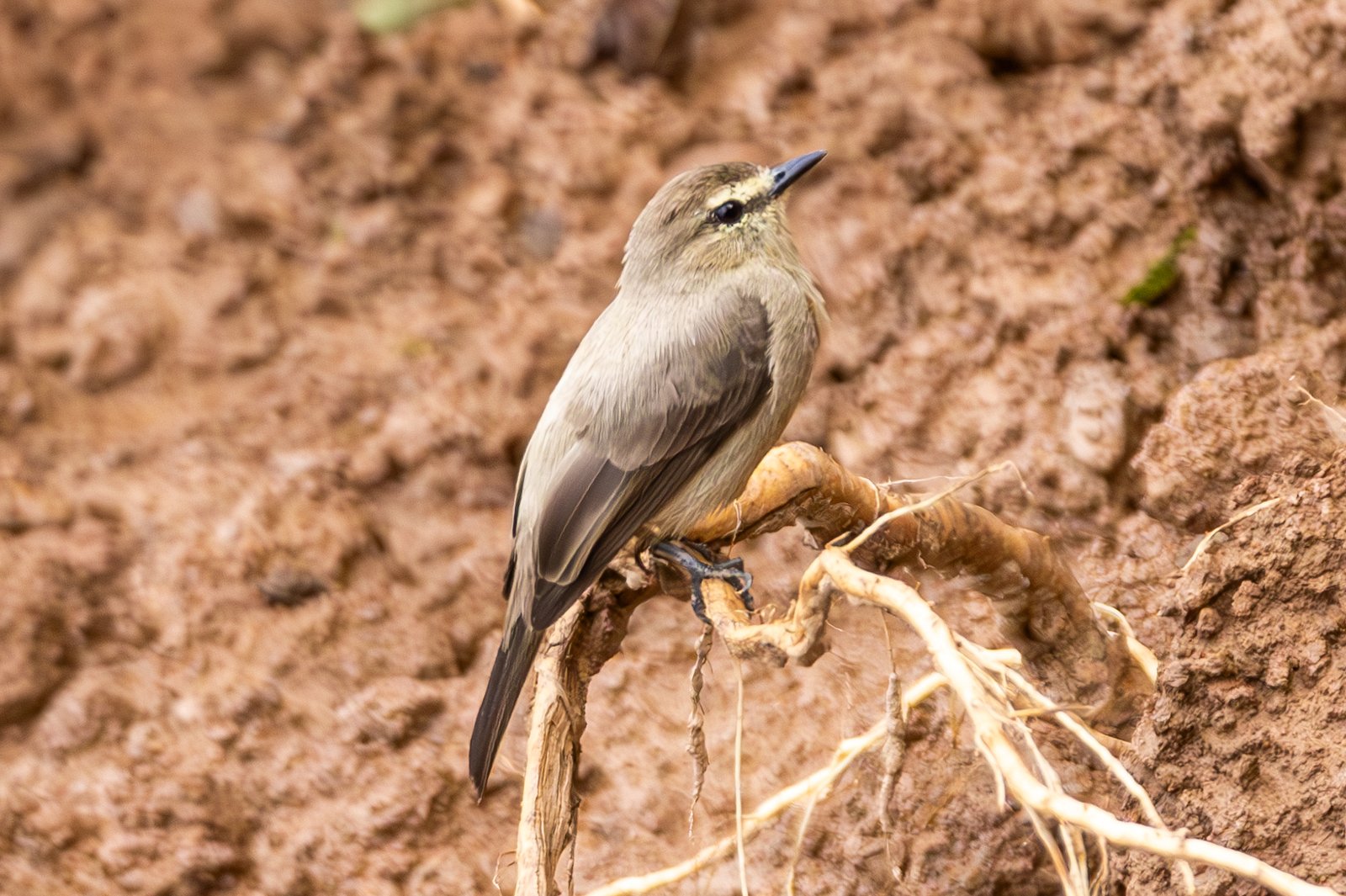
The Drab Water Tyrant is a small, sand-coloured tyrant of the banks of the large rivers in the Amazonian lowlands. It perches low on roots, branches and fallen trees just above the water and flies from one spot on the bank to the next. Its colour matches the bare, muddy banks where it lives.
Voice
Not very vocal. A thin, high peep and soft, short whistles; pairs sometimes give a rapid series of chirping notes.
Recording: Mauricio Cuellar Ramirez (@Birding.travel) — CC BY-NC-SA 4.0 · xeno-canto
Identification
13.5 cm, with a straight black bill and a fairly short tail. The plumage is plain pale sandy brown, with a paler rump and a faint pale supercilium above darker lores. The wings and tail are darker greyish brown, without distinct wing bars. The underparts are paler buffy brown, the throat almost white. The sexes are alike.
Confusion species
River Tyrannulet Serpophaga hypoleuca is smaller and slimmer, grey above and white below, and lives in young growth on river islands. The female Riverside Tyrant Knipolegus orenocensis is greyer, with a darker tail, and perches more in shrubs than on bare banks. Little Ground Tyrant Syrtidicola fluviatilis walks more on sandbars and bare ground, has longer legs and a dark tail with pale outer edges.
Habitat
Banks of large and medium-sized lowland rivers, especially along turbid rivers with muddy banks, exposed roots and driftwood; also along oxbow lakes. Up to about 500 m, locally higher. It catches insects in short flights from a low perch or from the ground at the water's edge. The nest is in a hole or crevice in the bank or among roots.
Where the bird is most at home, classified by the vegetation units of the Andes and the west coast.


Range and movements
Colombia: in the lowlands east of the Andes. Ecuador: in the east. Peru: throughout the Amazonian lowlands. Bolivia: in the north and in the lowlands of Beni and Pando. Absent from the Galápagos. Outside the guide area in Amazonia and the Orinoco basin of Venezuela, the Guianas and Brazil.
- Resident
- dark = core range, pale = thinly spread
How and when to look
On a boat trip along the river, watch for a small, sand-coloured bird that flies up from a root or branch on the bank just ahead of the boat and settles again a little further on.
Conservation status
Least Concern. The species is widespread along the large rivers and appears to be little affected by disturbance of the surrounding forest.
Scientific name
Ochthornis littoralis | (Pelzeln, 1868)
Pelzeln described the species in 1868 as Elainea littoralis; because it was later moved to another genus, the author and year stand in brackets. The genus Ochthornis was introduced in 1888 by Sclater. The genus name comes from Greek okhthē, 'bank, riverbank', and ornis, 'bird'. Latin litoralis means 'of the shore', referring to the riverbanks where the species lives. The specimen the first description was based on came from Borba, Amazonas, Brazil.