All species › Passerines › Tyrant flycatchers and allies › Pale-eyed Pygmy Tyrant
Pale-eyed Pygmy Tyrant | Atalotriccus pilaris
Bleekoogdwergtiran | Mosquerito ojiblanco | Maria-de-olho-claro
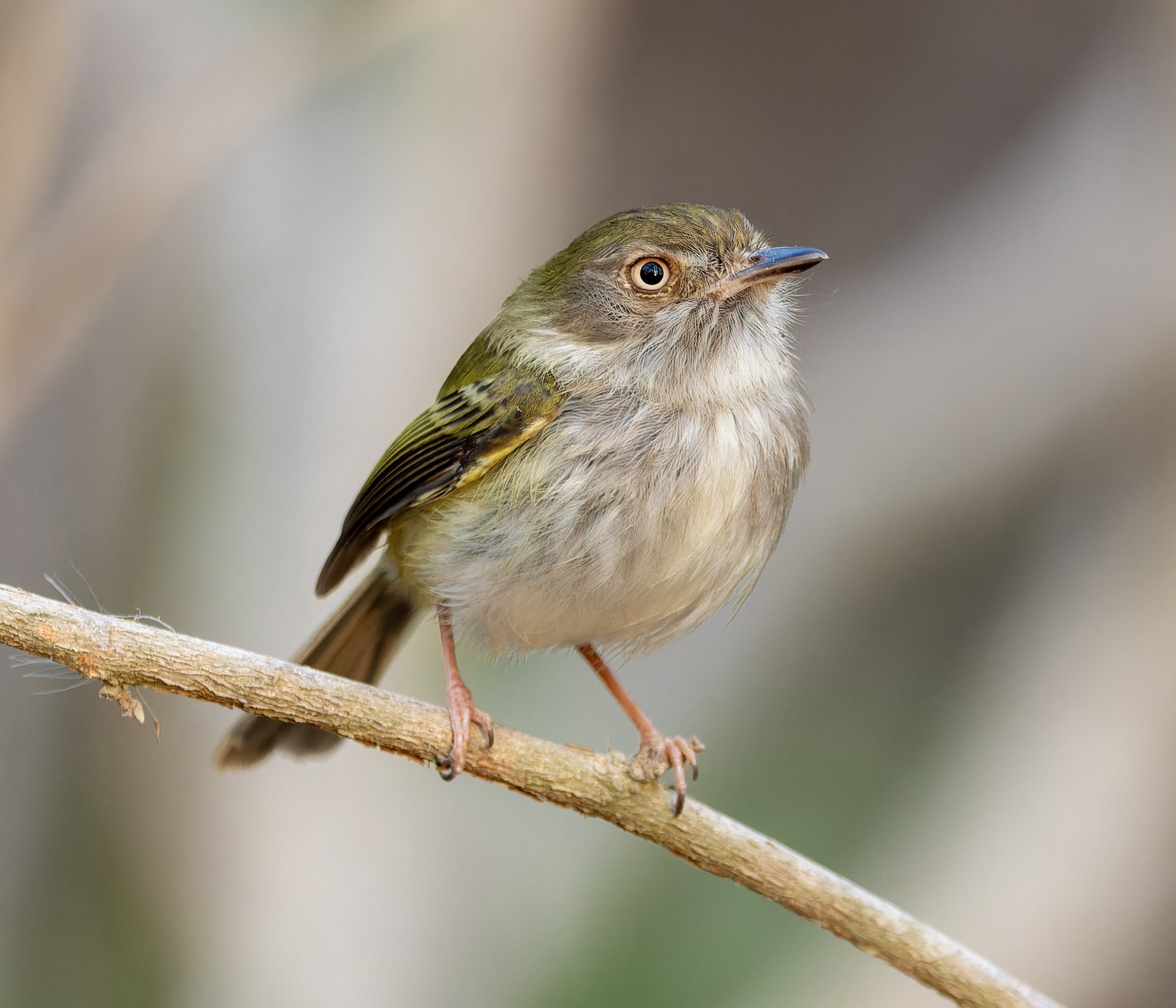
The Pale-eyed Pygmy Tyrant is a small, olive tyrant flycatcher with a pale eye, which in the guide area occurs only in the dry and semi-arid lowlands of Colombia. It lives in dry forest, scrub and gallery forest and is the only species in its genus.
Voice
Dry ticks and a short, rolling trill, often followed by a series of 'tik' notes.
Recording: GABRIEL LEITE — CC BY-NC-SA 4.0 · xeno-canto
Identification
9.5 cm, with a rather short, flat bill and a medium-length tail. The upperparts are olive-green, the face and lores buff. The eye is white to pale yellow. The wings are dusky with two yellowish wing bars and yellow edges. The throat and breast are whitish with faint grey streaks, and the belly is whitish with a yellow tinge. The sexes are alike.
Confusion species
Pearly-vented Tody-Tyrant Hemitriccus margaritaceiventer also has a pale eye and a streaked breast, but a browner crown, no buff face and a longer bill; in Colombia only locally in the north-east. Common Tody-Flycatcher Todirostrum cinereum has a blackish head, entirely yellow underparts and a long tail. Scale-crested Pygmy Tyrant Lophotriccus pileatus has a crest and lives in humid montane forest.
Habitat
Dry forest, thorn scrub, gallery forest along rivers, forest edges and shrubby savanna, from sea level to about 900 m, locally higher. It keeps to dense thickets and the middle level and catches small insects with short sallies to leaves. The nest is a hanging globular nest with a side entrance.
Where the bird is most at home, classified by the vegetation units of the Andes and the west coast.


Range and movements
Colombia: in the Caribbean lowlands, in the dry parts of the Magdalena Valley and in the Llanos east of the Andes. Absent from Ecuador, Peru, Bolivia and the Galápagos. Outside the guide area in Venezuela, Guyana and the far north of Brazil.
- Resident
- dark = core range, pale = thinly spread
How and when to look
Search dry forest and scrub in the Caribbean lowlands of Colombia or gallery forest in the Llanos; listen for the dry ticks and look into dense thickets at mid-height.
Conservation status
Least Concern. The species tolerates scrub and degraded forest.
Scientific name
Atalotriccus pilaris | (Cabanis, 1847)
Cabanis described the species in 1847 as C[olopterus] pilaris; because it was later moved to another genus, the author and year stand in brackets. The genus Atalotriccus was introduced in 1905 by Ridgway. The genus name comes from Greek atalos, 'tender, delicate', and trikkos, an unidentified small bird (used for tyrant flycatchers). The species name comes from Latin pilaris, 'hairless', that is 'crestless' (from pilare, 'to deprive of hair', and pilus, 'hair'). The specimen the first description was based on came from Cartagena, Bolívar, Colombia.