All species › Passerines › Tyrant flycatchers and allies › Grey Monjita
Grey Monjita | Nengetus cinereus
Grijze monjita | Monjita gris | Primavera
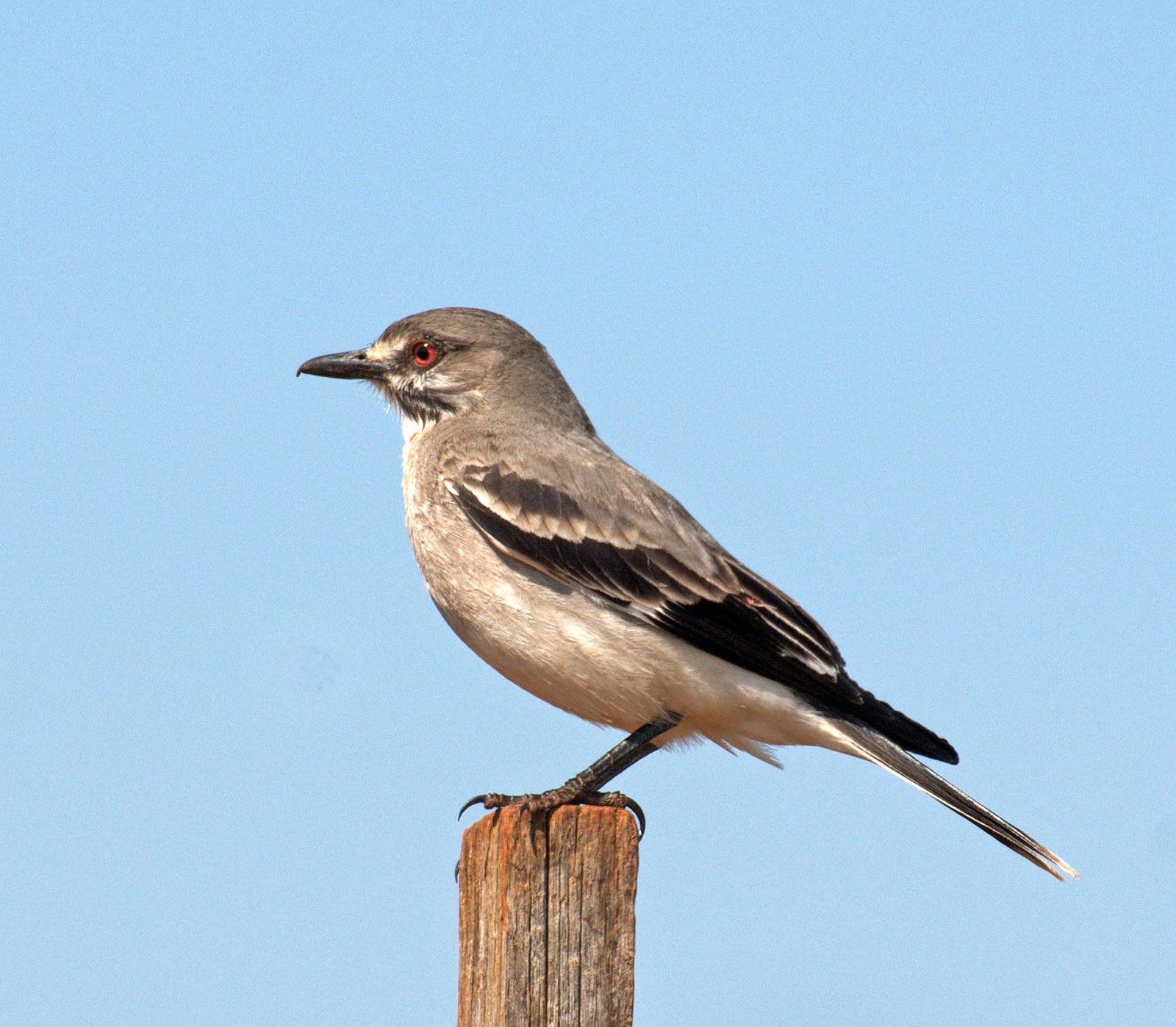
The Grey Monjita is a fairly large, grey and white flycatcher of open grassland in central and eastern South America. It perches upright on posts, shrubs and termite mounds and shows a white patch in the black wing in flight. Southern birds move north in the austral winter.
Voice
Usually silent. Soft whistles, mainly at dusk, and a short, dry call.
Recording: JAYRSON ARAUJO DE OLIVEIRA — CC BY-NC-SA 4.0 · xeno-canto
Identification
22–23 cm, with a fairly long, black bill. The upperparts are grey, with white lores. The throat is white, bordered by a narrow black malar stripe; the breast is grey, the belly white. The wings are black, with a white patch at the base of the primaries and pale edges to the coverts; the tail is blackish. The sexes are alike; juveniles are browner.
Confusion species
White-rumped Monjita Xolmis velatus is smaller, with a white head and a white rump. Black-crowned Monjita Neoxolmis coronatus has a black crown with a broad white border and lacks the black malar stripe. Chalk-browed Mockingbird Mimus saturninus has a long tail with white corners, a brown, streaked back and a dark eyestripe.
Habitat
Open grassland, campos, savanna with scattered shrubs, pastures and roadsides in the lowlands. It perches on a lookout and drops to the ground to catch insects. The nest is an open cup in a shrub or tree.
Where the bird is most at home, classified by the vegetation units of the Andes and the west coast.


Range and movements
Bolivia: in the savannas of Beni and in eastern Santa Cruz; mainly in the austral winter migrants from the south join them. Peru: very local in the Pampas del Heath in Madre de Dios. Absent from Colombia, Ecuador and the Galápagos. Outside the guide area in central and eastern Brazil, Paraguay, Uruguay and north-eastern Argentina.
- Resident
- dark = core range, pale = thinly spread
How and when to look
Search the open savannas of Beni, for example around Trinidad, on posts and shrubs along the road; outside the breeding season small groups also occur.
Conservation status
Least Concern. Conversion of grassland to cropland degrades its habitat locally, but the species also occurs in pastures.
Scientific name
Nengetus cinereus | (Vieillot, 1816) (GBIF: Xolmis cinereus)
Vieillot described the species in 1816 as Tyrannus cinereus; because it was later moved to another genus, the author and year stand in brackets. The genus Nengetus was introduced in 1827 by Swainson. The genus name, introduced by William Swainson in 1827, probably derives from an indigenous (Tupi) bird name from Brazil; the exact derivation is uncertain. Latin cinereus, 'ash-grey', for the grey plumage. The specimen the first description was based on came from Hinterland of Rio de Janeiro, Brazil.