All species › Passerines › Tyrant flycatchers and allies › Red-rumped Bush Tyrant
Red-rumped Bush Tyrant | Cnemarchus erythropygius
Roodstuitstruiktiran | Birro culirrojo | Tirano-arbustivo-de-uropígio-vermelho
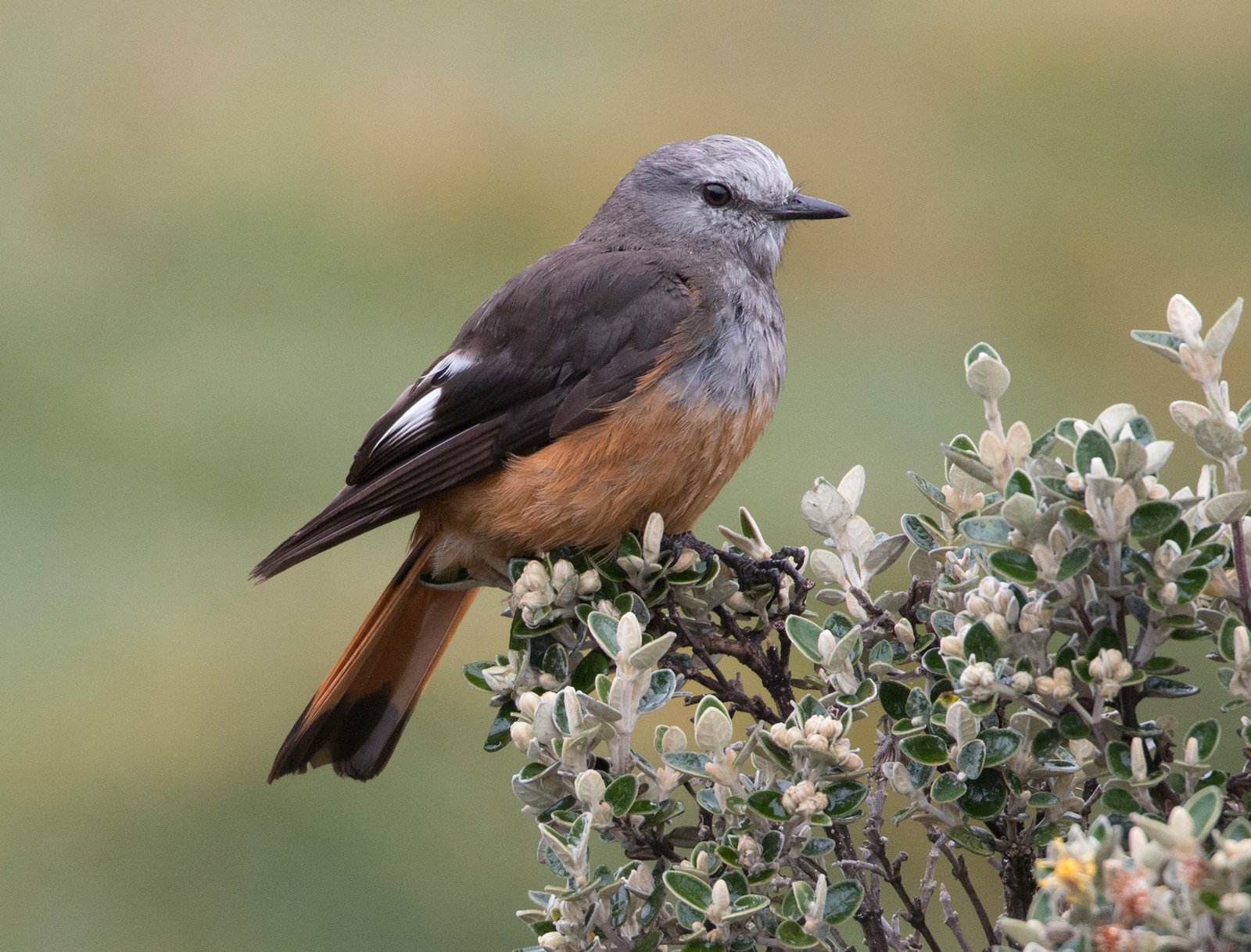
The Red-rumped Bush Tyrant is a large, grey flycatcher of páramo and puna with scattered shrubs, close to the treeline. It perches upright on top of a shrub or rock and stands out in flight by its rufous rump and tail. It usually lives alone or in pairs.
Voice
Usually silent. A soft, whistled piiu and at dusk a repeated, thin whistle.
Recording: Iván Lau — CC BY-NC-SA 4.0 · xeno-canto
Identification
23 cm, with a fairly small, black bill and long wings. The forehead and forecrown are whitish, the rest of the head and the back greyish brown. The rump is rufous, the tail rufous with dark central feathers and a dark terminal band. The wings are blackish with whitish edges to the secondaries. The throat is whitish with grey streaks, the breast grey and the belly rufous. The sexes are alike.
Confusion species
Streak-throated Bush Tyrant Myiotheretes striaticollis has a clearly streaked throat, entirely cinnamon underparts and no rufous rump, and lives lower, at forest edges. Rufous-webbed Bush Tyrant Cnemarchus rufipennis is plain grey, with rufous in the wing, and lacks the white forecrown and rufous rump. Black-billed Shrike-Tyrant Agriornis montanus has a heavy, hooked bill and white outer tail feathers.
Habitat
Páramo, humid puna and jalca with scattered shrubs, the upper forest edge and open Polylepis groves, roughly between 2800 and 4300 m, locally lower. It perches on a lookout and sallies to the ground or into the air to catch insects. The nest is in a cavity in a steep bank or among rocks.
Where the bird is most at home, classified by the vegetation units of the Andes and the west coast.


Range and movements
Colombia: in the Central and Eastern Andes and in the Sierra Nevada de Santa Marta. Ecuador: in the páramo along the whole of the Andes. Peru: along the Andes from north to south. Bolivia: in the Andes of La Paz and Cochabamba. Absent from the Galápagos. Does not occur outside the guide area.
- Resident
- dark = core range, pale = thinly spread
How and when to look
Search the páramo or puna just above the treeline, for example at Papallacta or Cajas in Ecuador; look for a grey flycatcher perched upright on a shrub that shows a rufous rump and tail in flight.
Conservation status
Least Concern. The species is widespread but occurs at low densities; burning and grazing of the páramo degrade its habitat locally.
Scientific name
Cnemarchus erythropygius | (Sclater, 1853)
Sclater described the species in 1853 as Taenioptera erythropygia; because it was later moved to another genus, the author and year stand in brackets. The genus Cnemarchus was introduced in 1905 by Ridgway. The genus name combines Greek knēmos, 'mountain slope', with arkhos, 'ruler, chief'. Greek eruthros, 'red', and pugē, 'rump': red-rumped. The specimen the first description was based on came from Verdecocha, Pichincha, Ecuador.