All species › Passerines › Manakins › Painted Manakin
Painted Manakin | Machaeropterus eckelberryi
Eckelberry's manakin | Saltarín pintado | Dançarino-pintado
The Painted Manakin is a small streaked manakin that was described as a species only in 2017, from the Cordillera Escalera in northern Peru. Its scientific name honours the bird painter Don Eckelberry, which also explains the English name. The species closely resembles Striolated Manakin but differs mainly in voice.
Voice
The male gives a short, sharp call that differs clearly from the nasal chik of Striolated Manakin; this voice was an important argument for describing the species. Also ticking wing sounds during display.
Recording: GABRIEL LEITE — CC BY-NC-SA 4.0 · xeno-canto
Identification
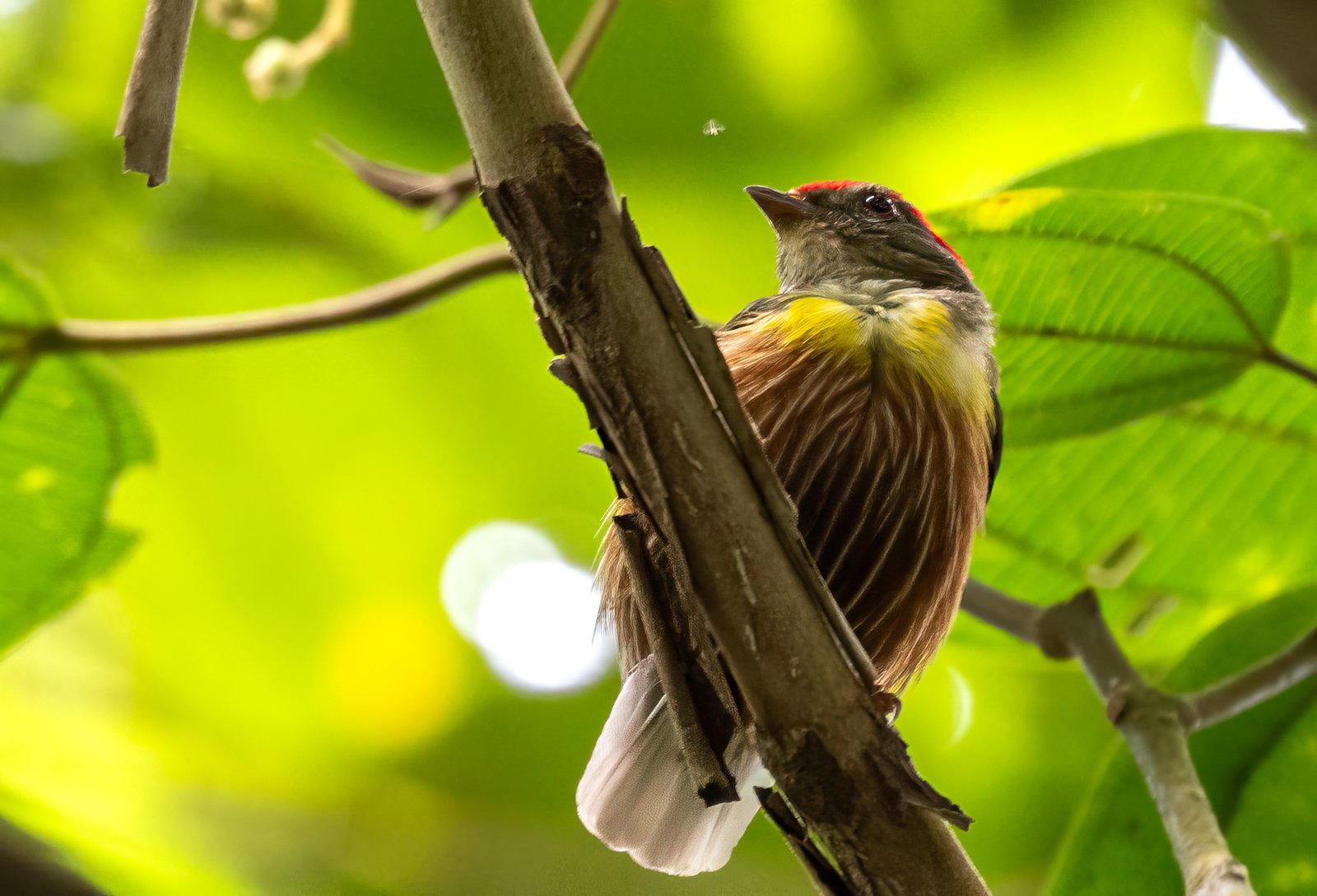
9 cm, compact, with a short tail. The male has a red crown, olive-green upperparts and pale, yellow-tinged underparts with rufous-red streaks on the breast and flanks. The female is olive-green, without red on the head, with pale underparts with faint streaks. The plumage differences from Striolated Manakin are small.
Confusion species
Striolated Manakin Machaeropterus striolatus can hardly be told apart by plumage in the field and lives in the surrounding lowlands and foothills; voice and elevation are decisive. Fiery-capped Manakin Machaeropterus pyrocephalus has a yellow crown with a red central stripe.
Habitat
Humid foothill and lower montane forest on ridges, with relatively low trees on poor soils, at roughly 600 to 1400 m. It lives in the middle storey and the understorey and, like its relatives, presumably eats small fruits and insects.
Where the bird is most at home, classified by the vegetation units of the Andes and the west coast.


Range and movements
Peru: known only from a small area in the north, in the Cordillera Escalera and adjacent ranges in San Martín and Loreto. Absent from Colombia, Ecuador, Bolivia and the Galápagos. The species does not occur outside the guide area.
- Resident
- dark = core range, pale = thinly spread
How and when to look
Search in forest on the ridges of the Cordillera Escalera, for example along trails from the Tarapoto area, and pay attention to the voice to tell it from Striolated Manakin.
Conservation status
Least Concern according to the current assessment. The range is small and largely poorly surveyed; deforestation around Tarapoto is a possible threat.
Scientific name
Machaeropterus eckelberryi | Lane, Kratter & O'Neill, 2017
Lane, Kratter & O'Neill described the species in 2017 and placed it straight away in the genus where it still stands. The genus Machaeropterus was introduced in 1854 by Bonaparte. The genus name combines Greek makhaira, 'knife' or 'dagger', with -pteros, '-winged', after the thickened wing feathers of the males. The specific name honours the American bird artist Donald R. Eckelberry (1921–2001). The specimen the first description was based on came from near Contamana, Loreto, Peru.