All species › Passerines › Manakins › Striolated Manakin
Striolated Manakin | Machaeropterus striolatus
Westelijke gestreepte manakin | Saltarín rayado occidental | Tangará-riscado
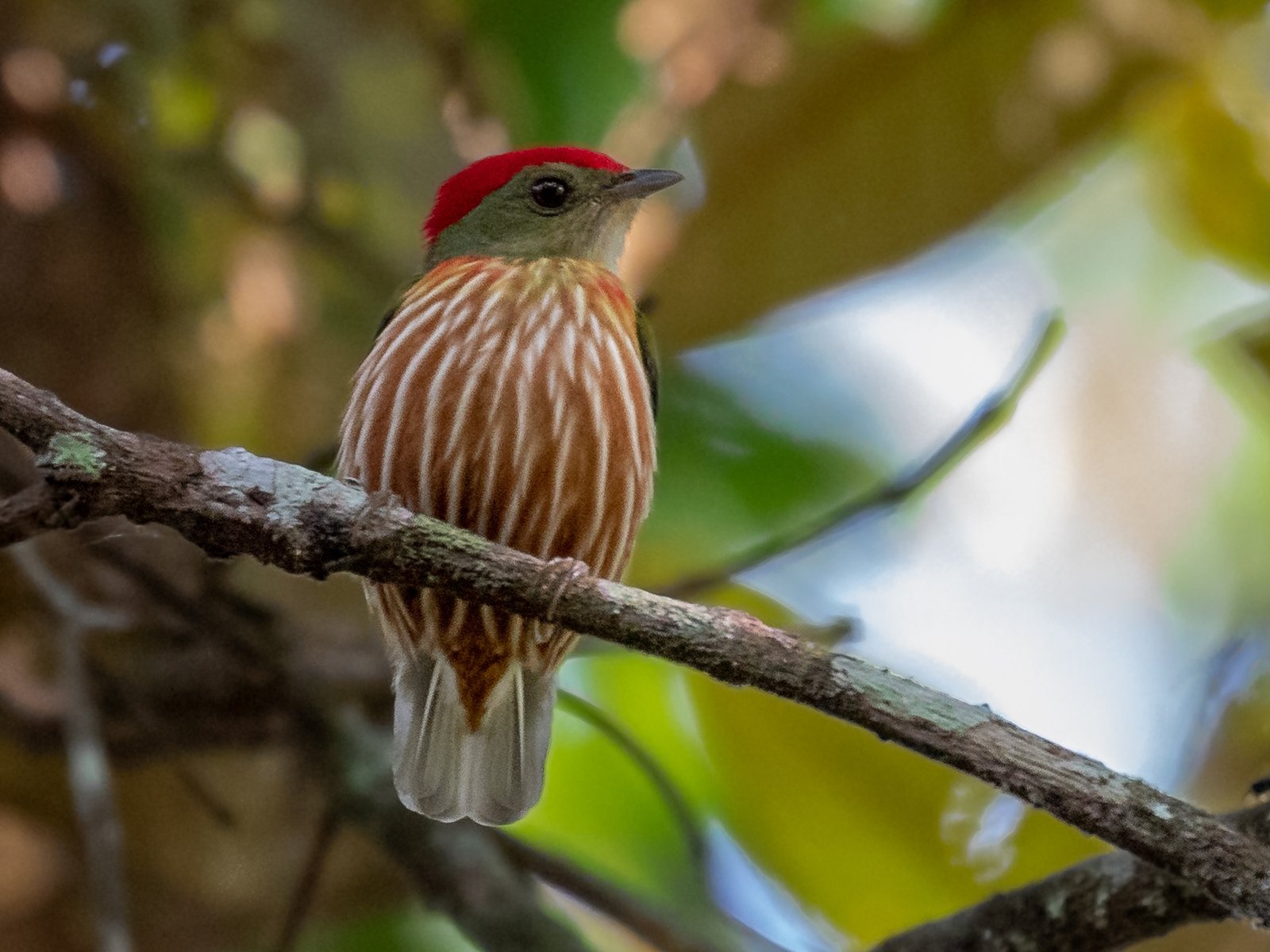
The Striolated Manakin is a very small manakin with a red crown and rufous-streaked underparts. It lives in western Amazonia and in the foothills of the eastern slope of the Andes. It was formerly treated as one species together with the Brazilian Kinglet Manakin.
Voice
A short, nasal, insect-like chik or cheep, often repeated with pauses. During display the male makes buzzing and ticking wing sounds.
Recording: Joe Klaiber — CC BY-NC-SA 4.0 · xeno-canto
Identification
9 cm, compact, with a short tail. The male has a scarlet crown, olive-green upperparts and wings, and whitish to pale yellow underparts with narrow rufous-red streaks on the breast and flanks. The female is olive-green above, without a red crown, with pale underparts with faint brownish streaks. Young males resemble the female.
Confusion species
Fiery-capped Manakin Machaeropterus pyrocephalus has a yellow crown with a red central stripe and pinker streaks on the underparts; it lives further south, in Peru and Bolivia. Painted Manakin Machaeropterus eckelberryi is very similar and is restricted to a small area in northern Peru; there the voice is the best feature. Females of other small manakins lack the streaks on the underparts.
Habitat
Humid terra firme lowland forest, foothill forest and forest edges, also older secondary forest, from the lowlands to about 1500 m. It lives in the middle storey and the understorey, often at fruiting trees, and eats small fruits and insects.
Where the bird is most at home, classified by the vegetation units of the Andes and the west coast.


Range and movements
Colombia: east of the Andes, mainly at the base of the Eastern Andes and in western Amazonia. Ecuador: in the eastern lowlands and foothills. Peru: in the north and centre, east of the Andes. Absent from Bolivia and the Galápagos. Outside the guide area in southern Venezuela and western Brazil.
- Resident
- dark = core range, pale = thinly spread
How and when to look
Search in the foothills of the eastern slope and in Amazonian forest in Ecuador and northern Peru, and listen for the repeated nasal chik. The bird often sits still in the middle storey.
Conservation status
Least Concern. The species is widespread and locally fairly common.
Scientific name
Machaeropterus striolatus | (Bonaparte, 1838)
Bonaparte described the species in 1838 as Pipra striolata; because it was later moved to another genus, the author and year stand in brackets. The genus Machaeropterus was introduced in 1854 by Bonaparte. The genus name combines Greek makhaira, 'knife' or 'dagger', with -pteros, '-winged', after the thickened wing feathers of the males. The specific name is New Latin striolatus, 'finely streaked', after the streaked underparts. The specimen the first description was based on came from lower Javari River, Brazil–Peru border.