All species › Passerines › Manakins › Club-winged Manakin
Club-winged Manakin | Machaeropterus deliciosus
Stompveermanakin | Saltarín alitorcido | Dançarino-de-asa-em-clava
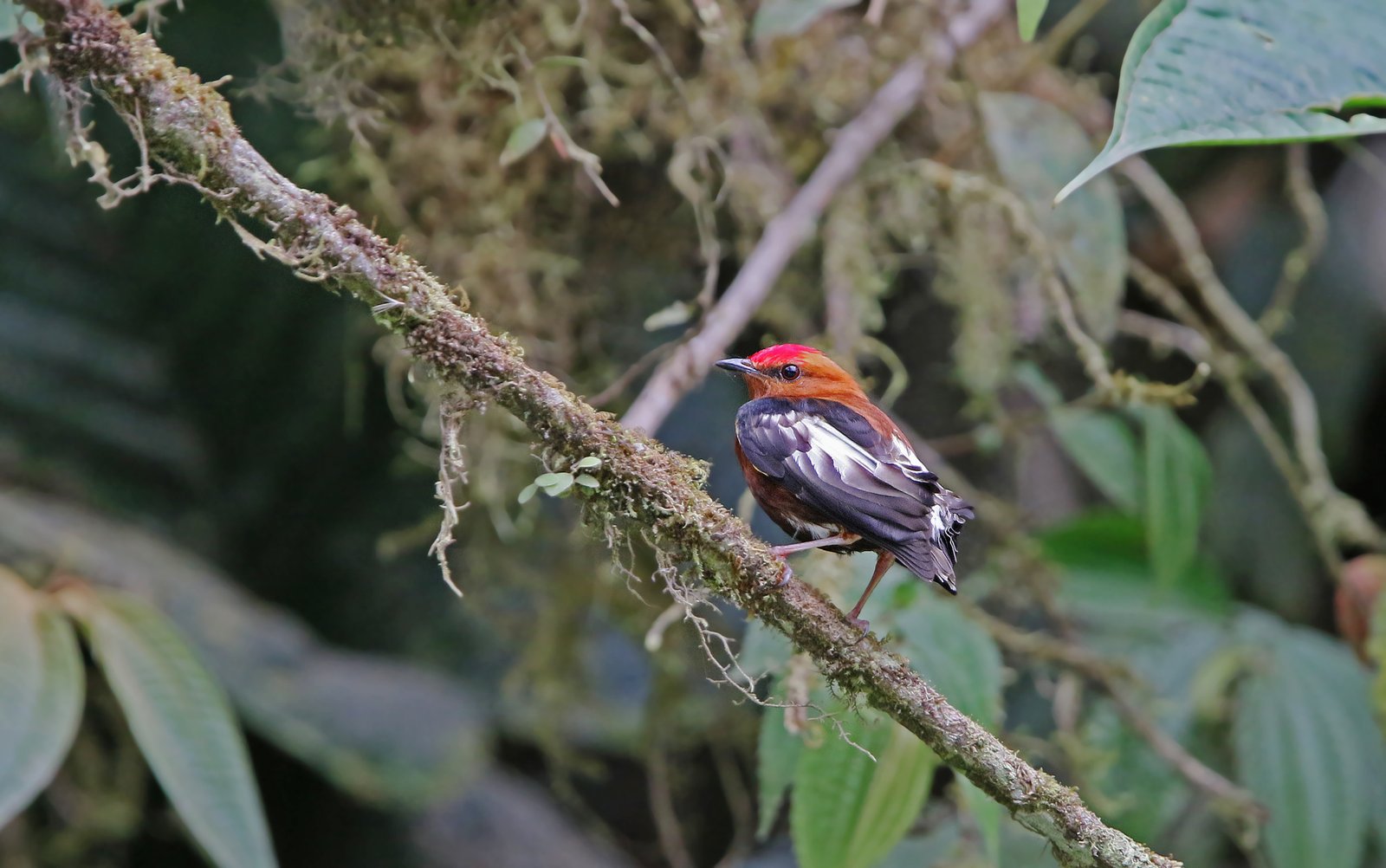
The Club-winged Manakin is a small chestnut-brown manakin of the western slope of the Andes in Colombia and Ecuador. The male has thickened, twisted secondaries with which he produces sound: he raises the wings over the back and vibrates them very rapidly, giving a high, violin-like tone. The sound therefore comes not from the throat but from the wings.
Voice
The male produces with the wings a short tick-tick followed by a drawn-out, buzzing teeeen, like a violin string. Also short, high call notes.
Recording: Paul Bourdin — CC BY-NC-SA 4.0 · xeno-canto
Identification
9–10 cm, compact, with a short tail. The male is mostly chestnut-brown, with a red crown, black wings and tail and a white patch on the inner webs of the secondaries, visible when the wings are raised. The secondaries are broadened, stiff and curved. The female is olive-green with a cinnamon wash on the face and throat, a paler belly and whitish inner webs to the secondaries. Young males resemble the female.
Confusion species
Golden-winged Manakin Masius chrysopterus occurs on the same slopes; the male is black with a yellow crown and yellow wing patches, the female olive-green with a yellow throat. Other manakins in the western Andes, such as White-bibbed Manakin Corapipo leucorrhoa and White-bearded Manakin Manacus manacus, lack the cinnamon face of the female.
Habitat
Humid foothill forest and lower montane forest, also edges and older secondary forest, at roughly 400 to 1800 m, most often between 600 and 1500 m. It lives in the understorey and middle storey and eats small fruits and insects. Males display on a fixed branch, often with other males nearby.
Where the bird is most at home, classified by the vegetation units of the Andes and the west coast.


Range and movements
Colombia: on the Pacific slope of the Western Andes, from the north of the cordillera south to Nariño. Ecuador: on the western slope of the Andes, south to about El Oro. Absent from Peru, Bolivia and the Galápagos. The species does not occur outside the guide area.
- Resident
- dark = core range, pale = thinly spread
How and when to look
Listen in forest on the western slope between about 600 and 1500 m for the violin-like tone. The male always uses the same display branch in the understorey, where he may sit for long periods.
Conservation status
Least Concern. The range is limited and forest loss on the western slope of the Andes is a threat, but the species is locally fairly common.
Scientific name
Machaeropterus deliciosus | (Sclater, 1860)
Sclater described the species in 1860 as Pipra deliciosa; because it was later moved to another genus, the author and year stand in brackets. The genus Machaeropterus was introduced in 1854 by Bonaparte. The genus name combines Greek makhaira, 'knife' or 'dagger', with -pteros, '-winged', after the thickened wing feathers of the males. The specific name is Latin deliciosus, 'delightful'. The specimen the first description was based on came from Nanegal, Pichincha, Ecuador.