All species › Passerines › Manakins › Band-tailed Manakin
Band-tailed Manakin | Pipra fasciicauda
Bandstaartmanakin | Saltarín naranja | Uirapuru-laranja
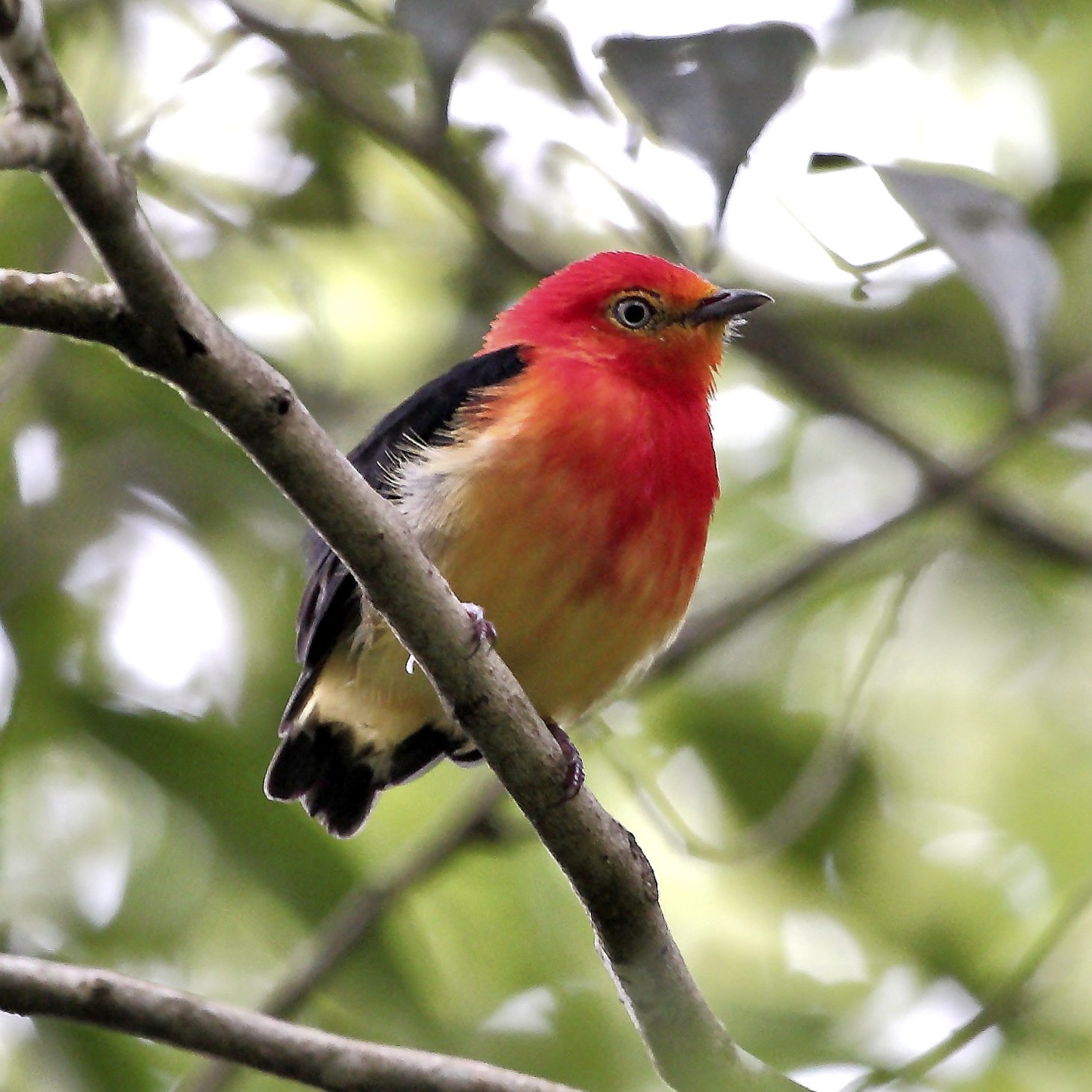
The Band-tailed Manakin is the southern counterpart of the Wire-tailed Manakin, with a red head, yellow underparts and a white band in the black tail. Males each display on their own branch, with rapid sideways hops and short flights. In northern Peru the two species form a zone with hybrids.
Voice
A nasal, descending neeeuw, often repeated, and dry snapping or buzzing wing sounds during display.
Recording: Jerome Fischer — CC BY-NC-SA 4.0 · xeno-canto
Identification
10–11 cm, with a short tail. The male has a red to orange-red crown and nape; the breast is red to orange in the guide area, the belly yellow, the back, wings and tail black. A white band crosses the middle of the tail, visible mainly from below and when the tail is spread. The iris is white. The female is olive-green, paler below with a yellowish belly and a pale iris. Young males resemble the female.
Confusion species
The male Wire-tailed Manakin Pipra filicauda has long tail wires, a yellow breast and no white tail band; it lives further north. Fiery-capped Manakin Machaeropterus pyrocephalus is smaller, with a yellow crown with a red central stripe and streaked underparts. Females of other manakins mostly have a dark iris.
Habitat
Várzea, forest along rivers and streams, transitional forest and the lower storey of humid lowland forest, also older secondary forest, from the lowlands to about 1000 m in the foothills. It lives in the understorey and middle storey and eats small fruits and insects.
Where the bird is most at home, classified by the vegetation units of the Andes and the west coast.


Range and movements
Peru: in the lowlands east of the Andes, north to about the Marañón region, where it intergrades with Wire-tailed Manakin. Bolivia: in the lowlands and foothills of the north and east. Absent from Colombia, Ecuador and the Galápagos. Outside the guide area in southern Amazonian Brazil, Paraguay and north-eastern Argentina.
- Resident
- dark = core range, pale = thinly spread
How and when to look
Search in forest along rivers and streams in the lowlands of Peru and Bolivia and listen for the nasal neeeuw. Males often sit on a fixed branch in the understorey.
Conservation status
Least Concern. The species is widespread and locally common.
Scientific name
Pipra fasciicauda | Hellmayr, 1906
Hellmayr described the species in 1906 and placed it straight away in the genus where it still stands. The genus Pipra was introduced in 1764 by Linnaeus. The genus name comes from Greek pipra, a name used by Aristotle and other Greek authors for a small bird; which species they meant is unclear. The species name comes from Latin fascia, 'band', and cauda, 'tail': 'band-tailed'. The specimen the first description was based on came from Guarayos, Santa Cruz, Bolivia.