All species › Passerines › Manakins › Wire-tailed Manakin
Wire-tailed Manakin | Pipra filicauda
Draadmanakin | Saltarín cola de alambre | Rabo-de-arame
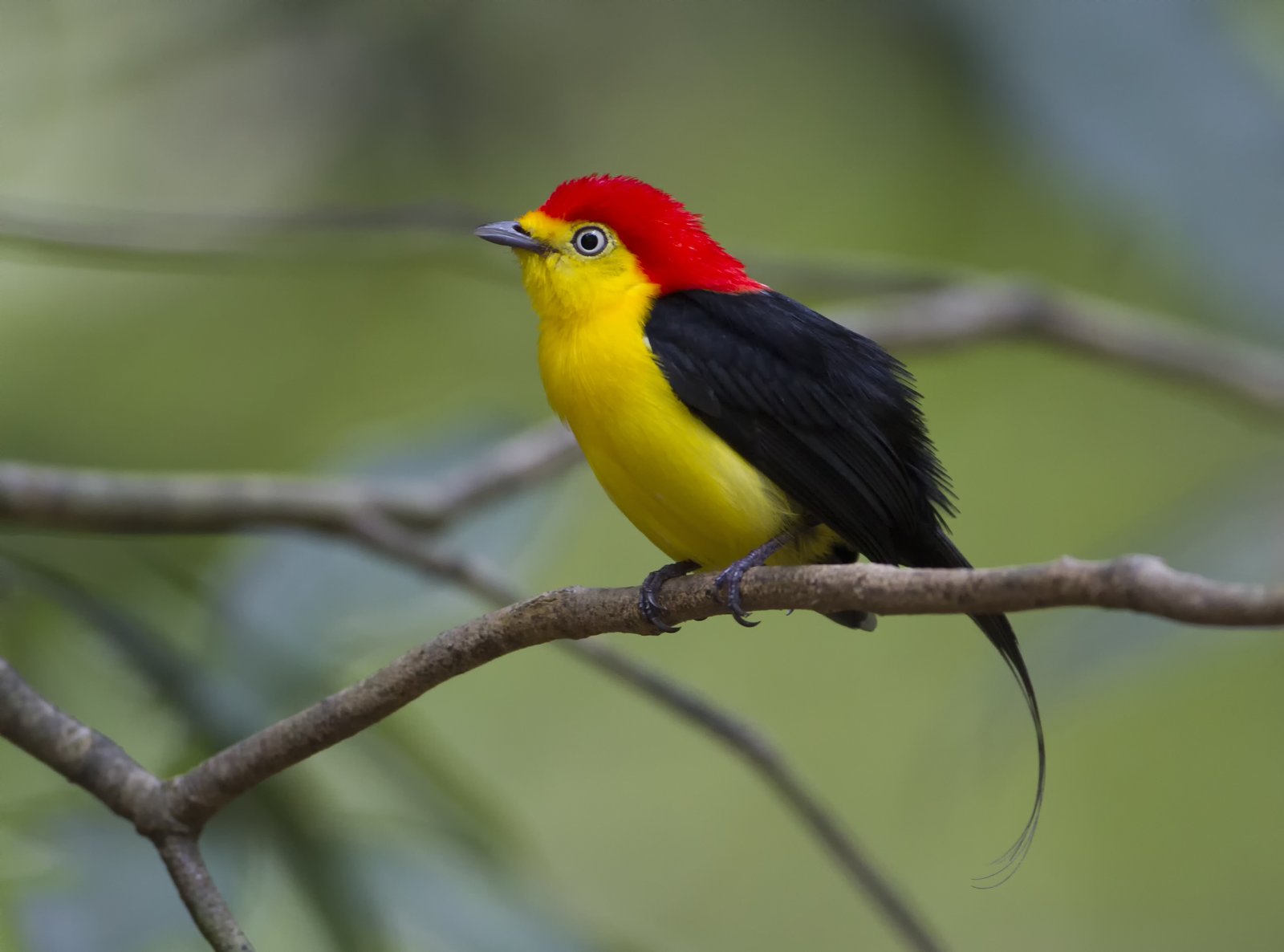
The Wire-tailed Manakin owes its name to the tail feathers, whose shafts extend into long, bare wires. The male is red, yellow and black and has a white iris. During display he brushes the female's chin with the tail wires.
Voice
A nasal, descending eeeuw or kweeeuw, and a short, dry trill. During display buzzing wing sounds.
Recording: Jerome Fischer — CC BY-NC-SA 4.0 · xeno-canto
Identification
11–12 cm, including the tail wires of about 4–5 cm in the male. The male has a scarlet crown and nape, black back, wings and tail, and bright yellow forehead, face and underparts. The iris is white. The female is olive-green, paler below with a yellow belly, has a pale iris and shorter tail wires. Young males resemble the female and first acquire red feathers on the head.
Confusion species
Band-tailed Manakin Pipra fasciicauda has no tail wires but a white band in the tail, and more red on the breast and head; it lives further south, and where the two meet in Peru hybrids occur. Females of other manakins have a dark iris and no tail wires. The female White-bearded Manakin Manacus manacus has orange legs.
Habitat
Várzea and other forest along rivers, swamp forest, gallery forest in the llanos and the lower storey of humid lowland forest, also older secondary forest, mostly below 500 m, locally higher. It lives in the understorey and middle storey and eats small fruits and insects. Males each display on their own perch, scattered through a stretch of forest.
Where the bird is most at home, classified by the vegetation units of the Andes and the west coast.


Range and movements
Colombia: in the lowlands east of the Andes, in the llanos and Amazonia. Ecuador: in the eastern lowlands. Peru: in the north-east, mainly north of the Amazon and Marañón. Absent from Bolivia and the Galápagos. Outside the guide area in Venezuela and western Brazil.
- Resident
- dark = core range, pale = thinly spread
How and when to look
Search along riverbanks and in várzea at low elevation. The nasal eeeuw gives away the male, which often sits for long periods on the same perch in the understorey.
Conservation status
Least Concern. The species is fairly common in most of its range.
Scientific name
Pipra filicauda | Spix, 1825
Spix described the species in 1825 and placed it straight away in the genus where it still stands. The genus Pipra was introduced in 1764 by Linnaeus. The genus name comes from Greek pipra, a name used by Aristotle and other Greek authors for a small bird; which species they meant is unclear. The species name comes from Latin filum, 'thread', and cauda, 'tail', after the wire-like tail feathers. The specimen the first description was based on came from São Paulo de Olivença, Amazonas, Brazil.