All species › Passerines › Manakins › White-bearded Manakin
White-bearded Manakin | Manacus manacus
Bonte manakin | Saltarín barbiblanco | Rendeira
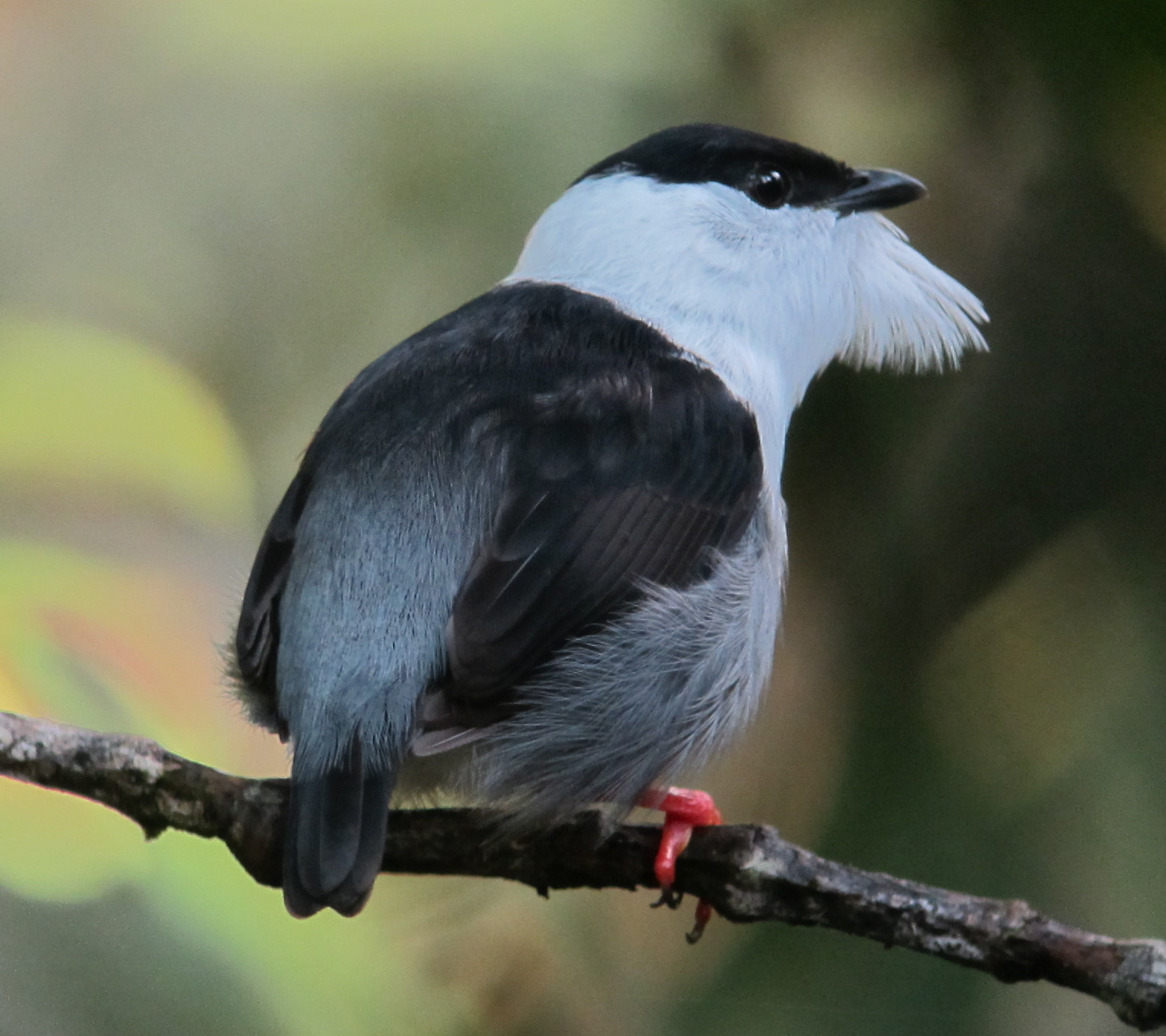
The White-bearded Manakin is a black-and-white manakin of forest edges and secondary forest in the lowlands. Males display in groups on small cleared spots on the forest floor, where they jump back and forth between thin saplings. While doing so they produce loud snaps and rattles with their wings, which carry far.
Voice
A sharp snap from the wings, like a firecracker, often in series, and a rattling rrrrr in flight. The call is a clear chee-poo or a rolled pirr.
Recording: Miguel Angelo Biz — CC BY-NC-SA 4.0 · xeno-canto
Identification
10–11 cm, compact, with a short tail and orange legs. The male has a black crown, back, wings and tail and a white throat and collar; the throat feathers are pushed forward as a beard during display. Rump grey, underparts white, greyish towards the belly. The female is olive-green, somewhat paler below with a yellowish wash on the belly, and also has orange legs. Young males resemble the female.
Confusion species
Golden-collared Manakin Manacus vitellinus has a yellow rather than white throat and collar in the male; it lives in north-western Colombia, where the two species meet and hybrids occur locally. Females of other manakins, such as White-crowned Manakin Pseudopipra pipra and Golden-headed Manakin Ceratopipra erythrocephala, have dark or grey legs instead of orange.
Habitat
Secondary forest, forest edges, dense thickets along rivers, old cacao and coffee plantings and the edge of várzea, from sea level to about 1000 m. It lives in the understorey and eats mainly small fruits, supplemented with insects. The nest is a shallow cup, low in a fork of a shrub.
Where the bird is most at home, classified by the vegetation units of the Andes and the west coast.


Range and movements
Colombia: widespread in the lowlands east of the Andes, in the Magdalena Valley, the Caribbean lowlands and in the south-west on the Pacific side; in the north-west replaced by Golden-collared Manakin. Ecuador: on both sides of the Andes in the lowlands, in the west south to about El Oro. Peru: in the lowlands east of the Andes. Bolivia: in the northern and eastern lowlands. Absent from the Galápagos. Outside the guide area from Venezuela and the Guianas to Paraguay and north-eastern Argentina, and on Trinidad.
- Resident
- dark = core range, pale = thinly spread
How and when to look
Listen along forest edges and in overgrown secondary forest for the snapping of the wings; it leads you to a display site. Males are active there for most of the morning and can be seen at close range.
Conservation status
Least Concern. The species is widespread and common, and partly benefits from secondary forest and forest edges.
Scientific name
Manacus manacus | (Linnaeus, 1766)
Linnaeus described the species in 1766 as [Pipra] manacus; because it was later moved to another genus, the author and year stand in brackets. The genus Manacus was introduced in 1760 by Brisson. The genus name comes from Dutch manneken, 'pretty little thing', which is also the source of the word 'manakin'. The specific name repeats the genus name, from Dutch manneken, 'pretty little thing'. The specimen the first description was based on came from Suriname.