All species › Swifts › Hummingbirds › Pale-tailed Barbthroat
Pale-tailed Barbthroat | Threnetes leucurus
Zwartkeelbaardkolibrie | Ermitaño barbudo colipálido | Balança-rabo-de-garganta-preta
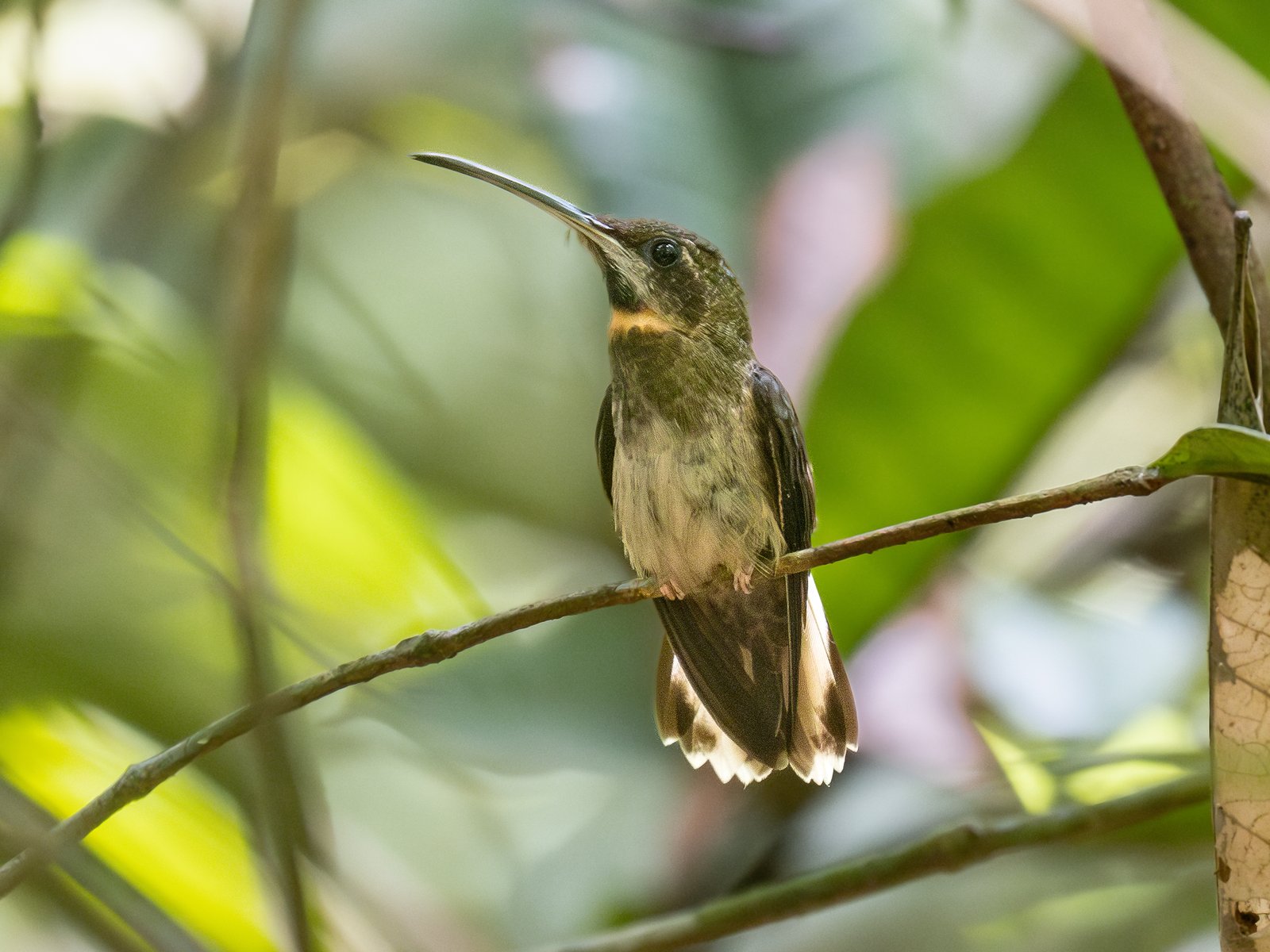
The Pale-tailed Barbthroat is an understorey hermit with a blackish throat, an orange-rufous breast band and pale outer tail feathers. It lives in heliconia thickets and the forest understorey of the Amazonian lowlands. Like other hermits it flies a fixed route along scattered flowers.
Voice
A high, thin tseep in flight; the song is a short, high series of squeaky notes, often from a low perch.
Recording: Dante Buzzetti — CC BY-NC-SA 4.0 · xeno-canto
Identification
10–12 cm, with a slightly decurved bill with a yellowish lower mandible. The upperparts are bronzy green. The face has a dark mask with a pale stripe above and a pale malar stripe below. The throat is blackish, with an orange-rufous to cinnamon breast band below it; the belly is grey. The outer tail feathers are white to pale buff, depending on the subspecies; the central feathers are green. The sexes are similar.
Confusion species
Rufous-breasted Hermit Glaucis hirsutus is entirely rufous below, without a blackish throat, and has a rufous tail with a black band. Band-tailed Barbthroat Threnetes ruckeri has a tail with a white base and a broad black band, and lives west of the Andes. Hermits of the genus Phaethornis have a long, pointed tail with white central feathers.
Habitat
Heliconia thickets, forest edges, river islands, várzea, secondary forest and the understorey of terra firme forest in the lowlands and foothills, up to about 1100 m. It visits mainly flowers of heliconias and other understorey plants. The nest hangs from the underside of a leaf, often of a heliconia or palm.
Where the bird is most at home, classified by the vegetation units of the Andes and the west coast.


Range and movements
In Colombia in the lowlands east of the Andes. In Ecuador in the eastern lowlands and foothills. In Peru in the Amazonian lowlands and the foothills of the eastern slope. In Bolivia in the lowlands of the north. Absent from the Galápagos. Outside the guide area in southern Venezuela, the Guianas and Amazonian Brazil.
- Resident
- dark = core range, pale = thinly spread
How and when to look
Wait at flowering heliconias along forest edges, riverbanks and clearings in the Amazonian lowlands. A bird returns to the same flowers at intervals.
Conservation status
Least Concern. The species has a large range and also uses secondary forest and forest edges.
Scientific name
Threnetes leucurus | (Linnaeus, 1766)
Linnaeus described the species in 1766 as Trochilus leucurus; because it was later moved to another genus, the author and year stand in brackets. The genus Threnetes was introduced in 1852 by Gould. The genus name comes from Greek thrēnētēs, 'mourner'. The specific name comes from Greek leukos, 'white', and oura, 'tail': white-tailed. The specimen the first description was based on came from Suriname.