All species › Swifts › Hummingbirds › Perija Starfrontlet
Perija Starfrontlet | Coeligena consita
Perijá-incakolibrie | Inca de Perijá | Inca-de-perijá
The Perija Starfrontlet lives only in the Serranía de Perijá, the mountain range on the border between Colombia and Venezuela. It was long regarded as a subspecies of Golden-bellied Starfrontlet and has recently been treated as a separate species. Its entire range is small and heavily degraded.
Voice
Poorly described; high, dry tsit notes as in related incas.
No recording with a suitable Creative Commons licence is available for this species yet.
Identification
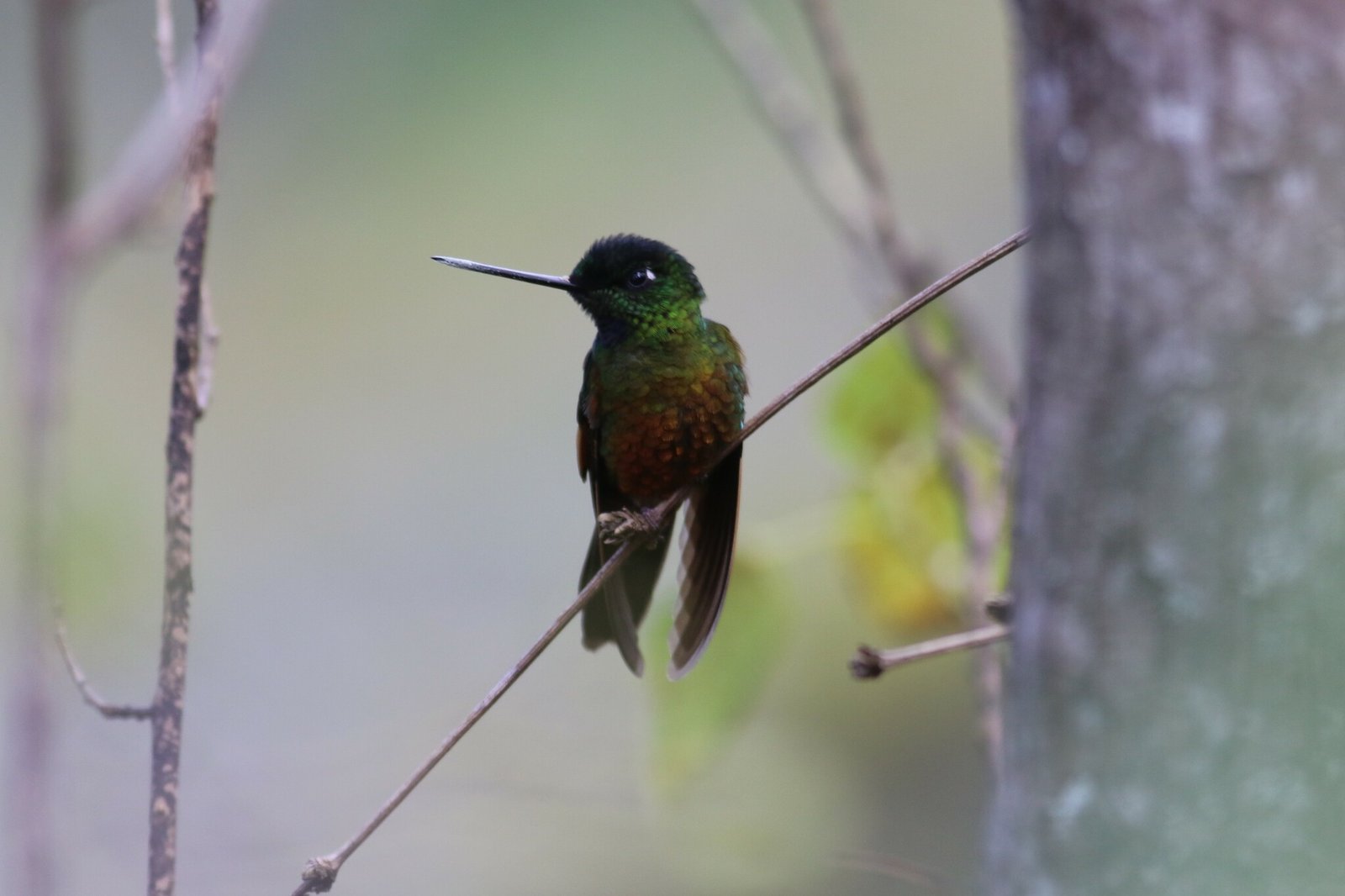
13–14 cm, with a long, straight, black bill. The male is green, with a glittering green forecrown and a small violet throat patch; towards the rear the back and rump become golden, and the underparts are glittering golden green, with an orange-gold gloss on the belly. The tail is golden bronze. The female is green above, with a cinnamon throat and golden-green-spotted underparts. The difference from Golden-bellied Starfrontlet lies in details of the gloss on rump and belly; in the field, range is the main criterion.
Confusion species
Golden-bellied Starfrontlet Coeligena bonapartei is almost identical, but lives in the Eastern Cordillera, not in the Serranía de Perijá. Blue-throated Starfrontlet Coeligena helianthea is much darker, with a blue throat patch and a rosy gloss on the belly. Collared Inca Coeligena torquata has a white breast shield and a white tail.
Habitat
Humid montane forest, cloud forest and their edges, also scrub and forest remnants at the edge of the páramo, at roughly 2000 to 3200 m. It visits long-tubed flowers in the lower and middle levels of the forest. Little is known about the nest.
Where the bird is most at home, classified by the vegetation units of the Andes and the west coast.


Range and movements
In Colombia only in the Serranía de Perijá, on the border of the departments of Cesar and La Guajira. Absent from Ecuador, Peru, Bolivia and the Galápagos. Outside the guide area on the Venezuelan side of the same range.
- Resident
- dark = core range, pale = thinly spread
How and when to look
The Chamicero de Perijá reserve above Manaure in Cesar protects part of the high forest of the Serranía de Perijá. Look for the species at flowering shrubs along forest edges and clearings.
Conservation status
Endangered. The range is very small and the montane forest of the Serranía de Perijá has largely been cleared for farming and cattle; only part of it is protected.
Scientific name
Coeligena consita | Wetmore & Phelps, 1952
Wetmore & Phelps described the species in 1952 and placed it straight away in the genus where it still stands. The genus Coeligena was introduced in 1833 by Lesson. The genus name comes from Latin coeligenus, 'heaven-born' or 'celestial'. The species name comes from Latin consitus, 'connecting' (from conserere, 'to connect'); according to the describers Wetmore and Phelps, the birds of the Sierra de Perijá link two related hummingbirds. The specimen the first description was based on came from Sierra de Perijá (Colombia–Venezuela).