All species › Swifts › Hummingbirds › Buff-winged Starfrontlet
Buff-winged Starfrontlet | Coeligena lutetiae
Bruinvleugelincakolibrie | Inca alihabano | Inca-de-asa-amarelada
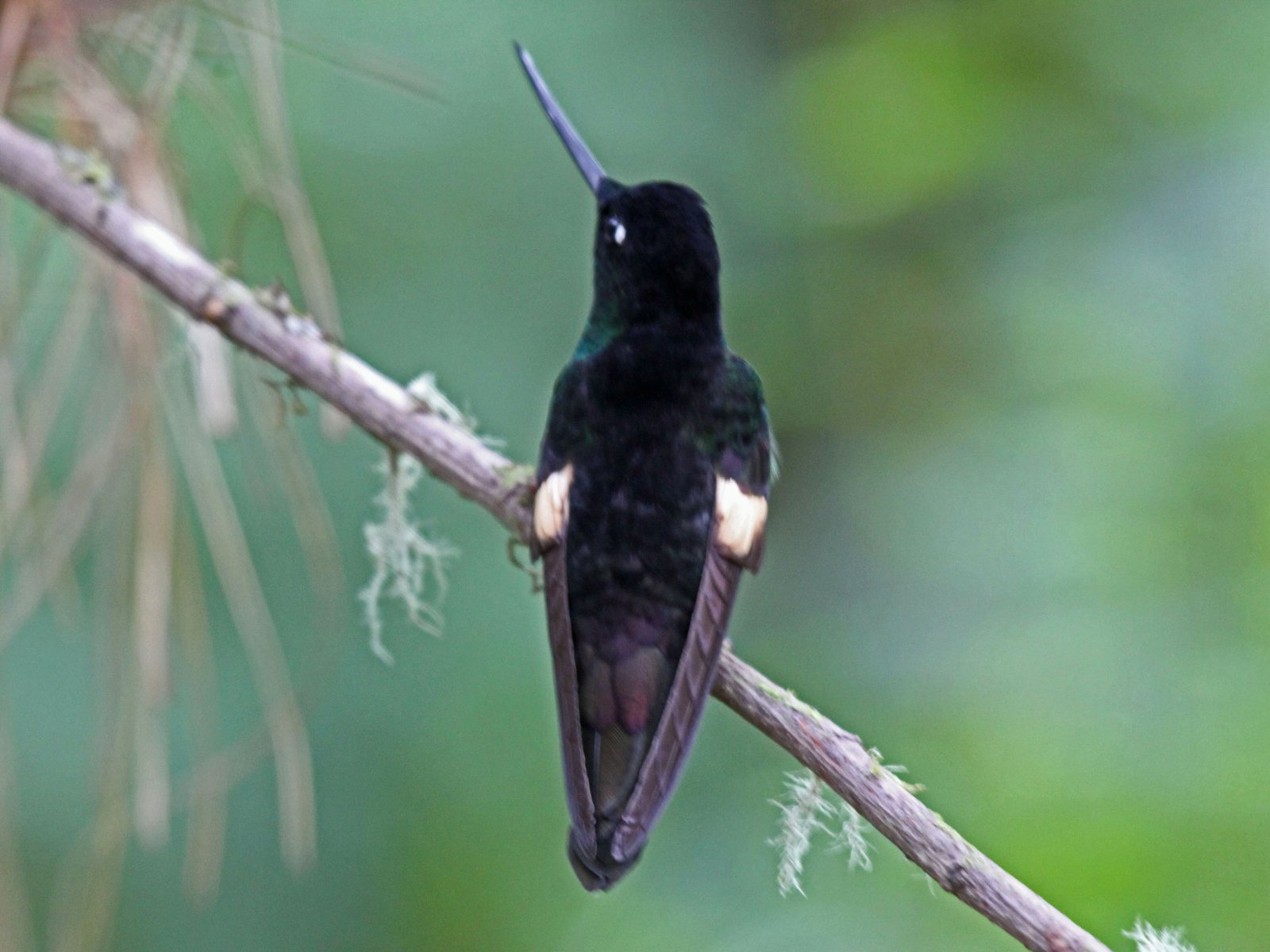
The Buff-winged Starfrontlet is a dark inca of the highest cloud forest of the northern Andes, recognised at once by a buff patch in the wing. It lives near the treeline and in scrub at the edge of the páramo. At feeders in high montane forest in Ecuador it is a regular visitor.
Voice
A dry, high tsit or tsik, often when moving between flowers; in chases a rapid, rasping series.
Recording: David Monroy Rengifo — CC BY-NC-SA 4.0 · xeno-canto
Identification
14–15 cm, with a long, straight, black bill. The male is velvety black to very dark green, with a glittering green forecrown, a small violet-blue throat patch and a green gloss on the belly. The secondaries form a clear buff patch on the closed wing, showing as a pale band in flight. The tail is dark and slightly forked. The female is green above, with a cinnamon throat and green-spotted underparts, and has the same buff wing patch.
Confusion species
Dusky Starfrontlet Coeligena orina lacks the buff wing patch and lives only in the Western Cordillera in Antioquia. Rainbow Starfrontlet Coeligena iris has cinnamon-rufous wings and tail. Collared Inca Coeligena torquata has a white breast shield and a white tail. Great Sapphirewing Pterophanes cyanopterus is much larger, with blue wings.
Habitat
High cloud forest, elfin forest, forest edges and scrub at the edge of the páramo, mostly between about 2600 and 3600 m. It visits long-tubed flowers of shrubs and epiphytes and takes small insects. It comes to feeders. The nest is a cup of moss in a sheltered spot.
Where the bird is most at home, classified by the vegetation units of the Andes and the west coast.


Range and movements
In Colombia in the Central Cordillera and in the Andes of the south-west, in Cauca and Nariño. In Ecuador on both slopes of the Andes. In Peru only in the far north, west of the Marañón. Absent from Bolivia and the Galápagos. Does not occur outside the guide area.
- Resident
- dark = core range, pale = thinly spread
How and when to look
At the feeders of the Yanacocha reserve above Quito in Ecuador, and along trails through high forest near the Papallacta pass. Watch for the buff wing patch when a dark inca flies off.
Conservation status
Least Concern. High montane forest is cleared and burnt locally, but the species is fairly common in protected areas.
Scientific name
Coeligena lutetiae | (Delattre & Bourcier, 1846)
Delattre & Bourcier described the species in 1846 as Trochilus Lutetiae; because it was later moved to another genus, the author and year stand in brackets. The genus Coeligena was introduced in 1833 by Lesson. The genus name comes from Latin coeligenus, 'heaven-born' or 'celestial'. The species name comes from Lutetia, the ancient name of Paris, capital of the Gaulish Parisii; another explanation links the name to Louis Philippe Albert d'Orléans, Count of Paris. The specimen the first description was based on came from Volcán Puracé, Cauca, Colombia.