All species › Swifts › Hummingbirds › Dusky Starfrontlet
Dusky Starfrontlet | Coeligena orina
Donkere incakolibrie | Inca de Antioquia | Inca-escuro
The Dusky Starfrontlet is a rare inca of the highest parts of the Western Cordillera in Antioquia, Colombia. After its description in the mid-20th century it went unrecorded for decades, until it was rediscovered in 2004 in the páramo of Frontino. Its entire world range covers only a few mountain tops.
Voice
Poorly described; high, dry tsit notes as in related incas.
Recording: A Edwar H Guarín — CC BY-NC-SA 4.0 · xeno-canto
Identification
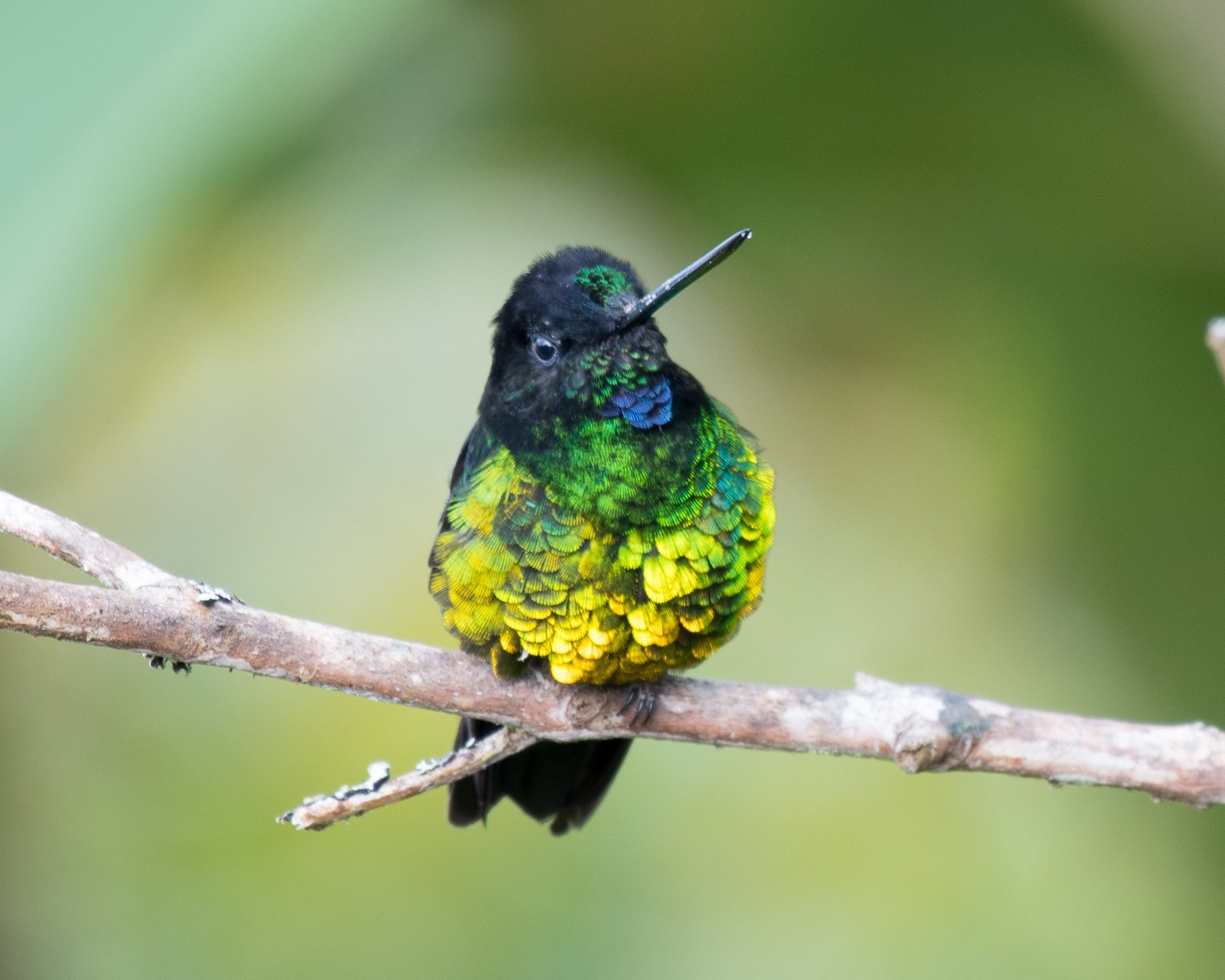
14 cm, with a long, straight, black bill. The male is very dark, blackish green, with a glittering green forecrown and a small, glittering blue throat patch; the tail is dark and slightly forked. The female is green above, with a cinnamon throat and paler, green-spotted underparts. Unlike Buff-winged Starfrontlet it lacks a pale wing patch.
Confusion species
Buff-winged Starfrontlet Coeligena lutetiae is very similar, but has an obvious buff patch in the wing and lives in the Central Cordillera and further south. Collared Inca Coeligena torquata has a white breast shield and a white tail. Tyrian Metaltail Metallura tyrianthina is much smaller, with a short bill and a rufous tail.
Habitat
Elfin forest and the upper edge of cloud forest, grading into scrub and páramo, at roughly 3100 to 3600 m. It visits long-tubed flowers of ericads and other shrubs near the treeline. Little is known about the nest.
Where the bird is most at home, classified by the vegetation units of the Andes and the west coast.


Range and movements
In Colombia only in the Western Cordillera in Antioquia, notably in the páramo of Frontino near Urrao and on a few neighbouring peaks. Absent from Ecuador, Peru, Bolivia and the Galápagos. Does not occur outside the guide area.
- Resident
- dark = core range, pale = thinly spread
How and when to look
The Colibrí del Sol reserve near Urrao in Antioquia protects part of its habitat and has feeders. Arrange a visit with the reserve's managers; the habitat lies high up and can only be reached on foot.
Conservation status
Endangered. Its habitat is very small and fragmented and is threatened by clearance for cattle, fire and mining; part of it is protected in a private reserve.
Scientific name
Coeligena orina | Wetmore, 1953
Wetmore described the species in 1953 and placed it straight away in the genus where it still stands. The genus Coeligena was introduced in 1833 by Lesson. The genus name comes from Latin coeligenus, 'heaven-born' or 'celestial'. The species name comes from the Greek prefix o-, denoting strength, and rhis, rhinos, 'nose'; according to the describer Wetmore, the bill is longer and more slender than in Coeligena bonapartei. The specimen the first description was based on came from Páramo de Frontino, Antioquia, Colombia.