All species › Swifts › Hummingbirds › White-tailed Starfrontlet
White-tailed Starfrontlet | Coeligena phalerata
Witstaartincakolibrie | Inca coliblanco | Inca-de-cauda-branca
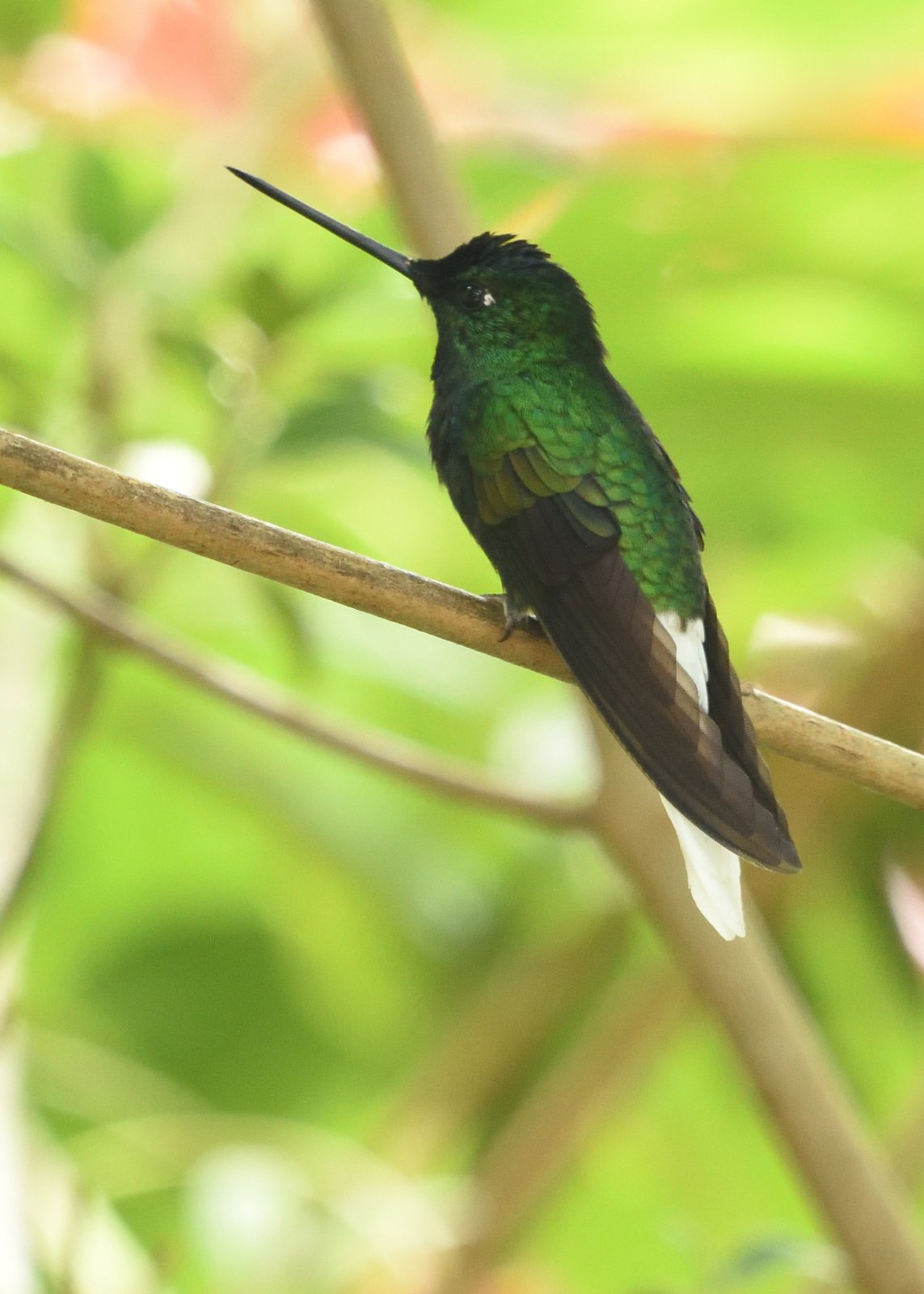
The White-tailed Starfrontlet occurs only in the Sierra Nevada de Santa Marta in northern Colombia. The male is the only male inca with an almost entirely white tail and no white breast shield. It lives in cloud forest and at the edges of the páramo of this isolated range.
Voice
High, dry tsit notes, often repeated, mainly while feeding and in chases.
Recording: Niels Krabbe — CC BY-NC-SA 4.0 · xeno-canto
Identification
13–14 cm, with a long, straight, black bill. The male is glossy green, with a glittering blue forecrown and a small, glittering violet-blue throat patch; the tail is white apart from the central feathers. The female is green above and rufous to cinnamon below, with a bronzy green tail lacking white.
Confusion species
No other inca occurs in the Sierra Nevada de Santa Marta. White-booted Racket-tail Ocreatus underwoodii is much smaller, with a short bill. The female resembles those of other incas with cinnamon underparts, but these do not live in this range.
Habitat
Humid montane and cloud forest, elfin forest, forest edges and scrub at the edge of the páramo, mostly between about 2000 and 3700 m. It feeds mainly in the lower and middle levels at long-tubed flowers; the male locally defends flowering shrubs. After the breeding season some descend to lower elevations. The nest is a cup of moss in a sheltered spot.
Where the bird is most at home, classified by the vegetation units of the Andes and the west coast.


Range and movements
In Colombia only in the Sierra Nevada de Santa Marta, in the departments of Magdalena, Cesar and La Guajira. Absent from Ecuador, Peru, Bolivia and the Galápagos. Does not occur outside the guide area.
- Resident
- dark = core range, pale = thinly spread
How and when to look
Along the mountain road to the San Lorenzo ridge and at the El Dorado reserve above Minca, especially at feeders and flowering shrubs along the forest edge. The male's white tail stands out as it hovers between flowers.
Conservation status
Near Threatened. The range is small and confined to a single mountain massif, where forest has been lost to fire, clearing and agriculture; part of it lies within a national park.
Scientific name
Coeligena phalerata | (Bangs, 1898)
Bangs described the species in 1898 as Leucuria phalerata; because it was later moved to another genus, the author and year stand in brackets. The genus Coeligena was introduced in 1833 by Lesson. The genus name comes from Latin coeligenus, 'heaven-born' or 'celestial'. The species name comes from Latin phaleratus, 'decorated with trappings', for the striking markings. The specimen the first description was based on came from Sierra Nevada de Santa Marta, Colombia.