All species › Swifts › Hummingbirds › Rainbow Starfrontlet
Rainbow Starfrontlet | Coeligena iris
Regenboogincakolibrie | Inca arcoíris | Inca-arco-íris
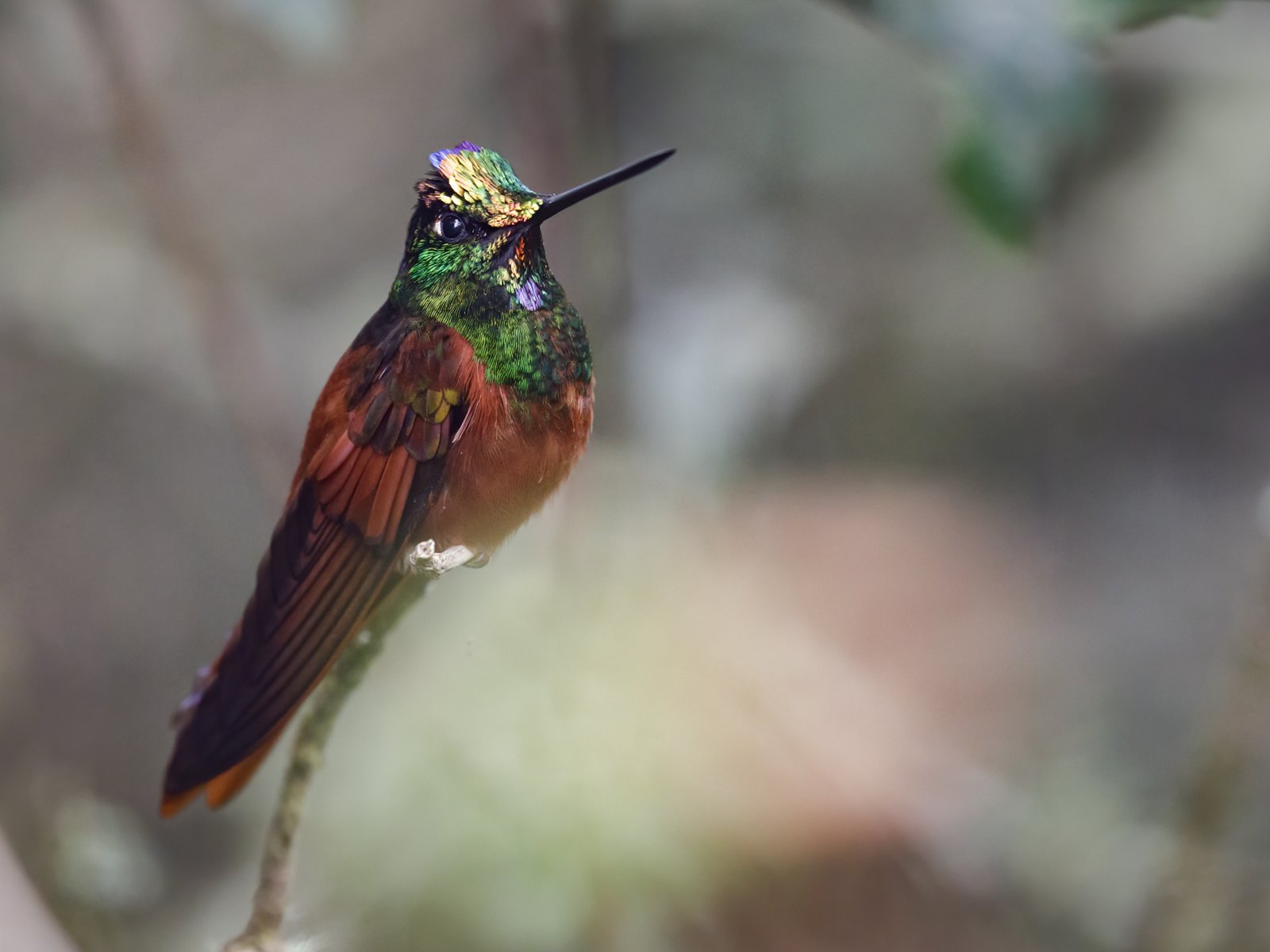
The Rainbow Starfrontlet is a large inca of the Andes of southern Ecuador and northern Peru, with much cinnamon-rufous in the wings and tail and a head that differs in colour between forms. More than other incas it lives in semi-open scrub and at forest edges. The name refers to the sequence of colours on crown, back and rump.
Voice
A dry, high tsit or chip, often when leaving a flower; in chases a rapid, shrill series.
Recording: Niels Krabbe — CC BY-SA 4.0 · xeno-canto
Identification
14 cm, with a long, straight, black bill. The male has a blackish head with a glittering forecrown, varying between forms from golden green to blue or reddish, and a small violet throat patch. The back changes from green to golden or coppery on the rump; the underparts are glittering golden green. The wings and tail are largely cinnamon-rufous. The female is duller, with a cinnamon throat and less gloss, but also has the cinnamon-rufous wings and tail.
Confusion species
Buff-winged Starfrontlet Coeligena lutetiae is blackish, with a pale patch in the wing and a dark tail. Bronzy Inca Coeligena coeligena is uniform bronzy brown, without a cinnamon-rufous tail. Shining Sunbeam Aglaeactis cupripennis also has rufous in the tail, but a short bill. Collared Inca Coeligena torquata has a white breast shield.
Habitat
Edges of humid montane forest, scrub, hedgerows and semi-open slopes with shrubs, also gardens and the scrub of jalca and páramo, mostly between about 2200 and 3400 m. It visits long-tubed flowers, also in gardens and along roads, and takes small insects. It comes to feeders. The nest is a cup of moss and plant down in a sheltered spot.
Where the bird is most at home, classified by the vegetation units of the Andes and the west coast.


Range and movements
Absent from Colombia. In Ecuador in the Andes of the south, roughly from Chimborazo and Azuay to Loja and Zamora-Chinchipe. In Peru in the Andes of the north, south to about La Libertad and Áncash. Absent from Bolivia and the Galápagos. Does not occur outside the guide area.
- Resident
- dark = core range, pale = thinly spread
How and when to look
At forest edges and feeders in southern Ecuador, such as at Cajanuma in Podocarpus National Park and in the Utuana reserve in Loja. Watch for the cinnamon-rufous tail and wings of a large inca along the edge of scrub.
Conservation status
Least Concern. The species also uses scrub and gardens, but high montane forest within its range is heavily fragmented in places.
Scientific name
Coeligena iris | (Gould, 1853)
Gould described the species in 1853 as Helianthea Iris; because it was later moved to another genus, the author and year stand in brackets. The genus Coeligena was introduced in 1833 by Lesson. The genus name comes from Latin coeligenus, 'heaven-born' or 'celestial'. The species name comes from Greek iris, 'rainbow', also the name of the rainbow goddess, for the many-coloured sheen. The specimen the first description was based on came from Eastern Andean slopes (per the description).