All species › Swifts › Hummingbirds › Violet-throated Starfrontlet
Violet-throated Starfrontlet | Coeligena violifer
Violetkeelincakolibrie | Inca gorgimorado | Inca-de-garganta-violeta
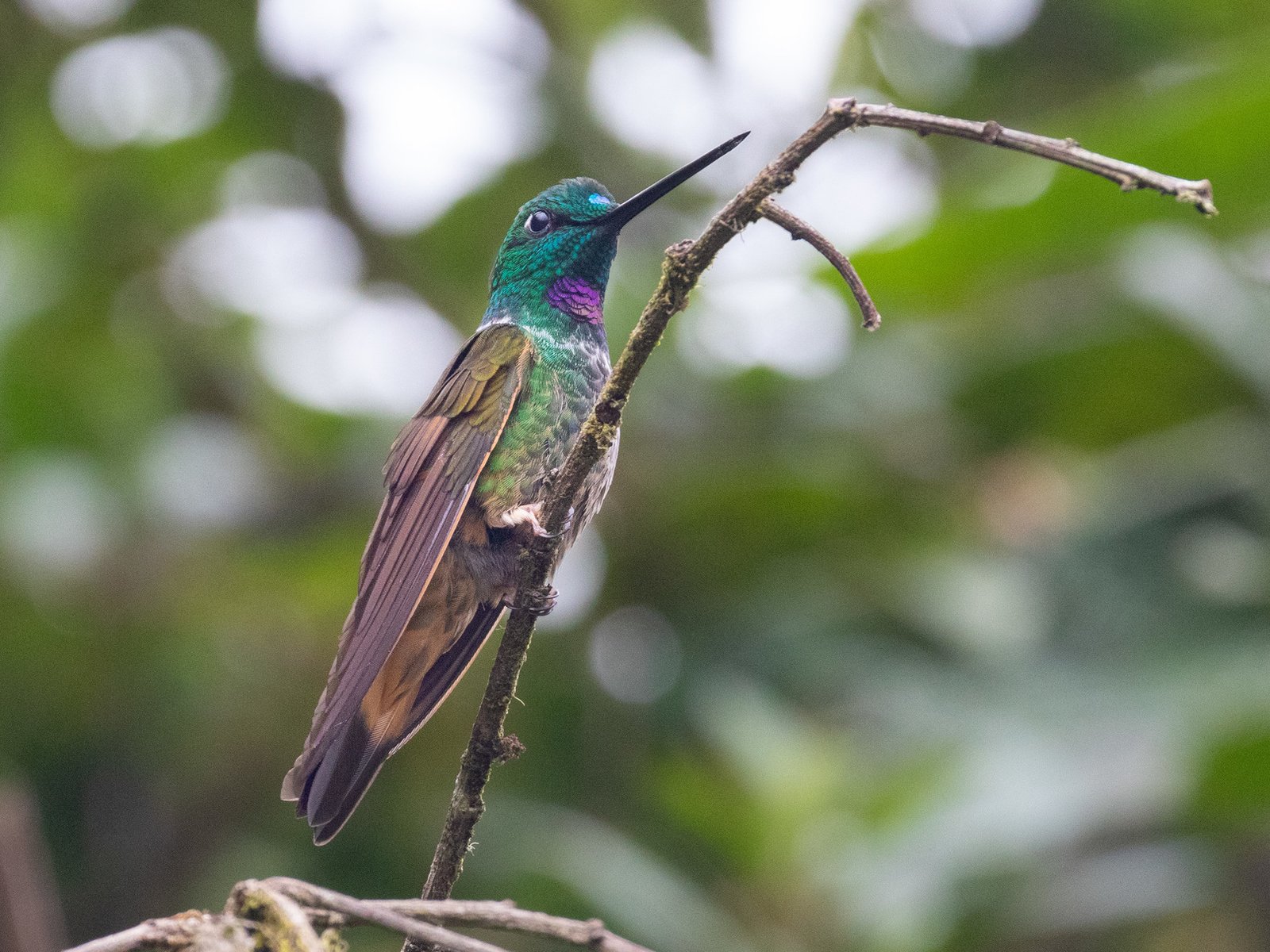
The Violet-throated Starfrontlet is the inca of high montane forest in central and southern Peru and Bolivia. The male has a glittering forecrown and a small violet throat patch, and the tail is cinnamon, buff or whitish depending on the form. It lives mainly near the treeline, where forest gives way to scrub and grassland.
Voice
A dry, high tsit, often repeated, and in chases a rapid, twittering series.
Recording: Sjoerd Mayer — CC BY-NC-SA 3.0 · xeno-canto
Identification
14–15 cm, with a long, straight, black bill. The male is green, with a glittering blue-green forecrown, a small, glittering violet throat patch and often a warm brown or cinnamon tinge to the belly. The tail is pale, from cinnamon and buff in Bolivia and southern Peru to whitish in parts of central Peru, with dark tips or central feathers. The female lacks the throat patch and is cinnamon below, with green spotting on the flanks.
Confusion species
Collared Inca Coeligena torquata has a white breast shield and a white tail with dark tips. Bronzy Inca Coeligena coeligena is bronzy brown, with a dark tail, and usually lives lower. Shining Sunbeam Aglaeactis cupripennis is also warm brown below, but has a short bill. Great Sapphirewing Pterophanes cyanopterus is larger and has blue wings.
Habitat
High montane and cloud forest, elfin forest, their edges and scrub just below and above the treeline, also Polylepis groves, mostly between about 2500 and 3600 m. It visits long-tubed flowers of shrubs and epiphytes and takes small insects. The nest is a cup of moss in a sheltered spot, as in other incas.
Where the bird is most at home, classified by the vegetation units of the Andes and the west coast.


Range and movements
Absent from Colombia and Ecuador. In Peru on the eastern slope of the Andes and in the higher parts of the inter-Andean valleys, from about Huánuco south to Puno. In Bolivia on the eastern slope of the Andes in La Paz and Cochabamba. Absent from the Galápagos. Does not occur outside the guide area.
- Resident
- dark = core range, pale = thinly spread
How and when to look
Along mountain roads through high montane forest, such as at Abra Málaga in Cuzco (Peru) and along the old Yungas road above Coroico in La Paz (Bolivia). Watch for the pale tail when a bird feeds at flowering shrubs along the forest edge.
Conservation status
Not Evaluated in this circumscription. The IUCN splits the species in two: the form of central Peru (Coeligena dichroura) and that of southern Peru and Bolivia (Coeligena violifer in the narrow sense). Both have fairly large ranges and are not considered threatened; locally, high montane forest is lost to logging and fire.
Scientific name
Coeligena violifer | (Gould, 1846)
Gould described the species in 1846 as Trochilus (--?) violifer; because it was later moved to another genus, the author and year stand in brackets. The genus Coeligena was introduced in 1833 by Lesson. The genus name comes from Latin coeligenus, 'heaven-born' or 'celestial'. The species name comes from Latin viola, 'violet', and -fer, 'bearing', for the violet throat patch. The specimen the first description was based on came from Sandillani, Yungas, La Paz, Bolivia.