All species › Swifts › Hummingbirds › Collared Inca
Collared Inca | Coeligena torquata
Gekraagde incakolibrie | Inca collarejo | Inca-de-colar
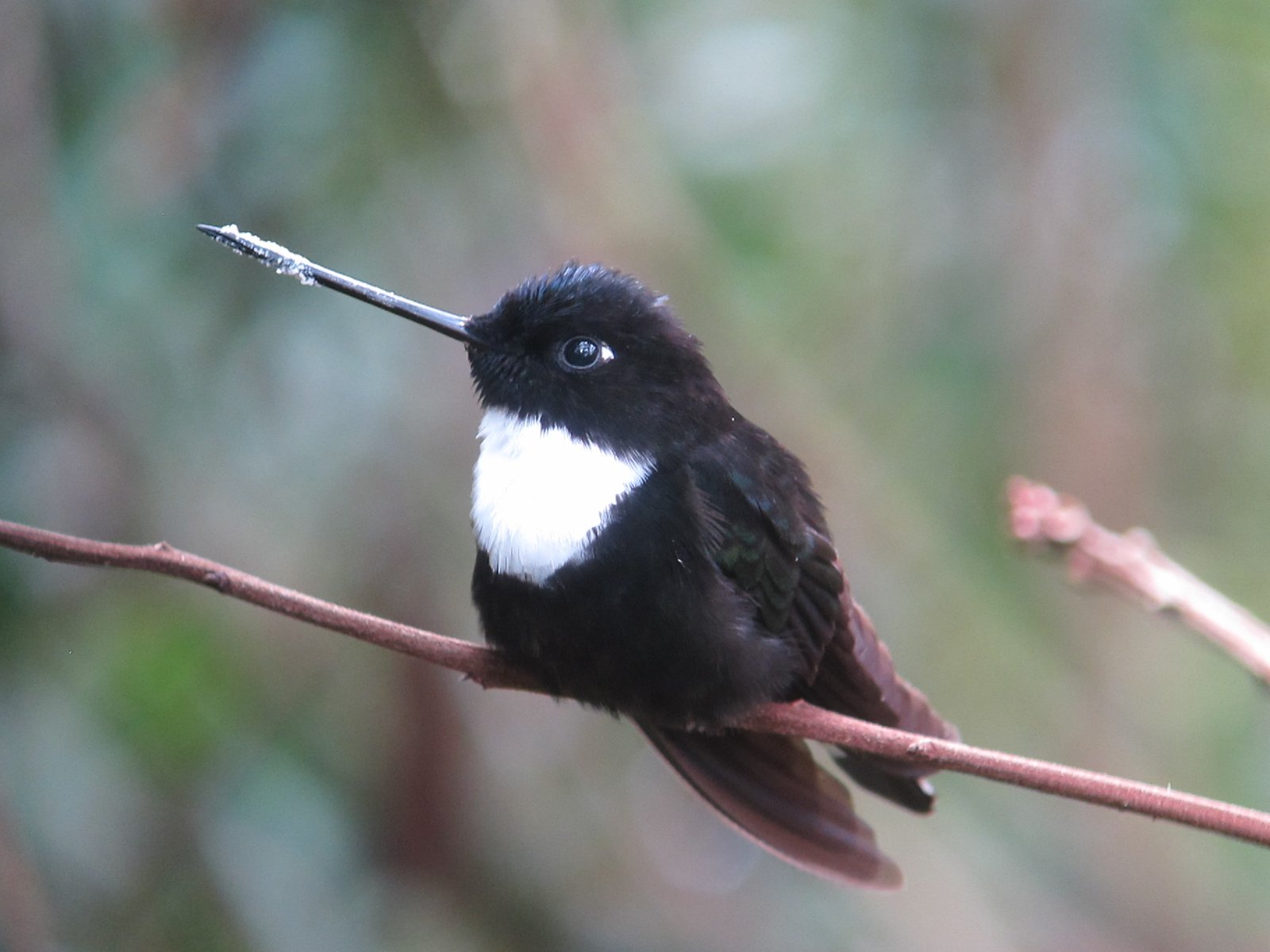
The Collared Inca is a large, dark hummingbird of humid montane forest in the Andes, with a conspicuous white breast shield and much white in the tail. It feeds mainly in the lower and middle levels of the forest and follows a regular route along flowering plants. It is the most widespread inca in the guide area.
Voice
Usually a short, dry, high tsit or tik, often when moving between flowers. In chases a rapid series of high, twittering notes.
Recording: John V. Moore — CC BY-NC-SA 4.0 · xeno-canto
Identification
14–15 cm, with a long, straight, black bill of just over 3 cm. The male is mostly blackish green, with a small, glittering violet-blue spot on the forecrown and a bright white breast shield. The tail is white with dark central feathers and dark tips; in flight the white flashes clearly. The female is greener, with a whitish, green-spotted throat and a less sharply defined white breast shield. In southern Peru and Bolivia (the form inca) the body is greener and the violet crown spot is lacking.
Confusion species
Bronzy Inca Coeligena coeligena is bronzy brown, without white on the breast and tail. Brown Inca Coeligena wilsoni lives lower on the western slope, is brownish and has only a small white patch on the side of the breast. Violet-throated Starfrontlet Coeligena violifer lacks the white breast shield and has a pale, cinnamon or whitish tail. Sword-billed Hummingbird Ensifera ensifera has a much longer bill.
Habitat
The interior and edges of humid montane and cloud forest, also older secondary growth and shrubby ravines, mostly between about 1800 and 3000 m, locally higher. It visits flowers with long tubes, such as those of fuchsias, ericads and bromeliads, and takes small insects. It comes to feeders. The nest is a cup of moss and plant down, often attached to a hanging root or twig in a sheltered spot.
Where the bird is most at home, classified by the vegetation units of the Andes and the west coast.


Range and movements
In Colombia in all three cordilleras. In Ecuador on both slopes of the Andes. In Peru along the eastern slope of the Andes over almost the entire length of the country. In Bolivia on the eastern slope of the Andes in La Paz and Cochabamba. Absent from the Galápagos. Outside the guide area in the Andes of western Venezuela.
- Resident
- dark = core range, pale = thinly spread
How and when to look
At feeders of lodges and reserves in cloud forest, such as Guango on the eastern slope in Ecuador. Inside the forest mainly in the lower levels and along trails; watch for the white tail flashes as a bird moves between flowers.
Conservation status
Not Evaluated in this circumscription. The IUCN treats the form of southern Peru and Bolivia as a separate species, Gould's Inca Coeligena inca; both are assessed as Least Concern. Deforestation of montane forest affects its habitat locally.
Scientific name
Coeligena torquata | (Boissonneau, 1840)
Boissonneau described the species in 1840 as Ornismia torquata; because it was later moved to another genus, the author and year stand in brackets. The genus Coeligena was introduced in 1833 by Lesson. The genus name comes from Latin coeligenus, 'heaven-born' or 'celestial'. The species name comes from Latin torquatus, 'collared', for the white breast band. The specimen the first description was based on came from Bogotá, Colombia.