All species › Swifts › Hummingbirds › Black Inca
Black Inca | Coeligena prunellei
Zwarte incakolibrie | Inca negro | Inca-preto
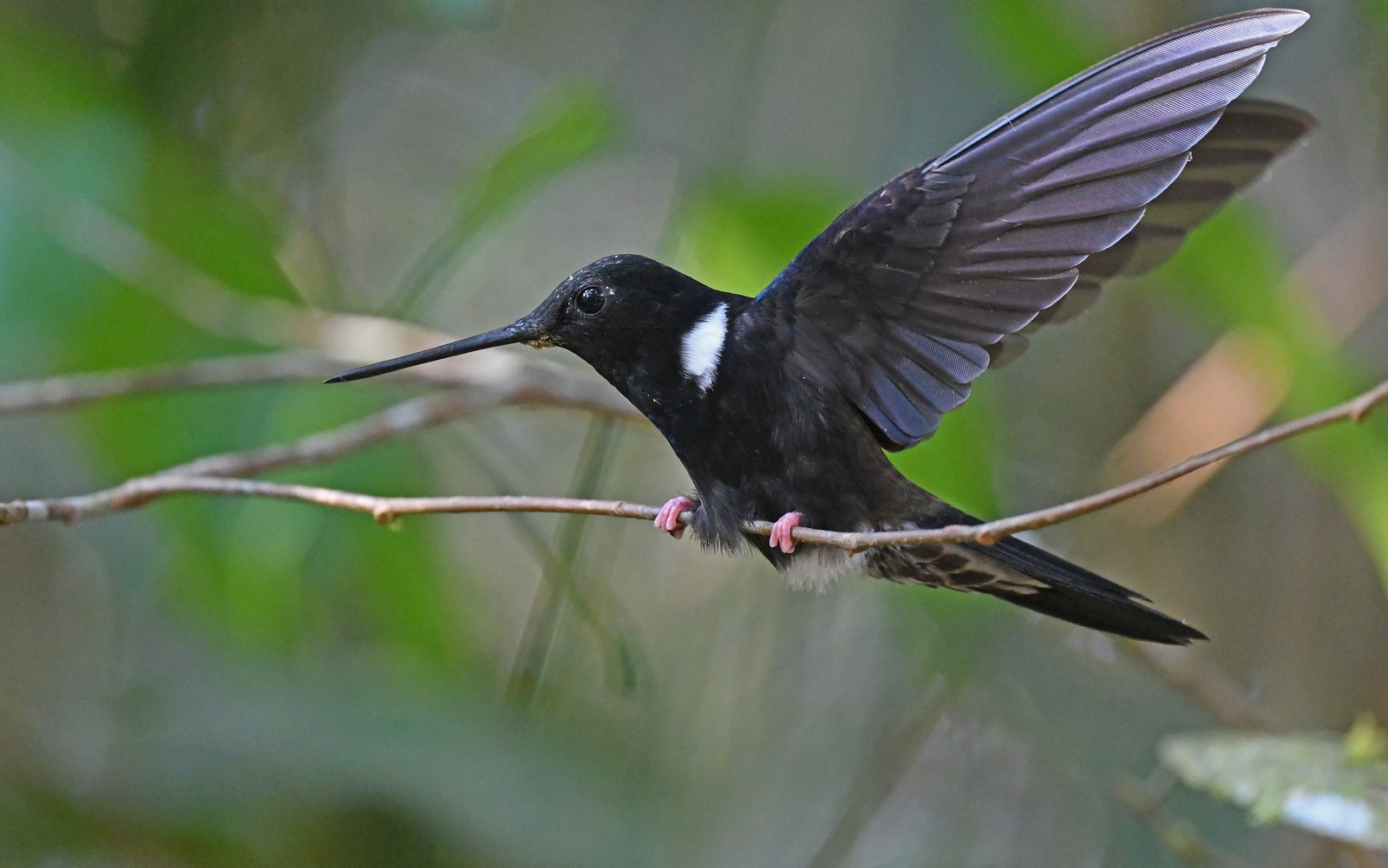
The Black Inca is an almost entirely black inca found only in the Eastern Cordillera of Colombia. It lives in humid montane forest, especially forest with Andean oak (Quercus humboldtii), on the western slope of that range. White patches on the sides of the breast and a blue-glittering throat spot mark the otherwise dark plumage.
Voice
It gives a high, repeated tsit. During chases a rapid chatter.
Recording: Simon Mills — CC BY-NC-SA 4.0 · xeno-canto
Identification
14 cm, with a long, straight, black bill of about 3 cm. The plumage is mostly black, with a blue-green sheen on the shoulders and a small, blue-glittering throat spot. On each side of the breast there is a distinct white patch. The tail is black and slightly forked. A small white spot behind the eye. The female resembles the male, but is slightly duller, with a smaller throat spot.
Confusion species
Within its small range there is little confusion. Collared Inca Coeligena torquata has a broad white breast band and white tail sides. Brown Inca Coeligena wilsoni also has white breast patches, but is brown and lives on the western slope of the Western Cordillera. Blue-throated Starfrontlet Coeligena helianthea lives higher in the same range and is dark with a rosy to violet glittering belly and a glittering green rump.
Habitat
Humid montane forest and cloud forest, especially oak forest with Quercus humboldtii, and their edges, also older secondary forest, mostly between about 1500 and 2600 m. It feeds low to mid-level in the forest along a fixed route of flowers, mainly of heaths and epiphytes, and catches small insects. Little has been published about the nest.
Where the bird is most at home, classified by the vegetation units of the Andes and the west coast.


Range and movements
Only in Colombia: on the western slope of the Eastern Cordillera, in Santander, Boyacá and Cundinamarca. Absent from Ecuador, Peru, Bolivia and the Galápagos. It does not occur outside the guide area.
- Resident
- dark = core range, pale = thinly spread
How and when to look
Look in the remaining oak forests on the western slope of the Eastern Cordillera in Santander and Boyacá, at flowering shrubs in the understorey and along forest edges. A bird often returns to the same flowers along its route.
Conservation status
Vulnerable. The range is small and fragmented; montane forest on the western slope of the Eastern Cordillera has largely been cleared for agriculture and cattle.
Scientific name
Coeligena prunellei | (Bourcier, 1843)
Bourcier described the species in 1843 as Trochilus Prunellei; because it was later moved to another genus, the author and year stand in brackets. The genus Coeligena was introduced in 1833 by Lesson. The genus name comes from Latin coeligenus, 'heaven-born' or 'celestial'. The species name honours Clément François Victor Gabriel Prunelle (1777–1853), French physician, classicist and politician, mayor of Lyon. The specimen the first description was based on came from Facatativá, Cundinamarca, Colombia.