All species › Swifts › Hummingbirds › Brown Inca
Brown Inca | Coeligena wilsoni
Bruine incakolibrie | Inca pardo | Inca-pardo
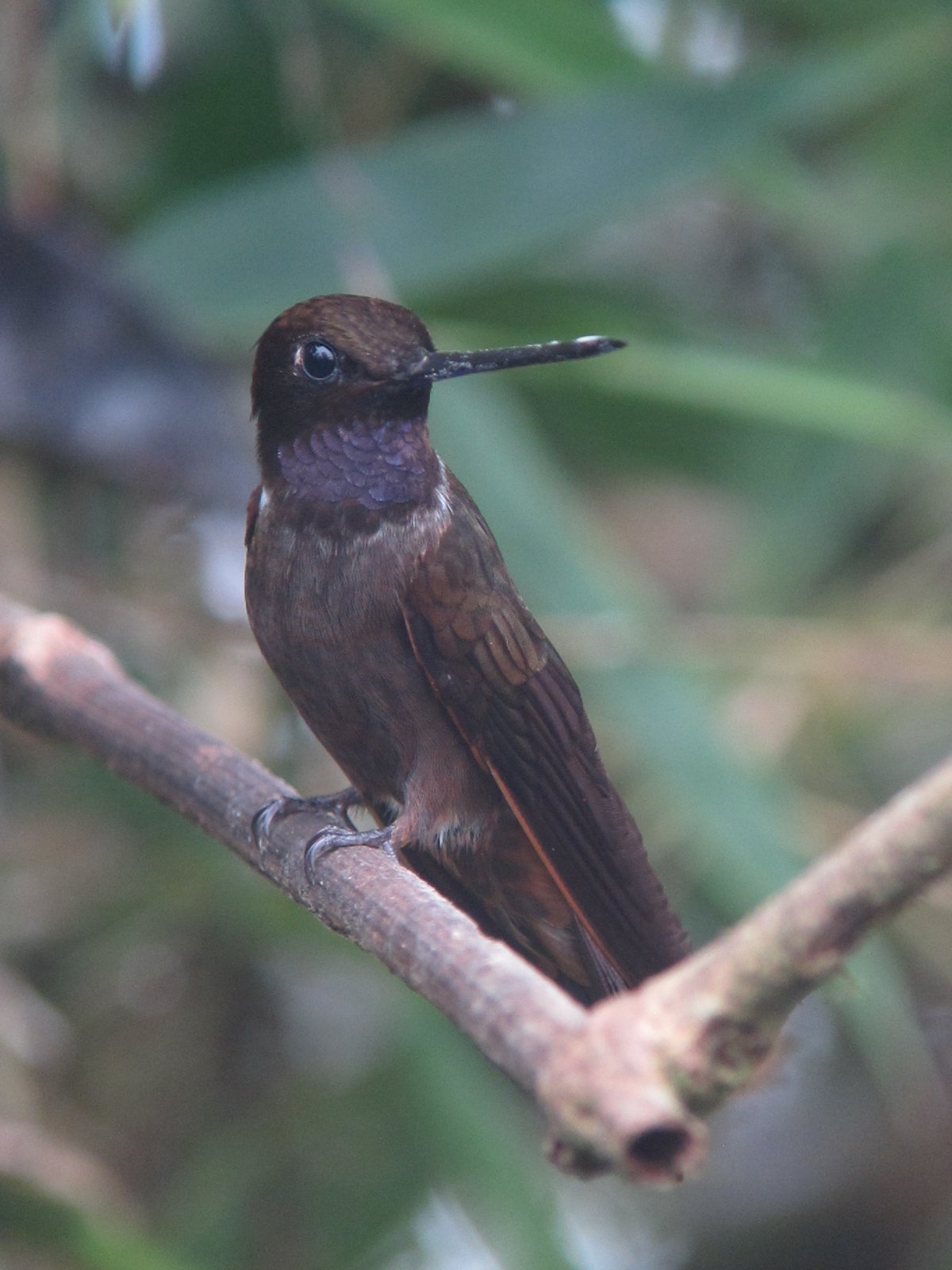
The Brown Inca is a dark brown inca of humid montane forest on the western slope of the Andes in Colombia and Ecuador. There it replaces the Bronzy Inca of the eastern slope. The white patch on the side of the breast is often the first feature you see in the dim forest.
Voice
It gives a high, repeated tsit or tsip. During chases a rapid chatter.
Recording: Paul Coopmans — CC BY-NC-SA 4.0 · xeno-canto
Identification
14 cm, with a long, straight, black bill of about 3 cm. The plumage is mostly dark chocolate brown, with a bronzy sheen on the back and rump. There is a distinct white patch on the side of the breast. The male has a small, violet-glittering throat spot, which is smaller or absent in the female. The tail is bronzy brown and slightly forked. A small white spot behind the eye.
Confusion species
Bronzy Inca Coeligena coeligena lives on the eastern slope, is paler bronzy brown, with a spotted greyish throat and no white breast patch. The female Fawn-breasted Brilliant Heliodoxa rubinoides is greener above and buff below, with a shorter bill. Hermits such as Green Hermit Phaethornis guy have a decurved bill and a long, pointed tail.
Habitat
Humid montane forest, cloud forest and their edges, also older secondary forest, mostly between about 700 and 2300 m, especially around 1200–2000 m. It feeds low to mid-level in the forest along a fixed route of flowers and catches small insects. It comes to feeders at lodges. The nest is a small cup of moss and plant fibres, usually attached to a hanging branch or root.
Where the bird is most at home, classified by the vegetation units of the Andes and the west coast.


Range and movements
In Colombia on the western slope of the Western Cordillera and on the western slope of the southern Central Cordillera. In Ecuador on the western slope of the Andes. In Peru at most in the far north-west. Absent from Bolivia and the Galápagos. It does not occur outside the guide area.
- Resident
- dark = core range, pale = thinly spread
How and when to look
Look at feeders and flowering plants in cloud forest on the western slope, such as around Mindo in Ecuador. Birds often appear briefly at a feeder and then vanish into the forest again.
Conservation status
Least Concern. The species also uses older secondary forest, but deforestation on the western slope of the Andes affects its habitat.
Scientific name
Coeligena wilsoni | (Delattre & Bourcier, 1846)
Delattre & Bourcier described the species in 1846 as Trochilus Wilsoni; because it was later moved to another genus, the author and year stand in brackets. The genus Coeligena was introduced in 1833 by Lesson. The genus name comes from Latin coeligenus, 'heaven-born' or 'celestial'. The species name honours Thomas Bellerby Wilson (1807–1865), an American naturalist and collector. The specimen the first description was based on came from Juntas, near Buenaventura, Valle del Cauca, Colombia.