All species › Swifts › Hummingbirds › Bronzy Inca
Bronzy Inca | Coeligena coeligena
Bronzen incakolibrie | Inca bronceado | Inca-bronzeado
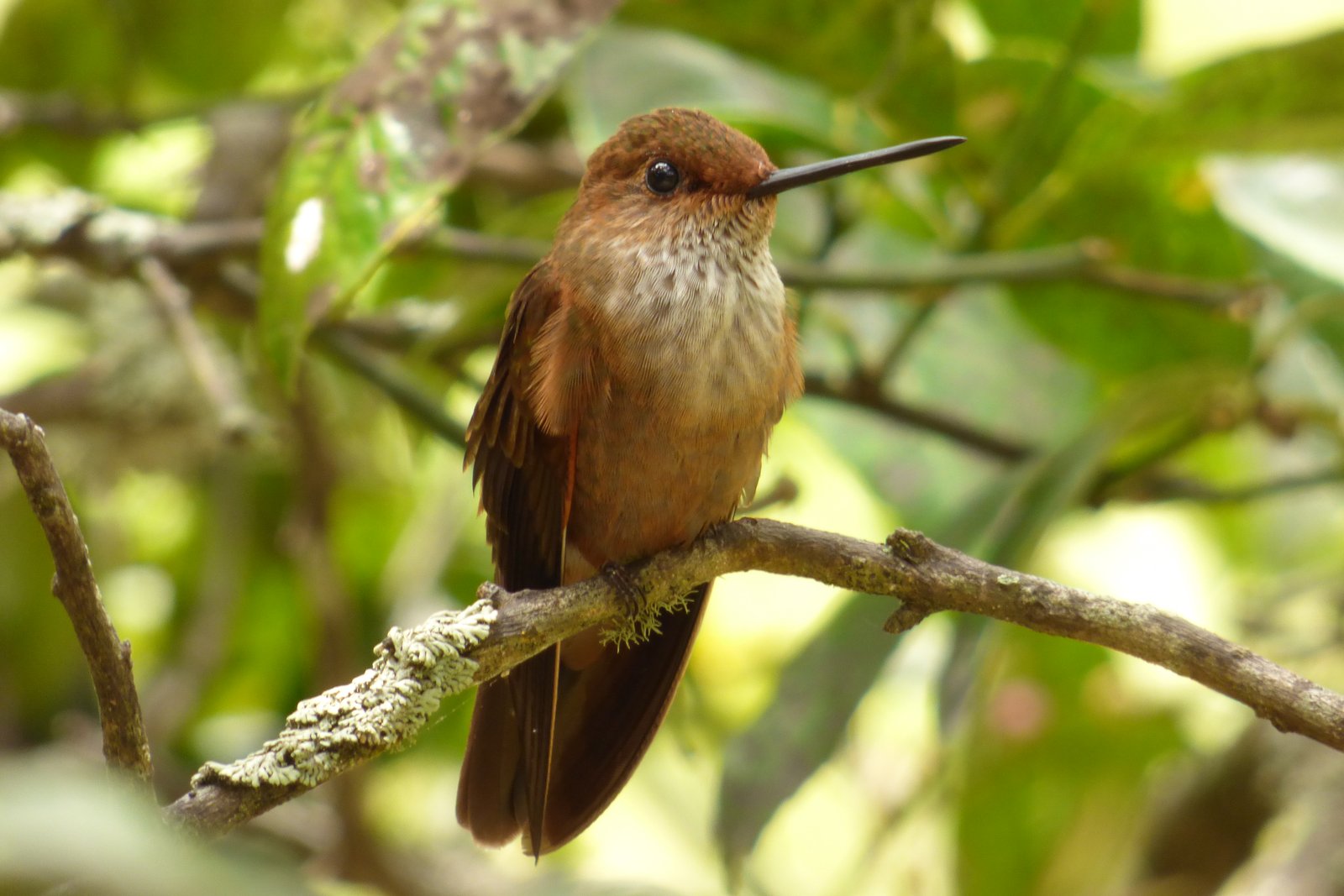
The Bronzy Inca is a plainly coloured, bronzy-brown inca of humid montane forest on the eastern slope of the Andes, from Colombia to Bolivia. It has the long, straight bill of its genus and feeds along a fixed route of flowers in the lower and middle levels of the forest. Of the incas it has the largest range in the guide area.
Voice
It gives a high, repeated tsip or tsit, sometimes in a short series. During chases a rapid chatter.
Recording: Mitch Lysinger — CC BY-NC-SA 4.0 · xeno-canto
Identification
14 cm, with a long, straight, black bill of about 3 cm. The plumage is mostly dull bronzy brown, with a greenish or coppery sheen on the back and rump. The throat and breast are greyish to dingy white with dark spots or streaks, and the belly is greyish brown. The tail is bronzy brown and slightly forked. A small white spot behind the eye. The sexes are alike.
Confusion species
Brown Inca Coeligena wilsoni lives on the western slope of the Andes in Colombia and Ecuador, is darker brown and has a white patch on the side of the breast. Collared Inca Coeligena torquata has a white breast band and white tail sides and usually lives higher. The female Fawn-breasted Brilliant Heliodoxa rubinoides is greener above and uniformly buff below, with a shorter bill.
Habitat
Humid montane forest, cloud forest and their edges, also older secondary forest, mostly between about 1400 and 2600 m, locally lower or higher. It feeds low to mid-level in the forest along a fixed route of flowers, often at long, pendent corollas, and catches small insects. It sometimes comes to feeders. The nest is a small cup of moss and plant fibres, usually attached to a hanging branch or root.
Where the bird is most at home, classified by the vegetation units of the Andes and the west coast.


Range and movements
In Colombia in all three cordilleras and in the Serranía de Perijá. In Ecuador mainly on the eastern slope of the Andes. In Peru along the eastern slope of the Andes throughout the country. In Bolivia on the eastern slope of the Andes. Absent from the Galápagos. Outside the guide area in the Andes and coastal cordillera of Venezuela.
- Resident
- dark = core range, pale = thinly spread
How and when to look
Look in the interior and along the edges of humid montane forest on the eastern slope, such as around San Isidro in Ecuador or along the road through the Manu valley in Peru. A bird often follows the same route along flowering plants; waiting at a flowering plant in the understorey pays off.
Conservation status
Least Concern. The species has a large range; deforestation of montane forest affects its habitat locally.
Scientific name
Coeligena coeligena | (Lesson, 1833)
Lesson described the species in 1833 as Ornismya coeligena; because it was later moved to another genus, the author and year stand in brackets. The genus Coeligena was introduced in 1833 by Lesson. The genus name comes from Latin coeligenus, 'heaven-born' or 'celestial'. The species name repeats the genus name (a tautonym), from Latin coeligenus, 'heaven-born'. The specimen the first description was based on came from Venezuela.