All species › Swifts › Hummingbirds › Black-hooded Sunbeam
Black-hooded Sunbeam | Aglaeactis pamela
Zwartkruinglanskolibrie | Colibrí negrito | Raio-de-sol-de-capuz-preto
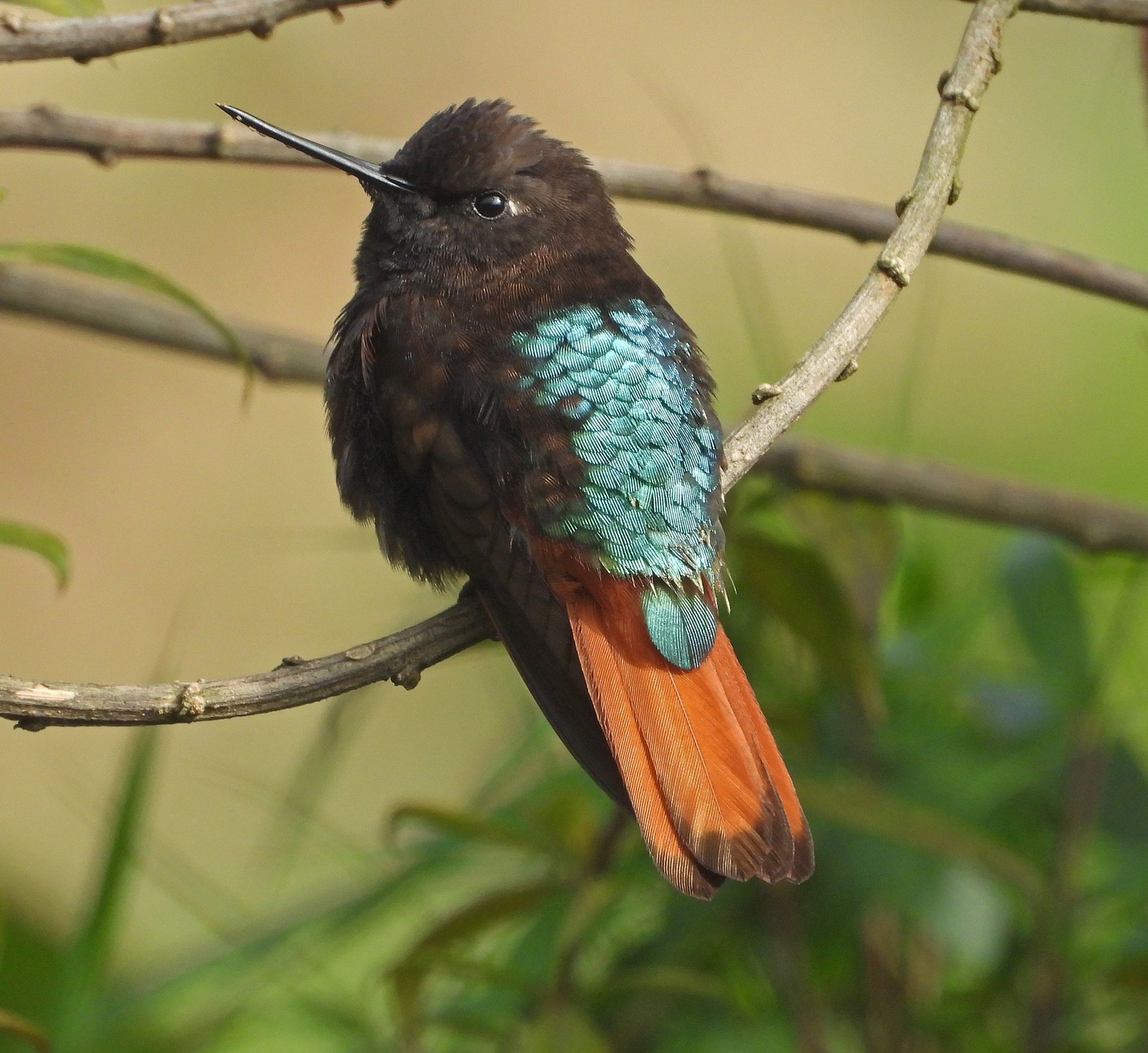
The Black-hooded Sunbeam is the only sunbeam in Bolivia and is found nowhere else. It is largely black, with a glittering rump and a rufous tail, and lives in scrub at the upper limit of Yungas forest. Like its relatives it vigorously defends flowering shrubs against other hummingbirds.
Voice
It gives a dry, sharp tsit. During chases a rapid, high chatter.
Recording: Andrew Spencer — CC BY-NC-SA 3.0 · xeno-canto
Identification
11–12 cm, with a short, straight, black bill. The plumage is mostly dull black, with a white tuft on the breast. The lower back and rump glitter blue to violet, and the uppertail coverts green. The tail is rufous with a dark tip. The sexes are similar; the female is slightly duller. After alighting it often holds its wings raised for a moment.
Confusion species
No other sunbeam occurs within its range. Metaltails such as Tyrian Metaltail Metallura tyrianthina are smaller, with a shorter bill, a green body and a coppery or reddish-brown tail. The female Great Sapphirewing Pterophanes cyanopterus also has a cinnamon tone, but is much larger, with green upperparts and blue wings.
Habitat
Scrub and thickets at the upper limit of cloud forest, elfin forest, Polylepis groves and shrubby slopes in humid puna, mostly between about 2700 and 4000 m. It visits shrub flowers, often clinging, and defends a flowering shrub as a territory; it also catches insects. The nest is a small cup of moss and plant down.
Where the bird is most at home, classified by the vegetation units of the Andes and the west coast.


Range and movements
Only in Bolivia: on the eastern slope of the Andes in La Paz and Cochabamba. Absent from Colombia, Ecuador, Peru and the Galápagos. It does not occur outside the guide area.
- Resident
- dark = core range, pale = thinly spread
How and when to look
Look at flowering shrubs along roads through the upper Yungas, such as the old road from La Cumbre to Coroico and the area around Cotapata in La Paz. Birds often perch on a projecting twig next to their shrub.
Conservation status
Least Concern. The range is limited, but the species also lives in scrub along roads and fields; burning and grazing affect high scrub locally.
Scientific name
Aglaeactis pamela | (d'Orbigny, ACVMD, 1838)
D'Orbigny, ACVMD described the species in 1838 as Ornismya Pamela; because it was later moved to another genus, the author and year stand in brackets. The genus Aglaeactis was introduced in 1848 by Gould. The genus name comes from Greek aglaos, 'bright, shining', and aktis, 'ray'. The species name honours Pamela d'Orbigny, née Martipon (1810–1842), first wife of the French zoologist and explorer Alcide d'Orbigny. The specimen the first description was based on came from Yungas, Bolivia.