All species › Swifts › Hummingbirds › Purple-backed Sunbeam
Purple-backed Sunbeam | Aglaeactis aliciae
Violetrugglanskolibrie | Rayo-de-sol de dorso púrpura | Raio-de-sol-de-dorso-roxo
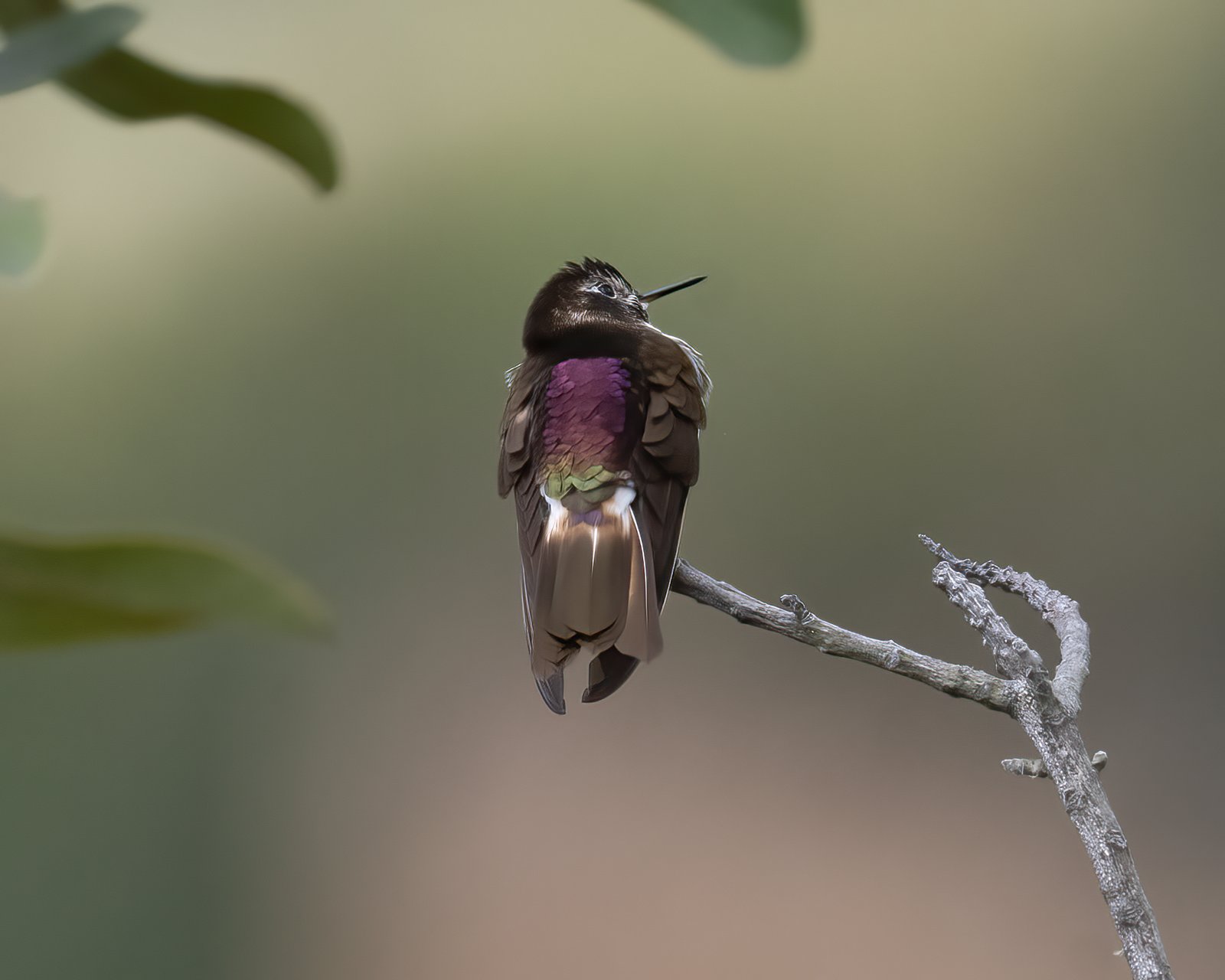
The Purple-backed Sunbeam is a sunbeam with a very small range in the Andes of northern Peru. It lives in scrub and thickets on the slopes above the Marañón valley. The violet to purple glittering back and the white patch on the breast distinguish it from the other sunbeams.
Voice
It gives a dry, sharp tsit. During chases a rapid, high chatter.
Recording: Andrew Spencer — CC BY-NC-SA 4.0 · xeno-canto
Identification
12 cm, with a short, straight, black bill. The head and underparts are dark brown to rufous-brown, with a distinct white patch on the breast. The back and rump glitter violet to purple. The tail is rufous with a dark tip. The sexes are similar. Like other sunbeams it often holds its wings raised for a moment after alighting.
Confusion species
Shining Sunbeam Aglaeactis cupripennis, which occurs further north and west, is paler cinnamon-rufous below, without a white breast patch, and has a coppery to golden-green glittering rump. White-tufted Sunbeam Aglaeactis castelnaudii, further south, has a smaller white breast tuft and less extensive glitter on the back.
Habitat
Scrub and thickets on mountain slopes, with alders (Alnus), Polylepis and other shrubs, also in hedgerows along fields, roughly between 2900 and 3300 m. It visits shrub flowers, often clinging, and defends flowering shrubs as territories; it also catches insects. Little is known about the nest.
Where the bird is most at home, classified by the vegetation units of the Andes and the west coast.


Range and movements
Only in Peru: in the Andes of the north of the country, on the slopes along the Marañón in La Libertad and possibly adjacent Ancash. Absent from Colombia, Ecuador, Bolivia and the Galápagos. It does not occur outside the guide area.
- Resident
- dark = core range, pale = thinly spread
How and when to look
The small range is remote; look in flowering scrub and alder thickets on the slopes above the Marañón in La Libertad. A bird keeps returning to the same flowering shrub.
Conservation status
Vulnerable. The range is very small, and the scrub and thickets in which it lives are cut, grazed and burned for agriculture.
Scientific name
Aglaeactis aliciae | Salvin, 1896
Salvin described the species in 1896 and placed it straight away in the genus where it still stands. The genus Aglaeactis was introduced in 1848 by Gould. The genus name comes from Greek aglaos, 'bright, shining', and aktis, 'ray'. The species name honours Alice Mary Godman, née Chaplin (1868–1944), second wife of the English ornithologist Frederick DuCane Godman. The specimen the first description was based on came from Suecha, Peru.