All species › Swifts › Hummingbirds › White-tufted Sunbeam
White-tufted Sunbeam | Aglaeactis castelnaudii
Witpluimglanskolibrie | Rayo-de-sol acanelado | Raio-de-sol-de-tufo-branco
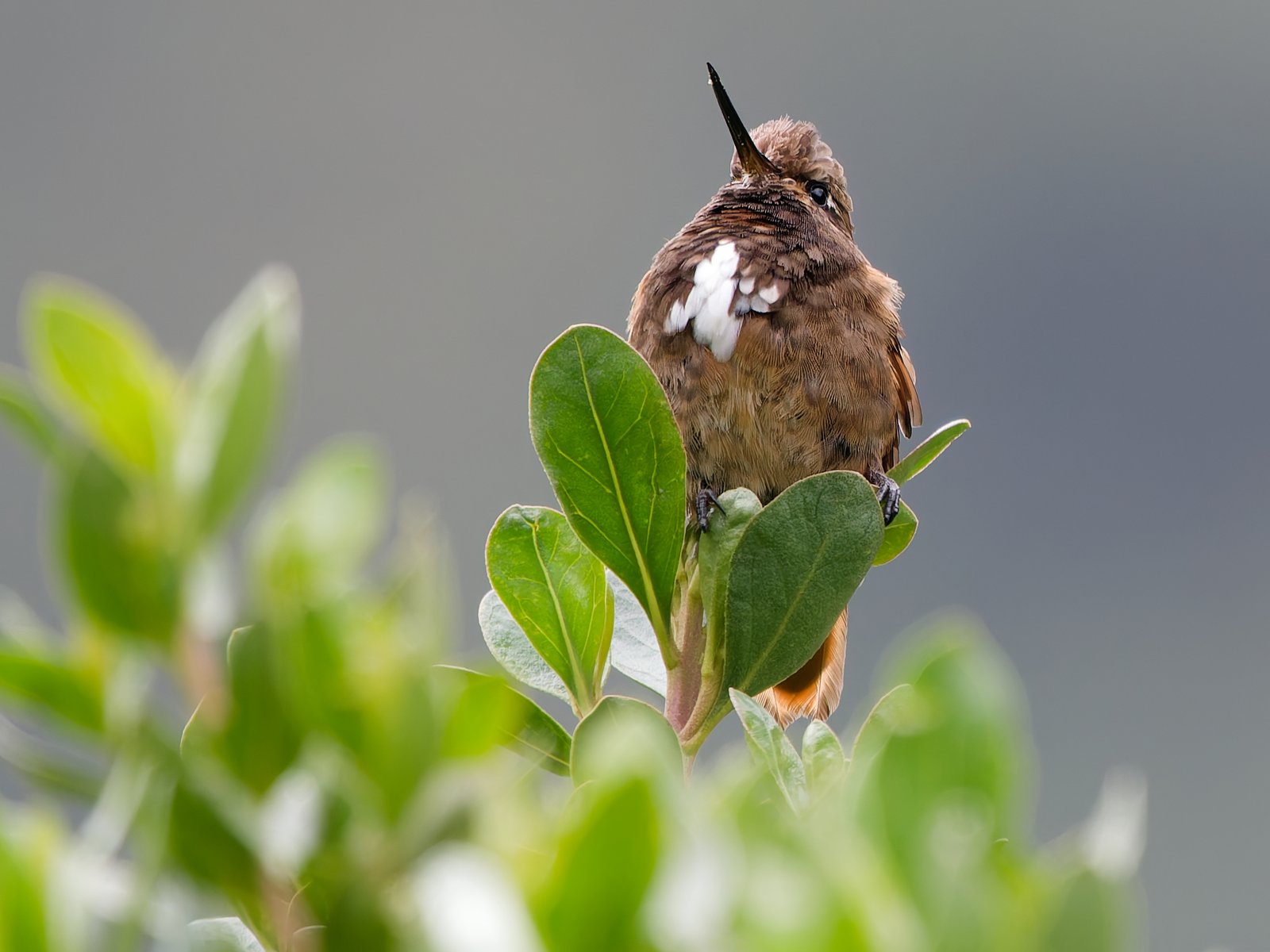
The White-tufted Sunbeam is a dark brown sunbeam found only in the Andes of central and southern Peru. It lives in scrub and Polylepis groves high on the slopes. The white tuft in the centre of the breast and the violet-glittering rump distinguish it from the related Shining Sunbeam.
Voice
It gives a dry, sharp tsit, sometimes in a short series. During chases a rapid, high chatter.
No recording with a suitable Creative Commons licence is available for this species yet.
Identification
12 cm, with a short, straight, black bill. The upperparts are dark brown, with a violet to purple glittering lower back and rump that is visible in flight and in good light. The head and underparts are dark rufous to cinnamon-brown, with a white tuft in the centre of the breast. The tail is rufous with a dark tip. The sexes are similar. After alighting it often holds its wings raised for a moment.
Confusion species
Shining Sunbeam Aglaeactis cupripennis is paler cinnamon-rufous below, without a white breast tuft, and has a coppery to golden-green glittering rump. Purple-backed Sunbeam Aglaeactis aliciae of northern Peru has a larger white patch on the breast and a more extensively purple-glittering back. Violet-throated Starfrontlet Coeligena violifer partly shares its habitat, but has a much longer bill and pale tail sides.
Habitat
Scrub on mountain slopes, Polylepis groves, edges of high montane forest and shrubby ravines, mostly between about 2500 and 4300 m. It visits shrub flowers, often clinging rather than hovering, and defends a flowering shrub as a territory; it also catches insects. The nest is a small cup of moss and plant down on a branch or against a rock.
Where the bird is most at home, classified by the vegetation units of the Andes and the west coast.


Range and movements
Only in Peru: in the Andes of the centre and south of the country, roughly from Huánuco and Pasco south to Cusco and Apurímac. Absent from Colombia, Ecuador, Bolivia and the Galápagos. It does not occur outside the guide area.
- Resident
- dark = core range, pale = thinly spread
How and when to look
Look in Polylepis groves and flowering scrub high on the slopes, such as around the Abra Málaga pass in Cusco. A bird often perches on a projecting twig next to its flowering shrub and keeps returning to it.
Conservation status
Near Threatened. The range is limited, and Polylepis woodland and high scrub are declining through cutting for firewood, grazing and burning.
Scientific name
Aglaeactis castelnaudii | (Bourcier & Mulsant, 1848)
Bourcier & Mulsant described the species in 1848 as Trochilus Castelnaudii; because it was later moved to another genus, the author and year stand in brackets. The genus Aglaeactis was introduced in 1848 by Gould. The genus name comes from Greek aglaos, 'bright, shining', and aktis, 'ray'. The species name honours François Louis Nompar de Caumont de Laporte, comte de Castelnau (1802–1880), a French naturalist who led an expedition across South America in 1843–1847. The specimen the first description was based on came from Cusco, Peru.