All species › Swifts › Hummingbirds › Shining Sunbeam
Shining Sunbeam | Aglaeactis cupripennis
Koperglanskolibrie | Rayo-de-sol brillante | Raio-de-sol-brilhante
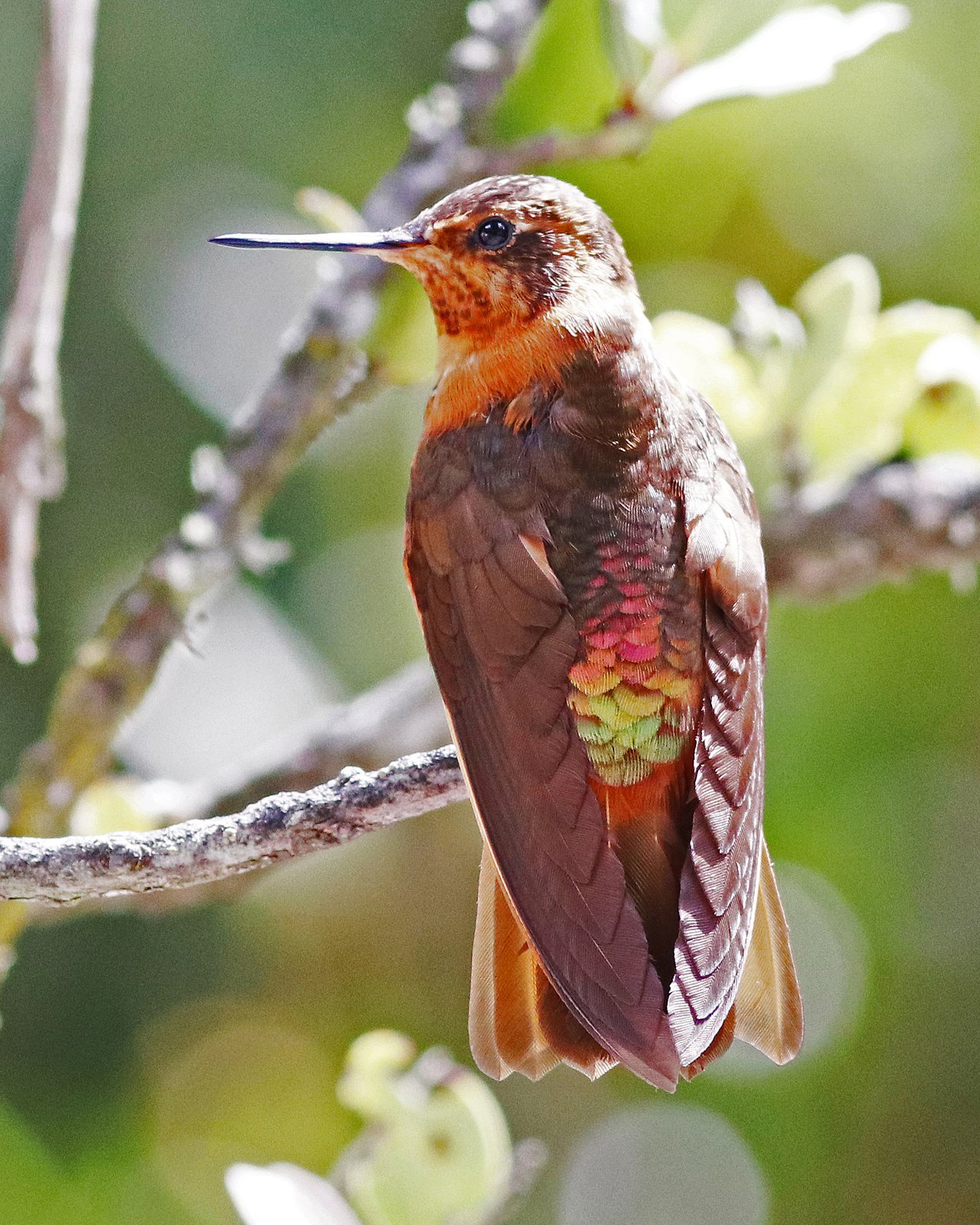
The Shining Sunbeam is a stocky, mainly cinnamon-brown hummingbird of scrub and forest edges at the treeline in the Andes from Colombia to Peru. The name refers to the lower back and rump, which shine coppery to violet and golden green in the light. It vigorously defends flowering shrubs against other hummingbirds.
Voice
It gives a dry, sharp tsit. During chases a rapid, high rattle or chatter.
Recording: Carlos Delgado JUMABITA — CC BY-NC-SA 4.0 · xeno-canto
Identification
12 cm, with a short, straight, black bill of about 2 cm. The head and underparts are cinnamon-rufous to rusty brown, and the back is dark olive-brown. The lower back and rump shine coppery, violet and golden green depending on the light. The tail is rufous with a bronzy tip. The sexes are similar; in the female the glitter on the rump is often less extensive. After alighting it often holds its wings raised for a moment.
Confusion species
White-tufted Sunbeam Aglaeactis castelnaudii in central and southern Peru is darker brown, with a white tuft on the breast. Rainbow Starfrontlet Coeligena iris also shows much rufous, but has a much longer bill and a glittering green head. Chestnut-breasted Coronet Boissonneaua matthewsii has a rufous breast, but green upperparts and a shorter tail with rufous outer feathers.
Habitat
Scrub, thickets and the edges of elfin forest around the treeline, shrubby páramo and jalca, Polylepis groves and hedgerows near fields, mostly between about 2500 and 3800 m. It visits shrub flowers, often clinging to them rather than hovering; it also catches insects. It defends a flowering shrub as a territory. The nest is a small cup of moss and plant down, on a branch or against a rock face.
Where the bird is most at home, classified by the vegetation units of the Andes and the west coast.


Range and movements
In Colombia in the Central and Eastern Cordilleras and in the south of the Western Cordillera. In Ecuador along both slopes and in the highlands between them. In Peru along the Andes south to about the centre of the country. Absent from Bolivia and the Galápagos. It does not occur outside the guide area.
- Resident
- dark = core range, pale = thinly spread
How and when to look
Look at flowering shrubs along forest edges and in shrubby páramo, such as in the Yanacocha reserve above Quito or around the Papallacta pass in Ecuador. A bird often perches in the open on a projecting twig next to its flowering shrub.
Conservation status
Least Concern. The species also lives in scrub strongly modified by people and along hedgerows, but loss of treeline scrub through grazing and burning plays a role locally.
Scientific name
Aglaeactis cupripennis | (Bourcier, 1843)
Bourcier described the species in 1843 as Trochilus cupripennis; because it was later moved to another genus, the author and year stand in brackets. The genus Aglaeactis was introduced in 1848 by Gould. The genus name comes from Greek aglaos, 'bright, shining', and aktis, 'ray'. The species name comes from Latin cuprum, 'copper', and penna, 'feather', after the coppery sheen. The specimen the first description was based on came from Colombia.