All species › Swifts › Hummingbirds › Mountain Velvetbreast
Mountain Velvetbreast | Lafresnaya lafresnayi
Draadvleugelkolibrie | Colibrí terciopelo | Beija-flor-de-peito-veludo
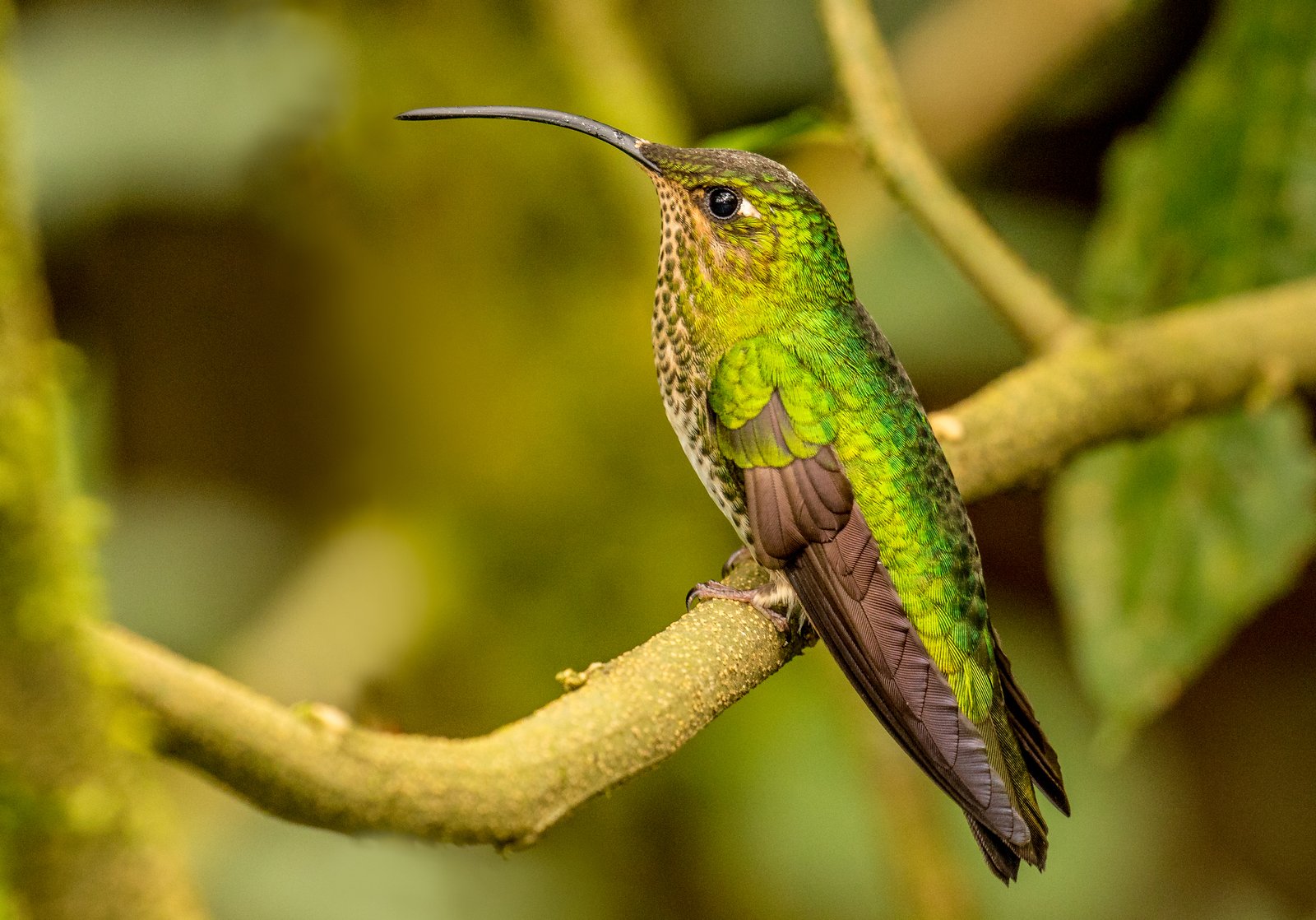
The Mountain Velvetbreast is a medium-sized hummingbird of high cloud forest and treeline scrub in the northern and central Andes. With its slightly decurved bill it visits mainly tubular flowers of heaths and other shrubs. The male has a blackish, velvety belly, which explains the English and Spanish names.
Voice
The call is a dry, repeated tsit or tsik. During chases a rapid, twittering chatter.
Recording: Niels Krabbe — CC BY-NC-SA 4.0 · xeno-canto
Identification
12 cm, with a slightly decurved, black bill of about 2.5–3 cm. The male is green above, with a glittering green throat and breast and a blackish, velvety belly. The tail is white or pale buff, with dark central feathers and dark tips to the outer feathers. The female is green above and whitish to pale buff below, densely spotted green, and has the same tail pattern. Young birds resemble the female.
Confusion species
Collared Inca Coeligena torquata is larger, with a straight bill and a white breast band. Buff-tailed Coronet Boissonneaua flavescens has a short, straight bill, a buff tail and buff underwings. Pufflegs such as Glowing Puffleg Eriocnemis vestita have a shorter, straight bill, white or coloured leg puffs and a dark tail without white.
Habitat
Humid cloud forest, elfin forest, forest edges and scrub at the treeline and in the transition to páramo, mostly between about 2300 and 3700 m. It often feeds low to mid-level and visits a fixed route of flowers, mainly of heaths (Ericaceae) and other shrubs with tubular corollas; it also catches small insects. The nest is a small cup of moss and plant fibres, usually on a branch or against a bank.
Where the bird is most at home, classified by the vegetation units of the Andes and the west coast.


Range and movements
In Colombia in all three cordilleras and in the Sierra Nevada de Santa Marta and the Serranía de Perijá. In Ecuador on both slopes of the Andes. In Peru along the eastern slope south to about the centre of the country. Absent from Bolivia and the Galápagos. Outside the guide area in the Andes of western Venezuela.
- Resident
- dark = core range, pale = thinly spread
How and when to look
Look at flowering shrubs at the edge of high cloud forest, for example along trails in the Yanacocha reserve above Quito in Ecuador. It comes to feeders less often than many other hummingbirds and is more often seen at natural flowers.
Conservation status
Least Concern. The species has a large range and also uses forest edges and scrub, but the loss of high montane forest affects its habitat locally.
Scientific name
Lafresnaya lafresnayi | (Boissonneau, 1840)
Boissonneau described the species in 1840 as Trochilus La Fresnayi; because it was later moved to another genus, the author and year stand in brackets. The genus Lafresnaya was introduced in 1850 by Bonaparte. The genus name honours Frédéric de Lafresnaye (1783–1861), a French ornithologist and collector. The species name honours Frédéric de Lafresnaye (1783–1861), a French ornithologist and collector, after whom the genus is also named. The specimen the first description was based on came from Bogotá, Colombia.