All species › Swifts › Hummingbirds › Emerald-bellied Puffleg
Emerald-bellied Puffleg | Eriocnemis aline
Smaragdbuikpluimbroekje | Calzadito pechiblanco | Calçudo-de-ventre-esmeralda
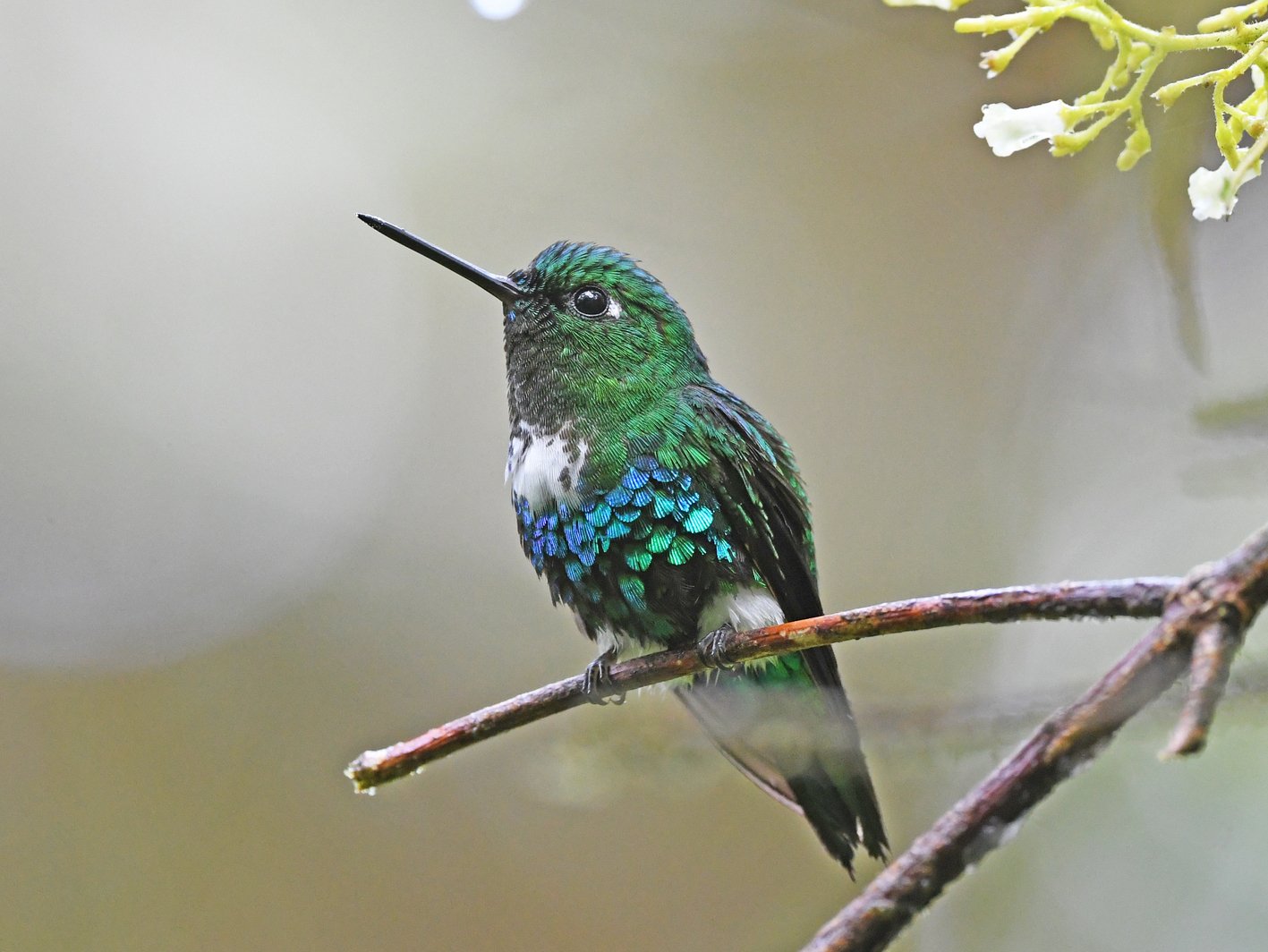
The Emerald-bellied Puffleg is a small puffleg of the cloud-forest interior, with conspicuously large white leg puffs. Unlike most of its relatives it feeds mainly inside the forest itself, low to mid-height. A white patch on the breast separates it from other pufflegs.
Voice
A high, thin tsit and a soft twitter.
Recording: Nick Athanas — CC BY-NC-SA 3.0 · xeno-canto
Identification
8–9 cm, with a short, straight black bill and a short, slightly forked, bronze-green tail. The male is glittering green, with a white patch on the upper breast, a glittering emerald-green belly and green undertail coverts. The leg puffs are large and pure white. The female resembles the male but is duller, with more white and green spotting on the underparts.
Confusion species
Glowing Puffleg Eriocnemis vestita is larger, with a blue-black tail, violet-blue undertail coverts and no white breast patch, and lives higher at the forest edge. Greenish Puffleg Haplophaedia aureliae is duller green, without glitter and without a white breast patch. White-booted Racket-tail Ocreatus underwoodii also has large white leg puffs, but the male has long tail feathers with rackets and the female a white cheek stripe.
Habitat
The interior and edges of humid cloud forest rich in moss and epiphytes, roughly between 2300 and 3300 m. It feeds low to mid-height in the forest, at flowers of epiphytes and shrubs, and often follows a fixed route along scattered flowers. The nest is a cup of moss in a shrub or on a fern.
Where the bird is most at home, classified by the vegetation units of the Andes and the west coast.


Range and movements
In Colombia in all three Andean ranges. In Ecuador on both slopes of the Andes. In Peru along the eastern Andes from the north south to the centre of the country. Absent from Bolivia and the Galápagos. Does not occur outside the guide area.
- Resident
- dark = core range, pale = thinly spread
How and when to look
Along trails through humid cloud forest, where the bird feeds low at flowering shrubs and epiphytes. At feeding stations in cloud forest it sometimes comes to the surrounding flowers.
Conservation status
Least Concern. The species depends on closed cloud forest and disappears where that forest is cleared.
Scientific name
Eriocnemis aline | (Bourcier, 1843)
Bourcier described the species in 1843 as Ornismya Alinae; because it was later moved to another genus, the author and year stand in brackets. The genus Eriocnemis was introduced in 1849 by Reichenbach. The genus name combines Greek erion, 'wool', with knēmis, 'legging', after the downy feather tufts on the legs. The species name honours Benoîte-Aline Bourcier, née Jusserand (1802–1889), the wife of the describer, Jules Bourcier. The specimen the first description was based on came from Tunja, Boyacá, Colombia.