All species › Passerines › Tyrant flycatchers and allies › Plumbeous Tyrant
Plumbeous Tyrant | Knipolegus cabanisi
Berlioz' moortiran | Viudita plomiza | Maria-preta-plúmbea
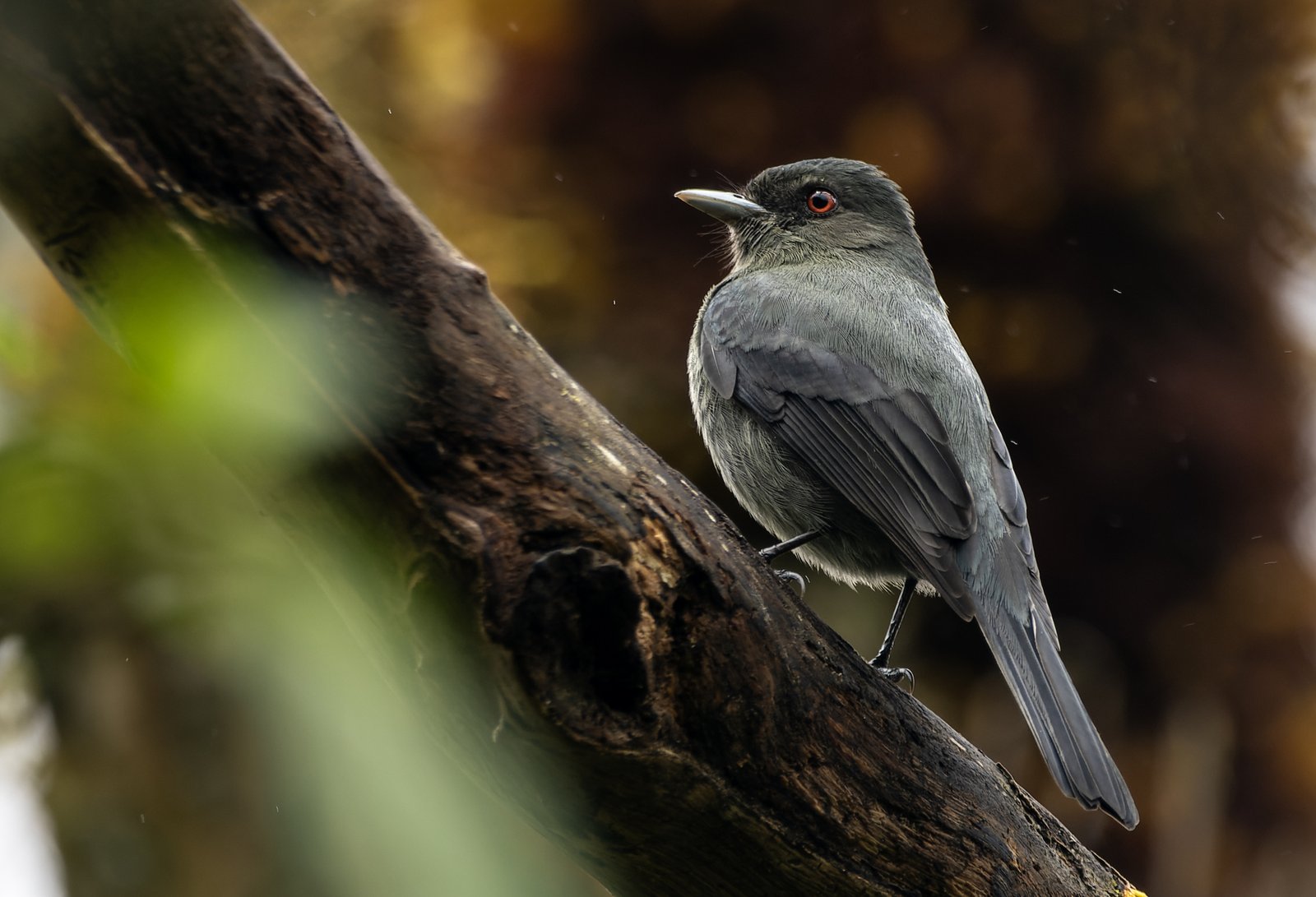
The Plumbeous Tyrant is a leaden-grey black tyrant of the Yungas, the montane forest on the eastern slope of the Andes in south-eastern Peru and Bolivia. It sits quietly at forest edges and attracts little attention. In the south of the range birds move north and to lower elevations in the austral winter.
Voice
Quiet. A soft tsip or pik; in display the male makes a short upward flight with a clicking sound.
Recording: Jacob Wijpkema — CC BY-NC-SA 4.0 · xeno-canto
Identification
15 cm, with a fairly long tail and a blue-grey bill. The male is uniform dark leaden grey, with blackish wings and tail and no white in the wing. The female is olive-brown above, with two pale wing bars, a rufous rump and rufous inner webs to the tail feathers; the underparts are paler, with faint brown streaking on the breast. Young birds resemble the female.
Confusion species
Jelski's Black Tyrant Knipolegus signatus is darker, the male almost black, and lives further north-west, in northern and central Peru. White-winged Black Tyrant Knipolegus aterrimus has a white wing band, visible in flight, and lives in dry scrub. The female Rufous-tailed Tyrant Knipolegus poecilurus has a red iris and greyer, unstreaked underparts.
Habitat
The edges and clearings of humid montane forest and cloud forest, riverside scrub, roadside scrub and young forest, roughly between 1500 and 3300 m; migrating birds also lower. It perches low to mid-height on a sheltered branch and catches insects with short sallies. The nest is a small cup in a shrub or tree.
Where the bird is most at home, classified by the vegetation units of the Andes and the west coast.


Range and movements
Peru: on the eastern slope of the Andes in the south-east, in Cusco and Puno. Bolivia: in the Yungas and montane forests of La Paz, Cochabamba, Santa Cruz, Chuquisaca and Tarija, in the austral winter also lower along the foot of the Andes. Absent from Colombia, Ecuador and the Galápagos. Outside the guide area in north-western Argentina.
- Resident
- dark = core range, pale = thinly spread
How and when to look
Search forest edges and roads through the Yungas, for example in Cusco or in the Bolivian Yungas above Coroico; look for a uniform grey flycatcher sitting quietly at the forest edge.
Conservation status
Least Concern. The species tolerates forest edges and secondary forest and is fairly common in suitable habitat.
Scientific name
Knipolegus cabanisi | Schulz, 1882
Schulz described the species in 1882 and placed it straight away in the genus where it still stands. The genus Knipolegus was introduced in 1826 by Boie. The genus name comes from Greek knips, 'insect', and legō, 'to pick', for its way of foraging. The species name honours Jean Cabanis (1816–1906), German ornithologist and curator at the natural history museum in Berlin. The specimen the first description was based on came from Tucumán, Argentina.