All species › Swifts › Hummingbirds › Red-billed Emerald
Red-billed Emerald | Chlorostilbon gibsoni
Roodsnavelsmaragdkolibrie | Esmeralda piquirroja | Esmeralda-de-bico-vermelho
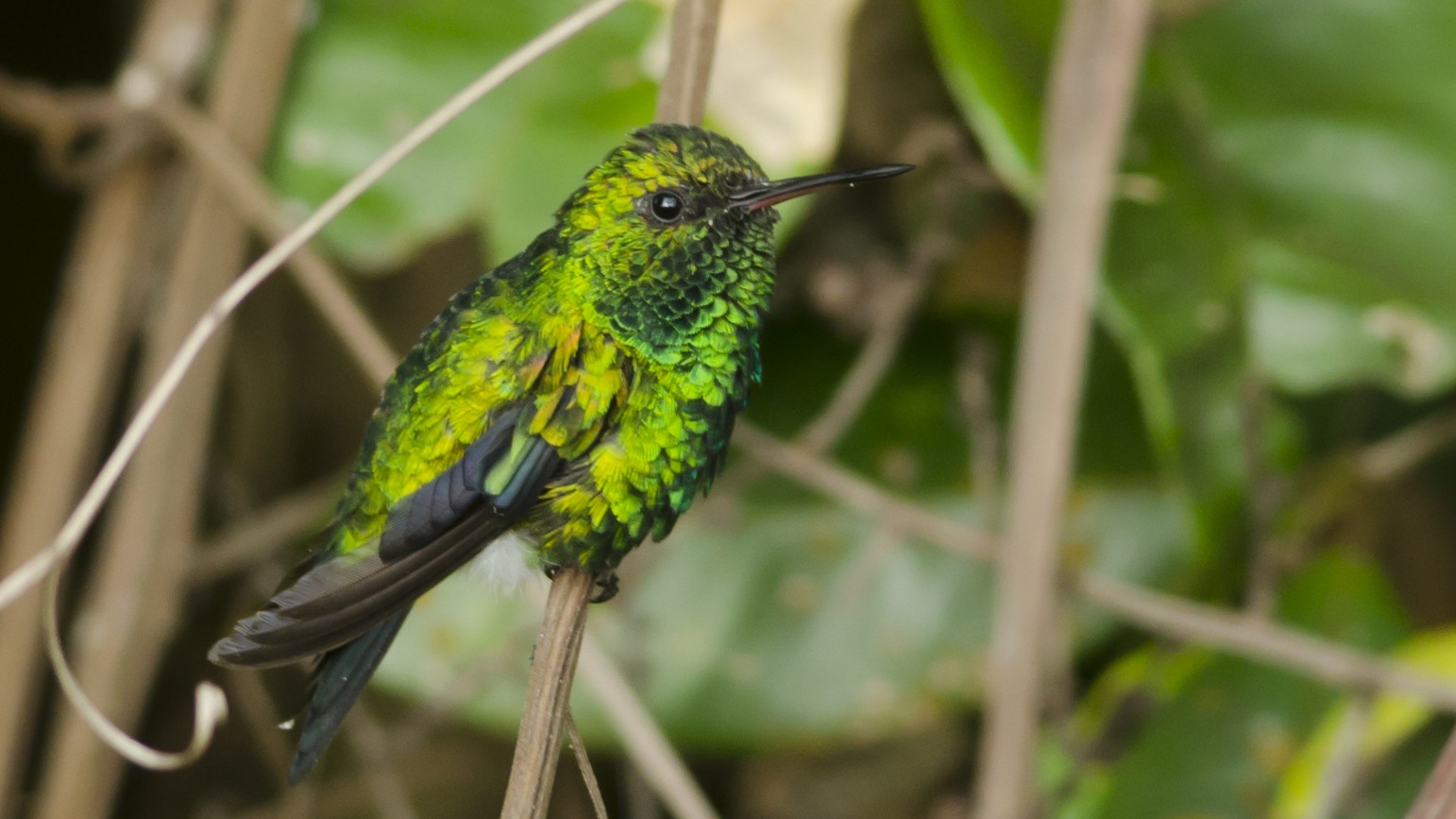
The Red-billed Emerald is a small emerald of the dry regions of northern Colombia and north-western Venezuela. It differs from the other emeralds in the guide area in its red bill with a black tip. It lives in dry scrub, open woodland and gardens, also in the dry valleys of the interior.
Voice
A dry, repeated tsik or tchip and a soft, high twittering.
Recording: Mauricio Álvarez Rebolledo (Colección de Sonidos Ambientales - Instituto Humboldt) — CC BY-NC-SA 3.0 · xeno-canto
Identification
7–8 cm, with a short, straight, red bill with a black tip and a blue-black, forked tail. The male is glittering green, with a golden-green to blue-green sheen on the throat and breast. The female is bronzy green above and pale grey below, with a white stripe behind the eye and a dark ear patch; in her often only the lower mandible is red. Young birds resemble the female.
Confusion species
Western Emerald Chlorostilbon melanorhynchus and Blue-tailed Emerald Chlorostilbon mellisugus have an all-black bill. Short-tailed Emerald Chlorostilbon poortmani has a black bill and a much shorter tail and lives higher in the Andes. Coppery Emerald Chlorostilbon russatus in the Santa Marta and Perijá ranges is more coppery, with a coppery-bronze tail.
Habitat
Dry scrub, thorn woodland, open woodland, forest edges, pastures with shrubs, gardens and parks, from sea level to about 2000 m in the dry valleys. It takes nectar from small flowers on shrubs and herbs and catches small insects. The cup nest is placed low in a shrub; the female alone incubates two white eggs.
Where the bird is most at home, classified by the vegetation units of the Andes and the west coast.


Range and movements
In Colombia in the Caribbean lowlands of the north and in the drier parts of the Magdalena valley, locally in other dry valleys. Absent from Ecuador, Peru, Bolivia and the Galápagos; reports from Ecuador probably refer to other species. Outside the guide area in north-western Venezuela.
- Resident
- dark = core range, pale = thinly spread
How and when to look
Look at flowering shrubs in dry scrub and in gardens in northern Colombia and the Magdalena valley; check for the red bill.
Conservation status
Least Concern. The species tolerates open and man-made habitats well.
Scientific name
Chlorostilbon gibsoni | (Fraser, 1840)
Fraser described the species in 1840 as Trochilus Gibsoni; because it was later moved to another genus, the author and year stand in brackets. The genus Chlorostilbon was introduced in 1853 by Gould. The genus name combines Greek khlōros, 'green', with stilbōn, 'glittering'. The species name honours John Gibson (1815–1875), English horticulturist at the Loddiges orchid nurseries, who collected plants in India in 1836–1837. The specimen the first description was based on came from Chicoral, Tolima, Colombia.