All species › Passerines › Shrike-babblers, Erpornis and vireos › Red-eyed Vireo
Red-eyed Vireo | Vireo olivaceus
Roodoogvireo | Vireo ojirrojo | Juruviara
The Red-eyed Vireo is the most widespread vireo in the Americas. In the guide area resident birds of the South American group live, which is sometimes treated as a separate species, Chivi Vireo; in addition there are North American winter visitors and, in the austral winter, migrants from the south. Its short, repeated phrases are heard all day from the canopy.
Voice
An endless series of short, clear phrases with short pauses, sung throughout the day. Calls with a nasal, whining note.
Recording: Benin Laliberte — CC BY-NC-SA 4.0 · xeno-canto
Identification
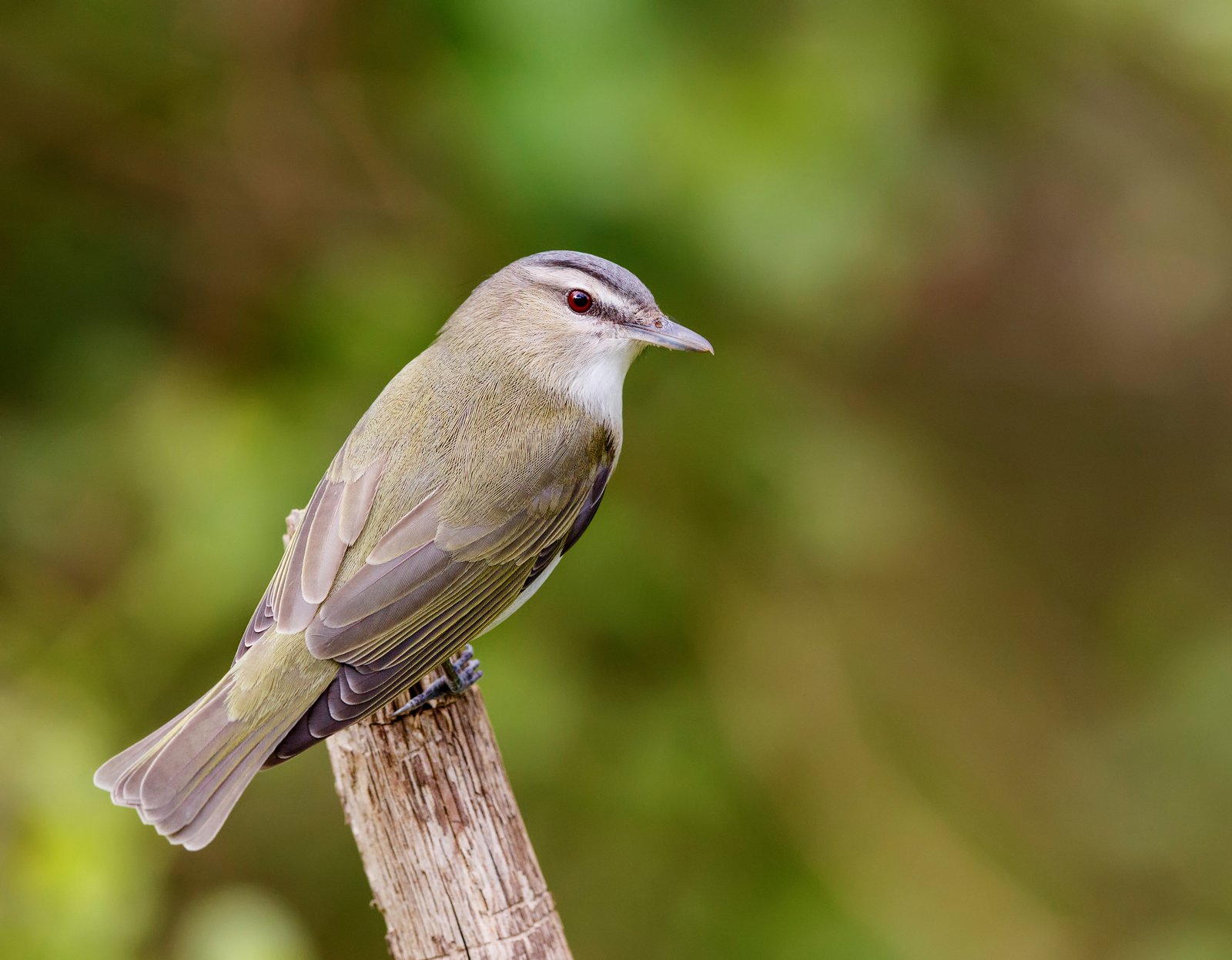
14–15 cm, with a fairly long bill. The crown is grey, in North American birds with a sharp black border, below it a white supercilium and a black eye-line. The eyes are red in adults, brown in young birds. The back, wings and tail are olive-green, without wing bars. The underparts are white; South American birds have a less sharply marked head and often a yellow wash on the flanks and undertail. The sexes are alike.
Confusion species
Yellow-green Vireo Vireo flavoviridis has bright yellow flanks and undertail, a weaker head pattern and pale lores. Black-whiskered Vireo Vireo altiloquus has a dark malar stripe. Brown-capped Vireo Vireo leucophrys is smaller, with a brown cap and dark eyes, and lives higher in the mountains.
Habitat
Canopy and edges of humid and dry lowland forest, várzea, foothill forest, secondary forest, plantations and gardens, up to about 2000 m in mountain valleys. It searches slowly among the foliage for caterpillars and other insects and also eats fruit; often in mixed flocks. The nest is a hanging cup in the fork of a branch.
Where the bird is most at home, classified by the vegetation units of the Andes and the west coast.


Range and movements
Colombia: in the lowlands and on the lower slopes, mainly east of the Andes and in the large valleys; North American birds on passage throughout the country. Ecuador: in the eastern lowlands and in the west. Peru: in the Amazonian lowlands and foothills, and in dry forest in the north-west. Bolivia: in the lowlands and the Yungas. Southern migrants reach the Amazonian lowlands in the austral winter. Absent from the Galápagos. Outside the guide area it breeds in North America and in much of South America.
- Resident
- dark = core range, pale = thinly spread
How and when to look
Listen at forest edges and in gardens in the lowlands for the monotonous series of phrases and scan the canopy for a vireo with a grey crown and white supercilium.
Conservation status
Least Concern. The species is widespread and common, and tolerates secondary forest and planted trees.
Scientific name
Vireo olivaceus | (Linnaeus, 1766)
Linnaeus described the species in 1766 as Muscicapa olivacea; because it was later moved to another genus, the author and year stand in brackets. The genus Vireo was introduced in 1808 by Vieillot. The genus name is Latin vireo, a green migratory bird, perhaps the female golden oriole or the greenfinch; related to virere, 'to be green'. The species name comes from New Latin olivaceus, 'olive-green', from Latin oliva, 'olive'. The specimen the first description was based on came from North America (probably South Carolina, United States).