All species › Passerines › Tyrant flycatchers and allies › River Tyrannulet
River Tyrannulet | Serpophaga hypoleuca
Riviertachuri | Piojito ribereño | Alegrinho-do-rio
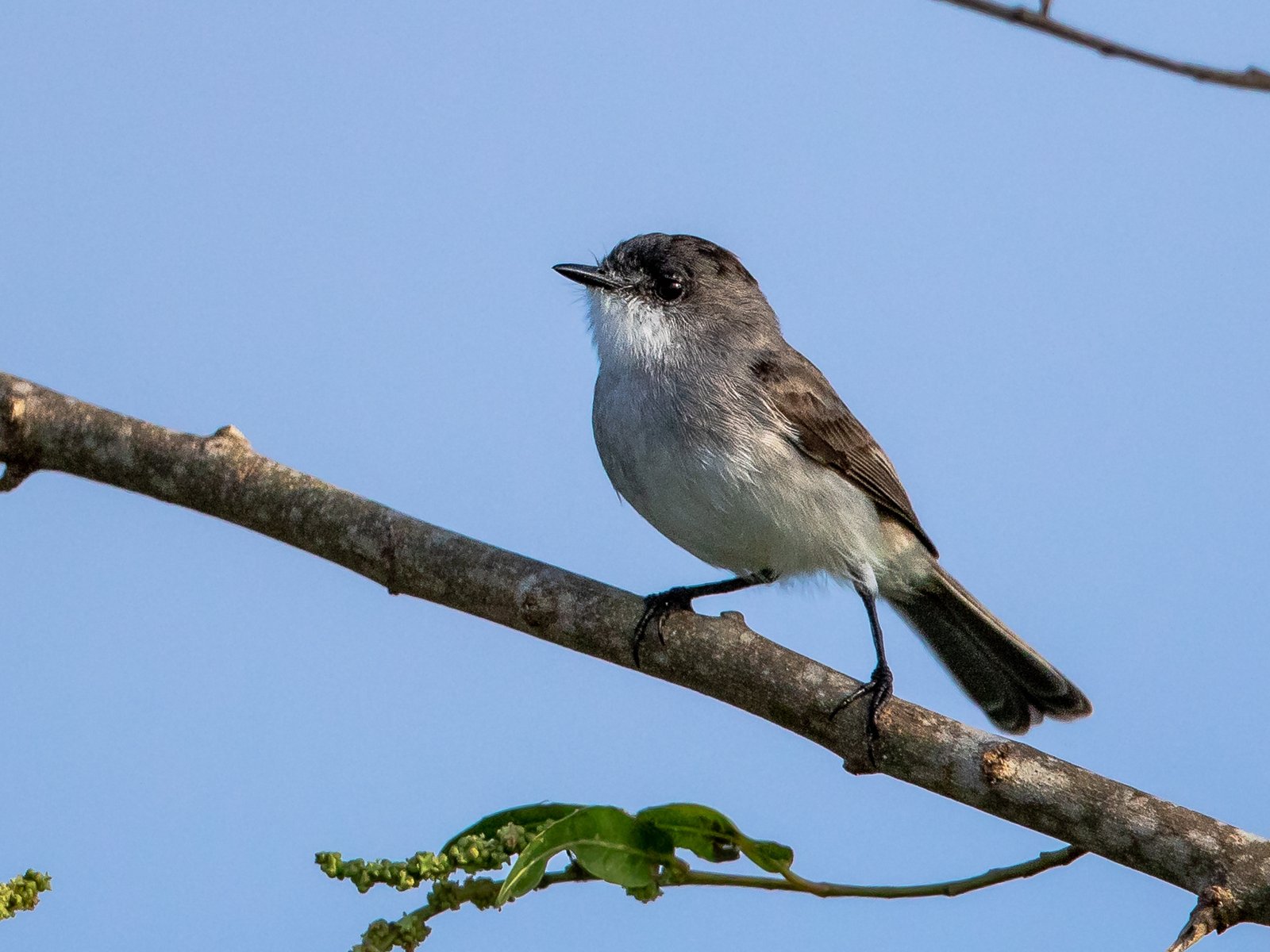
The River Tyrannulet is a small grey-brown tyrant of young vegetation on sandbars and river islands along the great rivers of the Amazon and Orinoco basins. It is closely tied to this early-successional growth, which forms anew with every flood. The plumage is plain, without wing bars.
Voice
A fast, dry, somewhat stuttering series of notes, often given by pairs in duet, and short, high calls.
Recording: Robson Silva e Silva — CC BY-NC-SA 4.0 · xeno-canto
Identification
12 cm, with a small black bill and a fairly long tail. The crown is darker grey-brown, with a concealed white crown patch. The upperparts are plain grey-brown; the wings and tail are darker, without clear wing bars. The throat is white, the breast pale grey and the belly whitish. The sexes are alike.
Confusion species
Amazonian Inezia Inezia subflava has a white eye-ring, wing bars and yellow underparts. Southern Beardless Tyrannulet Camptostoma obsoletum is smaller, with a small crest, wing bars and a yellowish belly. Lesser Wagtail-Tyrant Stigmatura napensis, on the same river islands, is yellow below and has a long tail with white. Drab Water Tyrant Ochthornis littoralis is larger, browner and perches on the bank and on driftwood.
Habitat
Early-successional growth of willows, Tessaria and cane (Gynerium) on sandbars, river islands and banks of large lowland rivers, mostly below 500 m. It searches for small insects in shrubs and low trees. The nest is a small cup on a branch.
Where the bird is most at home, classified by the vegetation units of the Andes and the west coast.


Range and movements
In Colombia along the rivers of the Orinoco and Amazon basins in the east. In Ecuador along the large rivers in the east, such as the Napo. In Peru along the Amazon, Marañón, Ucayali and their tributaries. In Bolivia along the rivers of the north, such as the Beni and Mamoré. Absent from the Galápagos. Outside the guide area in Venezuela and Brazilian Amazonia.
- Resident
- dark = core range, pale = thinly spread
How and when to look
Travel by boat along river islands with young growth or walk across a sandbar on the Amazon or Napo; birds keep to the low shrubs at the edge.
Conservation status
Least Concern. The species has a large range; the early-successional growth it depends on is constantly renewed by river dynamics.
Scientific name
Serpophaga hypoleuca | Sclater & Salvin, 1866
Sclater & Salvin described the species in 1866 and placed it straight away in the genus where it still stands. The genus Serpophaga was introduced in 1839 by Gould. The genus name comes from Greek serphos, 'gnat, small insect', and -phagos, '-eating'. The species name comes from Greek hupo, 'below', and leukos, 'white': 'white below'. The specimen the first description was based on came from Sarayacu, Ucayali, Peru.