All species › Passerines › Finches, euphonias and allies › Rufous-bellied Euphonia
Rufous-bellied Euphonia | Euphonia rufiventris
Roodbuikorganist | Eufonia ventrirrufa | Gaturamo-do-norte
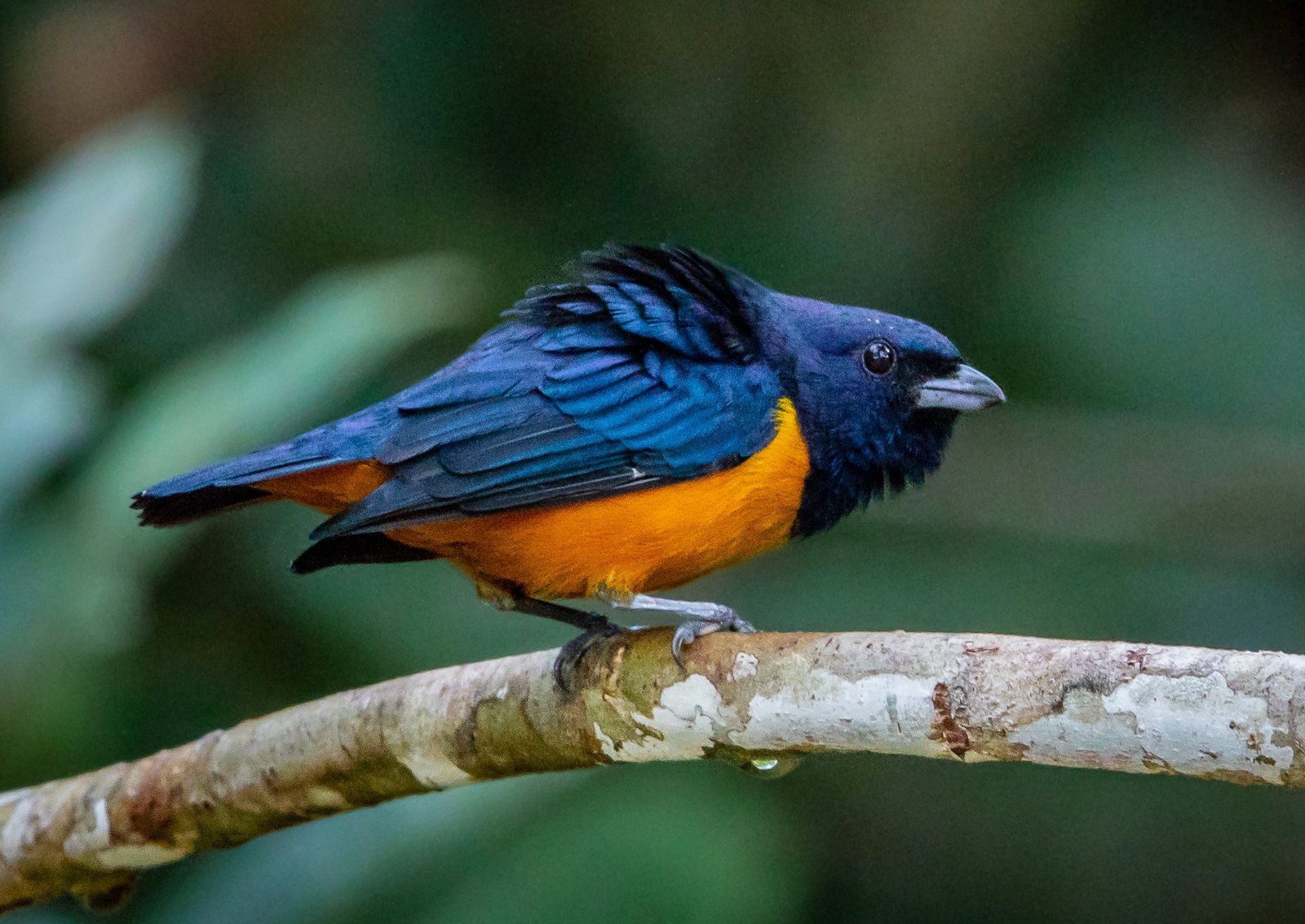
The Rufous-bellied Euphonia is a euphonia of the Amazonian lowlands. The male is the only euphonia in the guide area with blue-black upperparts and throat and deep rufous underparts without a yellow crown. It lives mainly high in the canopy of tall forest and joins mixed canopy flocks.
Voice
Dry, rasping and chattering calls, often in short series, and a soft, varied song of squeaky and chipping notes.
Recording: JAYRSON ARAUJO DE OLIVEIRA — CC BY-NC-SA 4.0 · xeno-canto
Identification
11 cm, compact, with a short, thick bill. The male has glossy blue-black upperparts, head and throat, with no yellow on the crown. The underparts are deep rusty orange to rufous, with a small yellow patch at the side of the breast. The female is olive-green above, with a grey central breast and belly, olive-yellow flanks and rufous undertail coverts. Young birds resemble the female.
Confusion species
Orange-bellied Euphonia Euphonia xanthogaster has a yellow forecrown and yellower underparts; its female has a rufous forehead rather than rufous undertail coverts. Other Amazonian euphonias, such as Thick-billed Euphonia Euphonia laniirostris and White-vented Euphonia Euphonia minuta, have a yellow forecrown; White-vented Euphonia also has a white belly.
Habitat
Tall humid lowland forest on terra firme and to a lesser extent várzea, mainly in the canopy and at forest edges, up to about 1000 m in the foothills. It feeds mainly on mistletoe berries and other small fruit. The nest is a domed structure with a side entrance, high in a tree.
Where the bird is most at home, classified by the vegetation units of the Andes and the west coast.


Range and movements
In Colombia in the Amazonian lowlands of the south-east. In Ecuador in the Amazonian lowlands. In Peru in the Amazonian lowlands and lower foothills east of the Andes. In Bolivia in the lowlands of the north. Absent from the Galápagos. Outside the guide area in southern Venezuela and western Amazonian Brazil.
- Resident
- dark = core range, pale = thinly spread
How and when to look
From a canopy tower or a forest edge, look for mixed flocks in the canopy of tall lowland forest; the rasping calls draw attention. The rufous undertail helps to identify the female.
Conservation status
Least Concern. The species is widespread in the Amazonian lowlands; deforestation is a local threat.
Scientific name
Euphonia rufiventris | (Vieillot, 1819)
Vieillot described the species in 1819 as Tanagra rufiventris; because it was later moved to another genus, the author and year stand in brackets. The genus Euphonia was introduced in 1806 by Desmarest, A-G. The genus name comes from Greek euphōnos, from eu 'good' and phōnē 'sound', meaning 'sweet-voiced', after the calls of these birds. The species name comes from Latin rufus, 'red', and venter, 'belly', after the rufous belly. The specimen the first description was based on came from Iquitos, Peru.