All species › Passerines › Tyrant flycatchers and allies › Rufous-breasted Flycatcher
Rufous-breasted Flycatcher | Leptopogon rufipectus
Roodborstleptopogon | Orejero pechirrufo | Cabeçudo-de-peito-ruivo
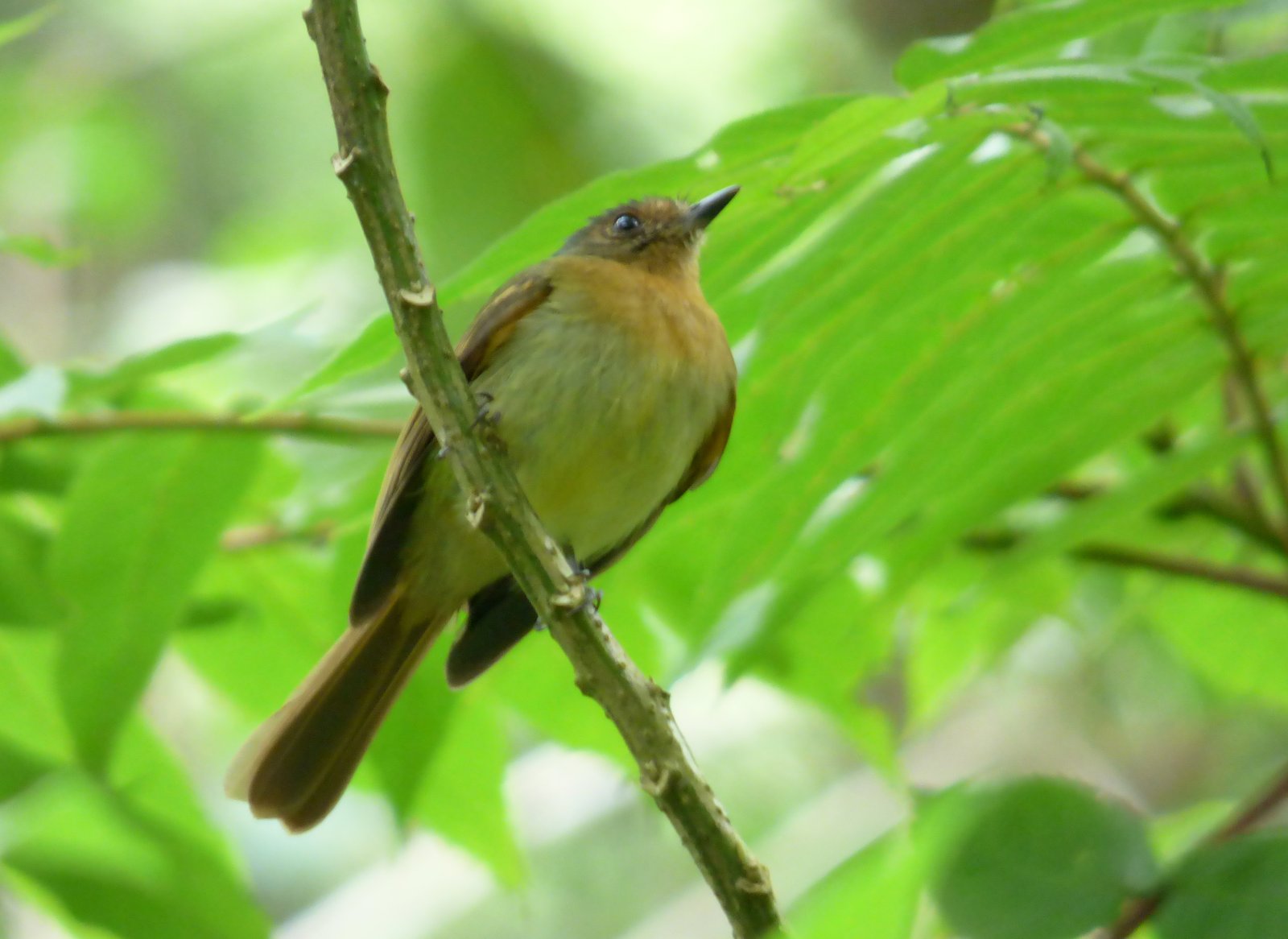
The Rufous-breasted Flycatcher is a Leptopogon of the higher montane forest of the northern Andes, identified by its rufous throat and breast. It perches upright in the middle storey of cloud forest, occasionally lifts a wing and often travels with mixed flocks.
Voice
A sharp, somewhat nasal call, given singly or repeated in short series, and a short, chattering trill.
Recording: Carlos Delgado JUMABITA — CC BY-NC-SA 4.0 · xeno-canto
Identification
13–14 cm, with a thin bill. The cap is grey, the face greyish and speckled with a dark crescent on the ear coverts. The back is olive-green, the wings dusky with two cinnamon wing bars. The throat and breast are rufous to cinnamon, the belly yellow. The sexes are alike.
Confusion species
Slaty-capped Flycatcher Leptopogon superciliaris has a greyish-olive breast without rufous and usually lives lower. Cinnamon Flycatcher Pyrrhomyias cinnamomeus is smaller, with cinnamon underparts and a rufous wing patch, and often perches in the open at forest edges. Flavescent Flycatcher Myiophobus flavicans is smaller, olive with yellow underparts, without an ear patch.
Habitat
The middle and lower levels of cloud forest and upper montane forest, also forest edges, roughly between 1500 and 2700 m. It perches upright on a branch and catches insects with short sallies to leaves, often with mixed flocks of tanagers and other insectivores. As in related species, the nest is a hanging ball of moss.
Where the bird is most at home, classified by the vegetation units of the Andes and the west coast.


Range and movements
Colombia: in the Andes, mainly in the Eastern and Central ranges. Ecuador: mainly on the east slope of the Andes. Peru: only in the far north, on the east slope in Cajamarca. Absent from Bolivia and the Galápagos. Outside the guide area in western Venezuela.
- Resident
- dark = core range, pale = thinly spread
How and when to look
Follow mixed flocks in cloud forest at 1800–2500 m on the east slope of the Andes in Ecuador and Colombia and watch for an upright bird with a rufous breast in the middle storey.
Conservation status
Least Concern. The species has a limited range in cloud forest, which has been heavily cleared in the northern Andes; in the remaining forests it is not rare.
Scientific name
Leptopogon rufipectus | (de Lafresnaye, 1846)
De Lafresnaye described the species in 1846 as Tyrannula rufipectus; because it was later moved to another genus, the author and year stand in brackets. The genus Leptopogon was introduced in 1844 by Cabanis. The genus name comes from Greek leptos, 'fine, slender', and pōgōn, 'beard', for the fine bristles at the base of the bill. The species name comes from Latin rufus, 'rufous', and pectus, 'breast'. The specimen the first description was based on came from Bogotá, Colombia.