All species › Passerines › Tyrant flycatchers and allies › Inca Flycatcher
Inca Flycatcher | Leptopogon taczanowskii
Incaleptopogon | Orejero inca | Cabeçudo-inca
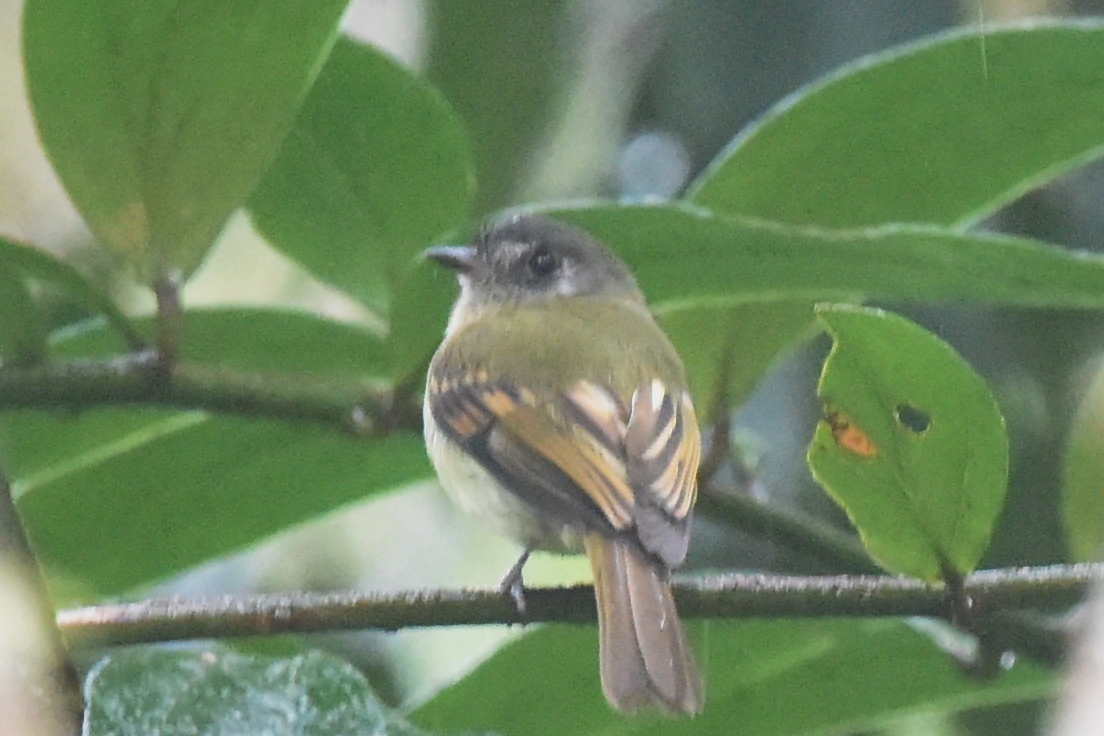
The Inca Flycatcher is a small, olive tyrant flycatcher of montane forest on the east slope of the Andes, found only in Peru. Like other Leptopogon it perches upright on an open branch in the middle storey and regularly lifts one wing briefly. South of the Marañón it takes the place of the Rufous-breasted Flycatcher.
Voice
Short, sharp call notes and a dry, rapid series of notes, often heard from mixed flocks.
Recording: Pritam Baruah — CC BY-NC-SA 4.0 · xeno-canto
Identification
13–14 cm, with a fairly long tail and a narrow, dark bill. The crown is dark grey, the back olive-green. The face is greyish and speckled, with a dark crescent on the ear-coverts. The wings are dark, with two distinct buffy wing-bars. The throat is greyish, the breast olive-grey with an ochre wash, the belly pale yellow. The sexes are alike.
Confusion species
Slaty-capped Flycatcher Leptopogon superciliaris has a purer slate-grey crown, a whiter, less speckled face and more yellowish wing-bars, and usually lives lower. Rufous-breasted Flycatcher Leptopogon rufipectus has a rufous face and breast and lives north of the Marañón. Marble-faced Bristle Tyrant Pogonotriccus ophthalmicus is smaller, with a shorter tail, yellow wing-bars and a more marbled face.
Habitat
Humid montane forest and cloud forest on the east slope of the Andes, mainly in the middle storey and at forest edges, roughly between 1200 and 2700 m. It perches upright and sallies to pick insects from leaves; it often joins mixed flocks. The nest is a ball of moss suspended from a bank or rock face.
Where the bird is most at home, classified by the vegetation units of the Andes and the west coast.


Range and movements
Peru: endemic, on the east slope of the Andes from Amazonas (south of the Marañón) and La Libertad through San Martín, Huánuco, Pasco and Junín to Cusco. Absent from Colombia, Ecuador, Bolivia and the Galápagos. Does not occur outside the guide area.
- Resident
- dark = core range, pale = thinly spread
How and when to look
Search cloud forest along roads on the east slope, for example in the Cordillera Escalera or the montane forests of Cusco, and follow mixed flocks; watch for an upright-perched flycatcher lifting one wing.
Conservation status
Least Concern. The species has a limited range, but is fairly common in the still largely forested east slope.
Scientific name
Leptopogon taczanowskii | Hellmayr, 1917
Hellmayr described the species in 1917 and placed it straight away in the genus where it still stands. The genus Leptopogon was introduced in 1844 by Cabanis. The genus name comes from Greek leptos, 'fine, slender', and pōgōn, 'beard', for the fine bristles at the base of the bill. The species name honours Władysław Taczanowski (1819–1890), Polish zoologist and author of Ornithologie du Pérou. The specimen the first description was based on came from Ray Urmaña, Huayabamba valley, Peru.