All species › Passerines › Shrike-babblers, Erpornis and vireos › Rufous-naped Greenlet
Rufous-naped Greenlet | Pachysylvia semibrunnea
Roodnekvireo | Verdillo nuquirrufo | Vite-vite-de-nuca-ruiva
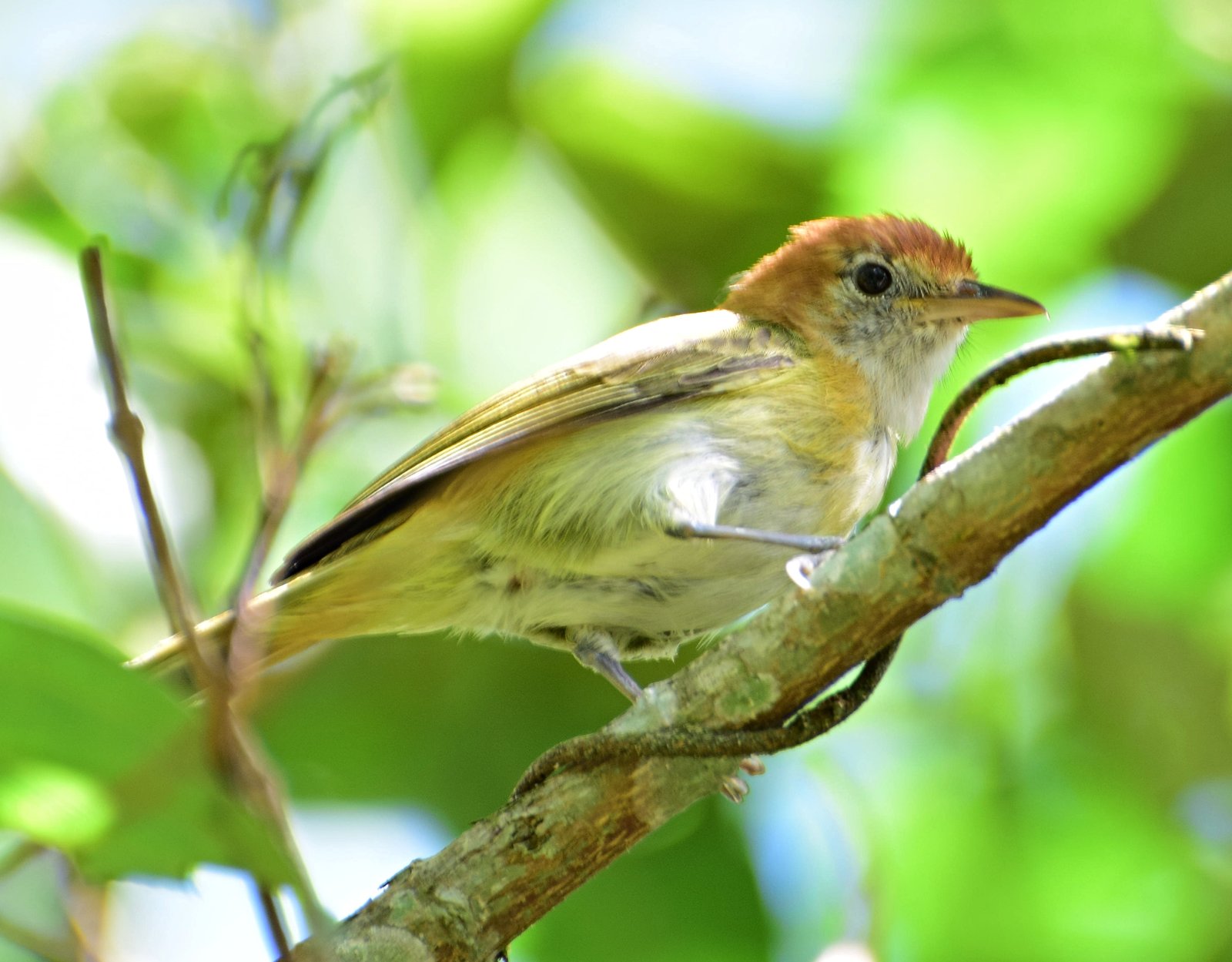
The Rufous-naped Greenlet is a small vireo of the lower montane forests of the northern Andes, with a conspicuously rufous crown and nape. It lives mainly in Colombia and eastern Ecuador. It forages in the middle and upper levels of the forest, often in mixed flocks.
Voice
A fast, rippling series of notes, often repeated. Calls with a nasal, scolding note.
Recording: Jerome Fischer — CC BY-NC-SA 4.0 · xeno-canto
Identification
12 cm, with a short, pale bill, dark eyes and a fairly short tail. The crown, nape and sides of the neck are rufous, the face greyish white. The back, wings and tail are olive-green. The throat and belly are whitish, the breast and flanks greyish with a buffy wash. The sexes are alike.
Confusion species
Ochre-crowned Greenlet Tunchiornis ochraceiceps has an ochre crown, pale eyes and an ochre-yellow breast and lives lower in the forest interior, usually below 1200 m. Dusky-capped Greenlet Pachysylvia hypoxantha has a brown cap and yellow underparts and lives in the Amazonian lowlands. Brown-capped Vireo Vireo leucophrys has a brown cap with a white supercilium and a yellowish belly, and a longer bill.
Habitat
Humid lower montane and foothill forest, forest edges, old secondary forest and shade coffee, roughly between 1000 and 2200 m. It searches the foliage and vines of the middle and upper levels for insects, often in mixed flocks with tanagers and warblers. Little is known about the nest.
Where the bird is most at home, classified by the vegetation units of the Andes and the west coast.


Range and movements
Colombia: in all three Andean ranges, mainly on the slopes of the Magdalena and Cauca Valleys, and on the eastern slope in Caquetá and Putumayo. Ecuador: on the eastern slope, mainly in Napo. Peru: no confirmed records. Absent from Bolivia and the Galápagos. Outside the guide area in western Venezuela.
- Resident
- dark = core range, pale = thinly spread
How and when to look
In Colombia, search forest edges and shade coffee in the Central Andes, for example in Caldas or Risaralda, for mixed flocks. In Ecuador on the eastern slope along the road to Tena.
Conservation status
Least Concern. Clearance of lower montane forest reduces its habitat, but the species tolerates old secondary forest and shade coffee.
Scientific name
Pachysylvia semibrunnea | (de Lafresnaye, 1845) (GBIF: Hylophilus semibrunneus)
De Lafresnaye described the species in 1845 as H[ylophilus] semi-brunneus; because it was later moved to another genus, the author and year stand in brackets. The genus Pachysylvia was introduced in 1850 by Bonaparte. The genus name comes from Greek pakhus, 'large, stout', and Sylvia, the warbler genus. The species name comes from Latin semi-, 'half', and Medieval Latin brunneus, 'brown': 'half brown', for the rufous crown and nape. The specimen the first description was based on came from Bogotá, Colombia.