All species › Passerines › Antbirds › Sclater's Antwren
Sclater's Antwren | Myrmotherula sclateri
Sclaters miersluiper | Hormiguerito de Sclater | Choquinha-de-garganta-amarela
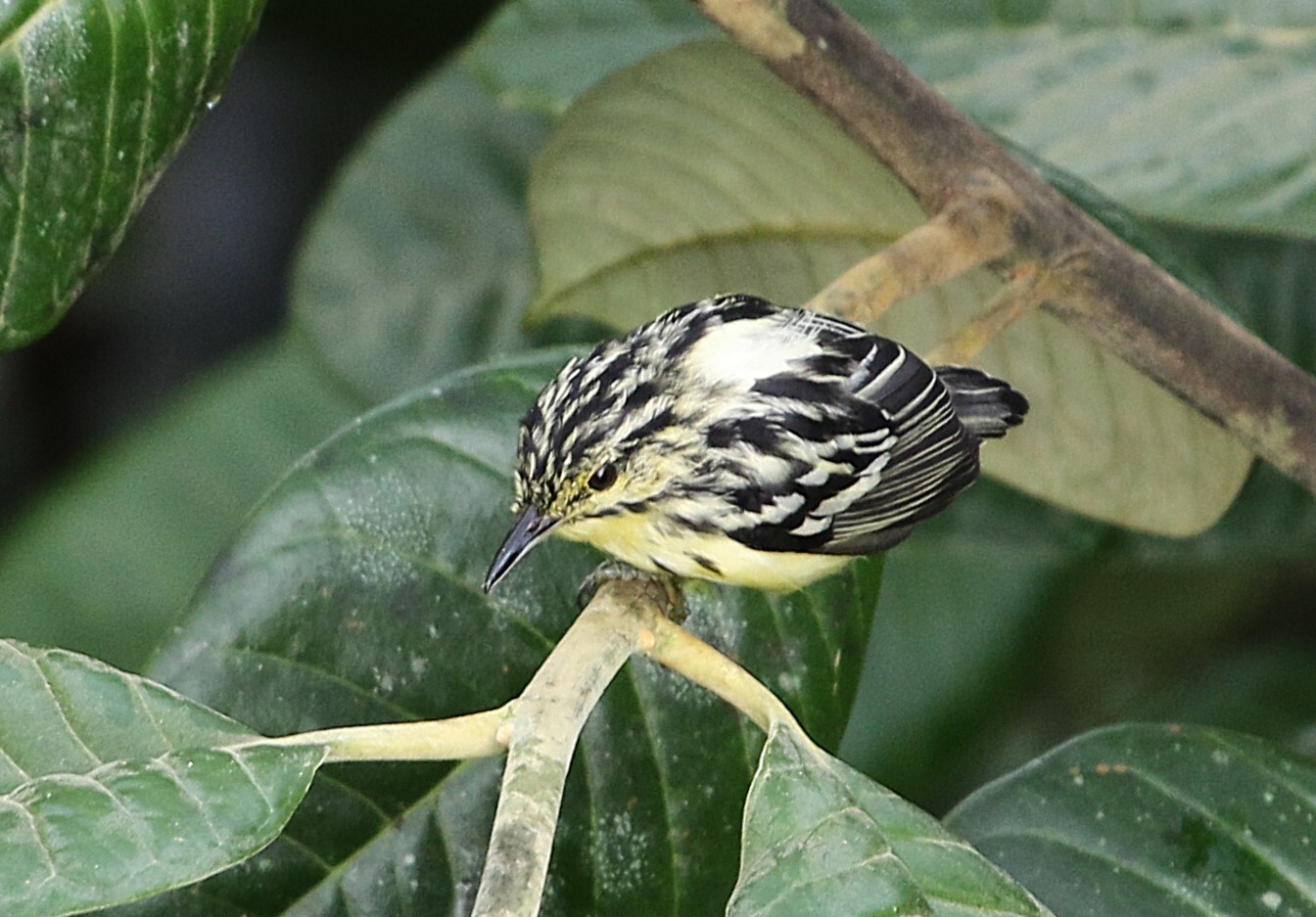
Sclater's Antwren is a small, black-and-yellow streaked antwren of the mid-levels and canopy of Amazonian lowland forest south of the Amazon. It usually stays high in the forest and prefers the interior to edges. In the guide area it lives in eastern Peru and northern Bolivia.
Voice
The song is a short, unhurried series of four to six widely spaced peuw notes. Calls are short, high notes.
Recording: JAYRSON ARAUJO DE OLIVEIRA — CC BY-NC-SA 4.0 · xeno-canto
Identification
8–9 cm, small, with a short tail. The male has a black-and-white streaked head with yellow cheeks and a broad black moustachial stripe, a black crown streaked pale yellow, and a black back streaked whitish with a pale yellow patch between the shoulders. The wings are black with white edges. The throat and breast are yellow, the belly paler, with a few black streaks on the sides of the breast. The female has ochre streaks on the head and upperparts, no patch between the shoulders and more streaking below.
Confusion species
Yellow-throated Antwren Myrmotherula ambigua is its closest relative and very similar, but lives north of the Amazon, in the Rio Negro basin. Pygmy Antwren Myrmotherula brachyura has a white throat, a yellower unstreaked belly and more often lives along forest edges. Amazonian Streaked Antwren Myrmotherula multostriata is white below and lives low in vegetation along water.
Habitat
Mid-levels and canopy of evergreen lowland forest, in terra firme as well as várzea and transitional forest, up to about 550 m. It searches in pairs for small arthropods among leaves and thin twigs, often with mixed canopy flocks. Little is known about the nest.
Where the bird is most at home, classified by the vegetation units of the Andes and the west coast.


Range and movements
Peru: in the Amazonian lowlands south of the Amazon and the Marañón, from southern Loreto to Madre de Dios and Puno. Bolivia: in the north, in Pando, Beni and the lowlands of La Paz. Absent from Colombia, Ecuador and the Galápagos. Outside the guide area in western and central Amazonian Brazil south of the Amazon, east to the Xingu and south to Mato Grosso.
- Resident
- dark = core range, pale = thinly spread
How and when to look
In the early morning listen for the unhurried series of whistles in the canopy of lowland forest, for example in Madre de Dios, and search canopy mixed flocks from a tower or canopy walkway.
Conservation status
Least Concern. The range is large; deforestation in southern Amazonia reduces the habitat locally.
Scientific name
Myrmotherula sclateri | Snethlage, HMMEE, 1912
Snethlage, HMMEE described the species in 1912 and placed it straight away in the genus where it still stands. The genus Myrmotherula was introduced in 1858 by Sclater. The genus name is a diminutive of Myrmothera (Greek murmos, 'ant', and thēras, 'hunter'): little ant-hunter. The species name honours Philip Lutley Sclater (1829–1913), British ornithologist and specialist in Neotropical birds. The specimen the first description was based on came from Boim, Tapajós, Pará, Brazil.