All species › Passerines › New World blackbirds, troupials and allies › Screaming Cowbird
Screaming Cowbird | Molothrus rufoaxillaris
Roodokselkoevogel | Tordo pico corto | Chupim-azeviche
The Screaming Cowbird is a brood parasite that uses almost exclusively Greyish Baywing Agelaioides badius as its host. Its young closely resemble those of the host and are raised by the host parents together with their own young. In the guide area it lives in southern and eastern Bolivia.
Voice
A high, shrill, screaming call, often in flight, which gives the species its English name; the male also sings a short, harsh phrase.
Recording: JAYRSON ARAUJO DE OLIVEIRA — CC BY-NC-SA 4.0 · xeno-canto
Identification
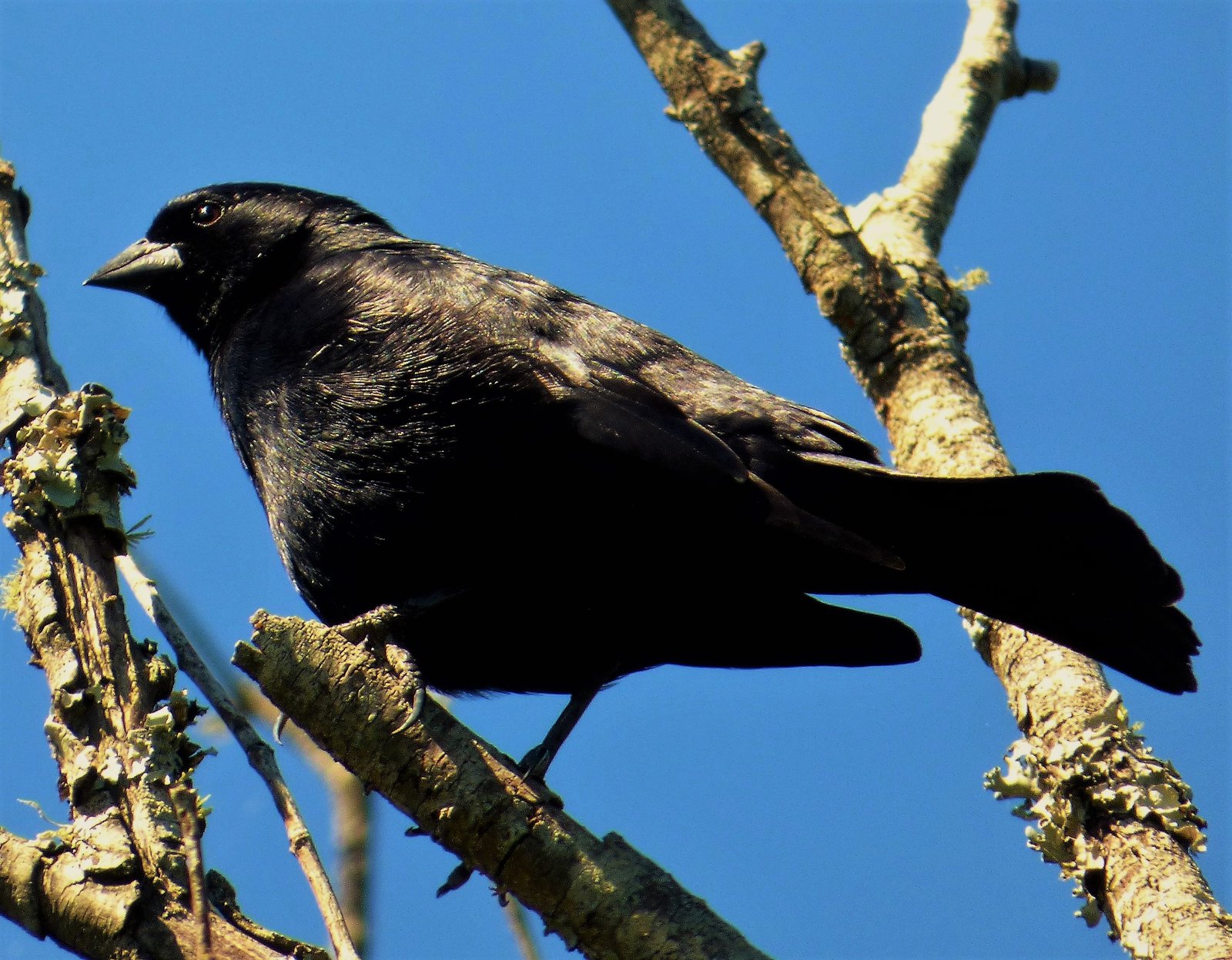
18–20 cm, with a fairly short, thick bill. Adults are black with a bluish to purplish gloss and a chestnut patch in the axillaries, visible only when the wings are spread. The sexes are alike; the female is slightly smaller and less glossy. Juveniles are greyish brown with rufous wings and closely resemble young Greyish Baywings.
Confusion species
Male Shiny Cowbird Molothrus bonariensis has a longer, more pointed bill, a stronger purple gloss and no chestnut axillaries; the female of that species is greyish brown. Chopi Blackbird Gnorimopsar chopi is larger, dull black, with grooves in the lower mandible. Greyish Baywing Agelaioides badius resembles the juveniles, but remains greyish brown with rufous wings as an adult.
Habitat
Open dry woodland, Chaco scrub, savanna with trees, pastures and farmland with scattered trees, mainly in the lowlands and dry valleys. It forages on the ground for seeds and insects, often in mixed flocks with Greyish Baywings and Shiny Cowbirds. It lays its eggs in the nests of Greyish Baywing, rarely in those of other icterids.
Where the bird is most at home, classified by the vegetation units of the Andes and the west coast.


Range and movements
In Bolivia in the south and east, mainly in the departments of Santa Cruz, Chuquisaca and Tarija. Absent from Colombia, Ecuador, Peru and the Galápagos. Outside the guide area in Paraguay, Argentina, Uruguay and southern Brazil.
- Resident
- dark = core range, pale = thinly spread
How and when to look
Search the Chaco and the dry valleys of southern Bolivia for flocks of Greyish Baywings; Screaming Cowbirds often forage with them. Note the shorter, thicker bill compared with Shiny Cowbird.
Conservation status
Least Concern. The population appears stable; the range follows that of the host species.
Scientific name
Molothrus rufoaxillaris | Cassin, 1866
Cassin described the species in 1866 and placed it straight away in the genus where it still stands. The genus Molothrus was introduced in 1832 by Swainson. The genus name comes from Greek mōlos, 'struggle', and thrōskō, 'to impregnate', referring to the brood parasitism of cowbirds. The species name comes from Latin rufus, 'rufous', and axilla, 'armpit', for the rufous axillaries. The specimen the first description was based on came from Buenos Aires, Argentina.