All species › Passerines › Shrike-babblers, Erpornis and vireos › Scrub Greenlet
Scrub Greenlet | Hylophilus flavipes
Struikvireo | Verdillo matorralero | Verdinho-do-matagal
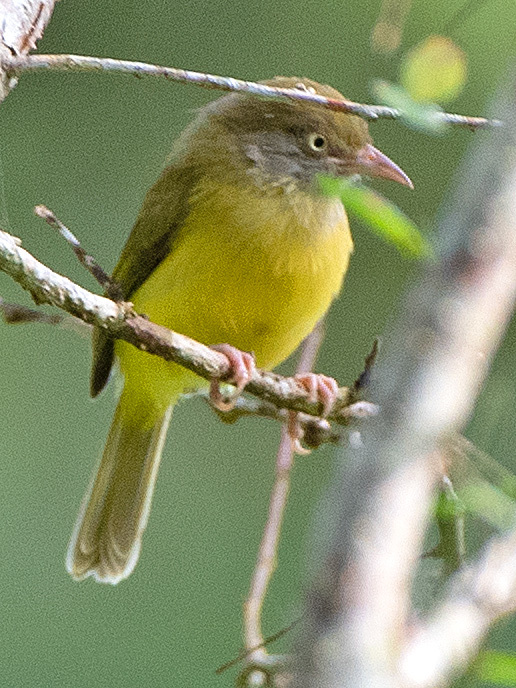
The Scrub Greenlet is a small, yellowish-green greenlet of dry scrub and open woodland in northern Colombia. It often gives a long series of loud, even notes. Within the guide area it is confined to the drier lowlands of the north.
Voice
A long, fast series of loud, even notes, like tree-tree-tree-tree-tree, repeated many times. Calls with nasal, descending notes.
Recording: Juliana Meneses Ruiz — CC BY-NC-SA 4.0 · xeno-canto
Identification
12 cm, with a pointed, pale, pinkish-horn bill and pale legs. The upperparts are olive-green, slightly browner on the crown; the underparts are pale yellowish, with an olive to buffy wash on the breast. In most birds the eye is pale yellow to whitish. The sexes are alike.
Confusion species
Lesser Greenlet Pachysylvia decurtata is stockier, with a grey head, a white eye-ring, a dark eye and a short tail, and lives in humid forest. Golden-fronted Greenlet Pachysylvia aurantiifrons has a dark eye, a buffy-yellow forehead and a yellower belly. Red-eyed Vireo Vireo olivaceus is larger, with a grey crown, a white supercilium and a red eye.
Habitat
Dry and semi-arid scrub, open dry woodland, forest edges, overgrown pastures and gardens with shrubs, in the lowlands and on the lower slopes up to about 1000 m. Pairs search shrubs and low trees for insects and spiders, often with mixed flocks. The nest is a hanging cup in a fork.
Where the bird is most at home, classified by the vegetation units of the Andes and the west coast.


Range and movements
Colombia: in the Caribbean lowlands, the dry north including La Guajira and the base of the Sierra Nevada de Santa Marta, and south in the Magdalena valley; locally also in the llanos at the foot of the Eastern Andes. Absent from Ecuador, Peru, Bolivia and the Galápagos. Outside the guide area in Panama and Venezuela.
- Resident
- dark = core range, pale = thinly spread
How and when to look
In dry scrub around Santa Marta and Barranquilla or in the Magdalena valley, listen for the long series of even notes; the bird often sings from a shrub at the edge of open ground.
Conservation status
Not Evaluated: the species has not yet been assessed separately in its current circumscription. Within its habitat it occurs in many places and tolerates disturbed vegetation.
Scientific name
Hylophilus flavipes | de Lafresnaye, 1845
De Lafresnaye described the species in 1845 and placed it straight away in the genus where it still stands. The genus Hylophilus was introduced in 1822 by Temminck. The genus name comes from Greek hulē, 'woodland, forest', and philos, 'loving': 'forest-lover'. The species name comes from Latin flavus, 'yellow', and pes, 'foot': 'yellow-footed'. The specimen the first description was based on came from Bogotá, Colombia.