All species › Swifts › Hummingbirds › Short-tailed Emerald
Short-tailed Emerald | Chlorostilbon poortmani
Kortstaartsmaragdkolibrie | Esmeralda rabicorta | Esmeralda-de-cauda-curta
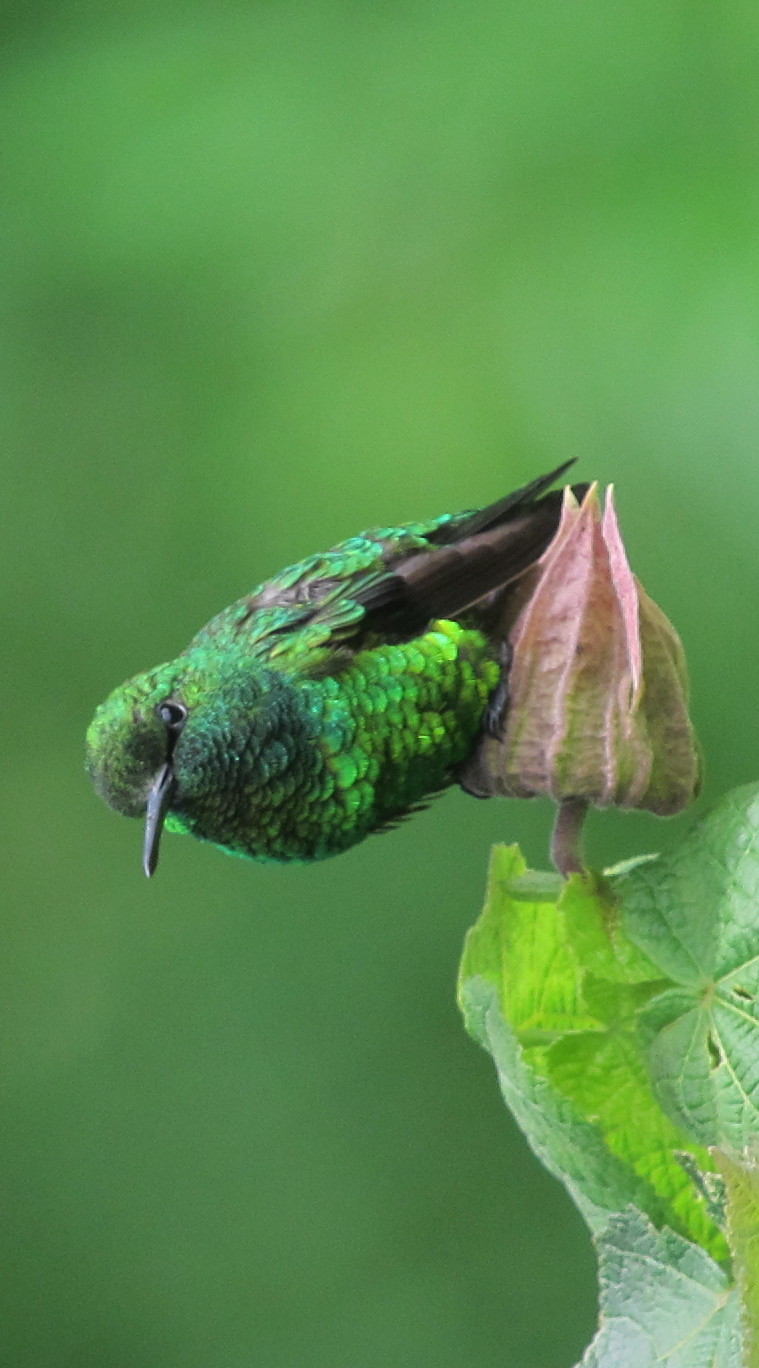
The Short-tailed Emerald is a small emerald of the Eastern Andes of Colombia and the Andes of Venezuela. As the name says it has a short tail, which in the male is bronze-green instead of blue-black. It lives at middle elevations in forest edges, plantations and gardens.
Voice
Repeated short tsip calls and longer, downslurred, plaintive tsew…tsew notes; the probable song, a long series of high tseep notes, is heard mainly in the wet season.
Recording: Bernabe Lopez-Lanus — CC BY-NC-SA 3.0 · xeno-canto
Identification
7–8 cm, with a short, straight, black bill and a short, slightly forked tail. The male is bronzy green above, with a glittering green forehead and glittering green underparts; the tail is shining bronze-green. The female is dull bronzy green above and grey below; the central tail feathers are green, the outer ones turquoise at the base, dark blue towards the tip and with pale grey tips. The form euchloris is slightly larger, with a golden tinge on the crown and underparts.
Confusion species
Western Emerald Chlorostilbon melanorhynchus has a longer, blue-black tail. Narrow-tailed Emerald Chlorostilbon stenurus has a longer, more clearly forked tail, in the male with very narrow outer tail feathers. Red-billed Emerald Chlorostilbon gibsoni has a red bill with a black tip and lives lower, in drier regions.
Habitat
The interior and edges of humid forest, open woodland and secondary forest, also coffee and banana plantations, gardens and pastures with trees, there often near streams; mostly between 750 and 2200 m. It forages low to middle heights at small flowers and catches small insects. The cup nest is placed low in a shrub; the female alone incubates two white eggs.
Where the bird is most at home, classified by the vegetation units of the Andes and the west coast.


Range and movements
In Colombia in the Eastern Andes: the nominate form on the eastern slope from Boyacá to Meta, the form euchloris on the western slope south to Huila and on the eastern slope in Santander. Absent from Ecuador, Peru, Bolivia and the Galápagos. Outside the guide area in the Andes of Venezuela.
- Resident
- dark = core range, pale = thinly spread
How and when to look
Look at flowering shrubs along forest edges, coffee plantations and gardens on the slopes of the Eastern Andes, for example in Santander and Cundinamarca.
Conservation status
Least Concern. The species also occurs in man-made habitats such as shade coffee and gardens.
Scientific name
Chlorostilbon poortmani | (Bourcier, 1843)
Bourcier described the species in 1843 as Ornismya poortmani; because it was later moved to another genus, the author and year stand in brackets. The genus Chlorostilbon was introduced in 1853 by Gould. The genus name combines Greek khlōros, 'green', with stilbōn, 'glittering'. The species name honours the French ornithologist and taxidermist Théodore Poortman (1804–1863), to whom Bourcier dedicated the species in 1843. The specimen the first description was based on came from Colombia.