All species › Passerines › Tyrant flycatchers and allies › Slender-billed Inezia
Slender-billed Inezia | Inezia tenuirostris
Dunsnavelinezia | Piojito picofino | Alegrinho-de-bico-fino
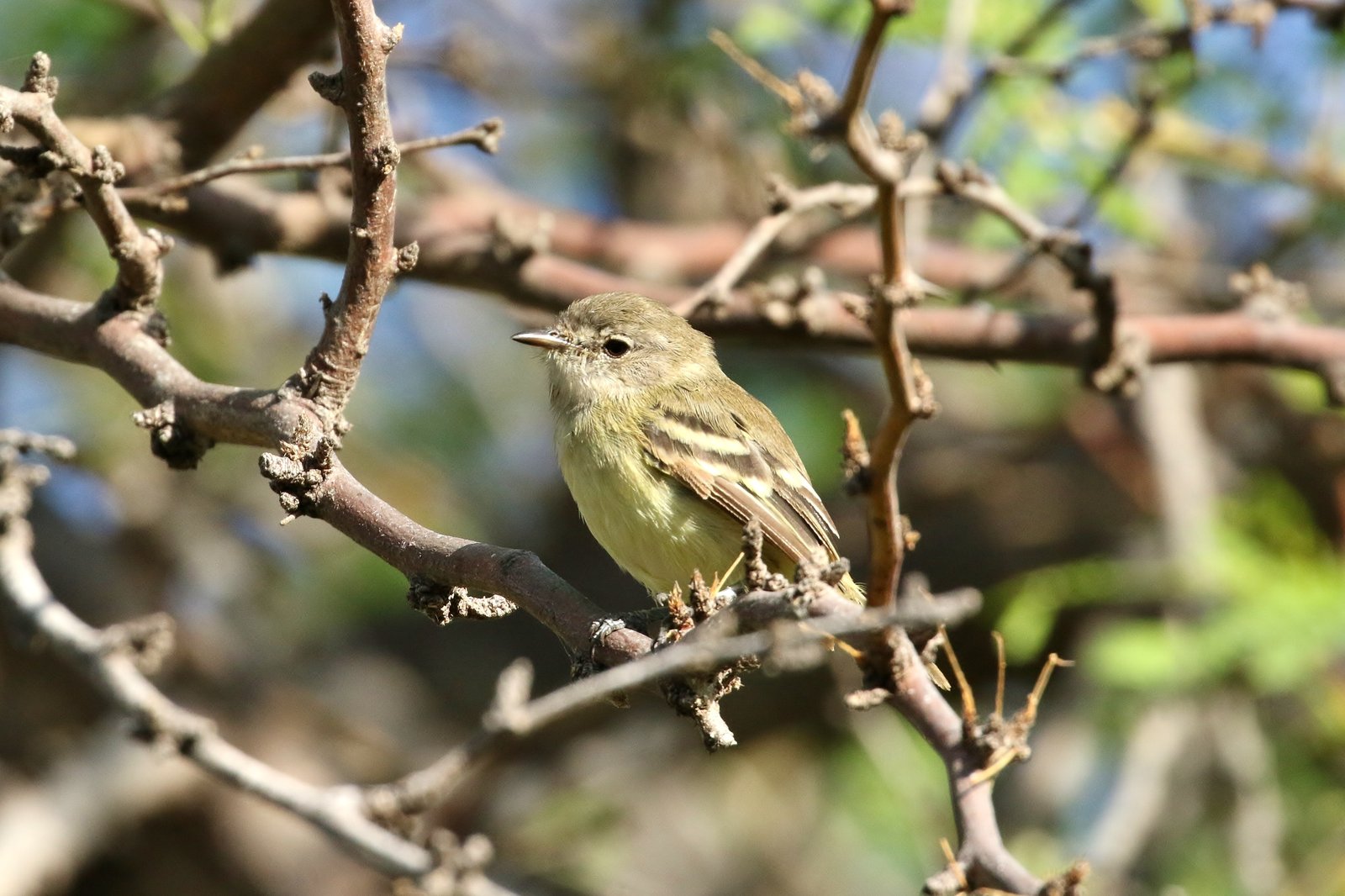
The Slender-billed Inezia is a very small, greyish-brown tyrant of dry thorn scrub on the Caribbean coast of Colombia and Venezuela. Within the guide area it lives only in the dry north of Colombia. The white spectacles and the thin bill separate it from other small tyrants in the same scrub.
Voice
A fast series of high, thin notes, often accelerating into a short trill, and short, sharp calls.
Recording: Ross Gallardy — CC BY-NC-SA 4.0 · xeno-canto
Identification
8.5 cm, with a thin black bill and a short tail. The upperparts are greyish brown to olive-grey. A white supraloral stripe and a white eye-ring form spectacles. The wings are dusky, with two whitish wing bars and pale edges to the flight feathers. The throat and breast are whitish, the belly tinged pale yellow. The sexes are alike.
Confusion species
Pale-tipped Inezia Inezia caudata is larger, yellower below, with a pale tip to the tail, and lives mainly in more humid woodland and scrub. Southern Beardless Tyrannulet Camptostoma obsoletum has a ragged crest and a shorter, thicker bill and often cocks its tail. Northern Scrub Flycatcher Sublegatus arenarum is larger, with a short, stubby bill and a grey breast.
Habitat
Dry thorn scrub, cactus scrub and low dry woodland in the lowlands, especially near the coast. It searches for small insects among leaves and twigs in shrubs and low trees, alone or in pairs. The nest is a small cup in a shrub.
Where the bird is most at home, classified by the vegetation units of the Andes and the west coast.


Range and movements
Colombia: only in the dry Caribbean north, mainly on the Guajira Peninsula and in the adjacent lowlands. Absent from Ecuador, Peru, Bolivia and the Galápagos. Outside the guide area in north-western Venezuela.
- Resident
- dark = core range, pale = thinly spread
How and when to look
Search thorn scrub on the Guajira, for example around Riohacha and Camarones, and look for a small grey bird with white spectacles moving through the shrubs.
Conservation status
Least Concern. The range is small, but the dry scrub of the Guajira is largely intact.
Scientific name
Inezia tenuirostris | (Cory, 1913)
Cory described the species in 1913 as Camptostoma pusillum tenuirostris; because it was later moved to another genus, the author and year stand in brackets. The genus Inezia was introduced in 1909 by Cherrie. The genus name honours Enriqueta Inez Cherrie (1898–1943), daughter of the American ornithologist George K. Cherrie, who described the genus in 1909; she was born in the region where he found these birds. The species name comes from Latin tenuis, 'slender', and rostrum, 'bill'. The specimen the first description was based on came from Río Aurare, Venezuela.